
NEWS
Trend predictions for 2021; Is breadfruit the new superfood?
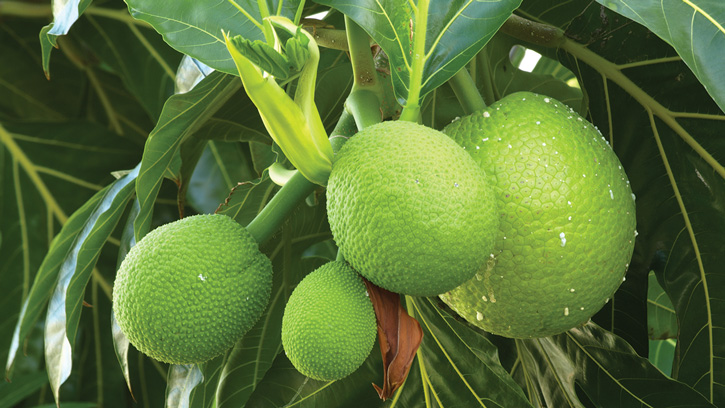
Flour produced from breadfruit could be used to develop nutritious, low-glycemic index foods that improve worldwide food security while promoting sustainability. © BergmannD /iStock/Getty Images Plus
Breadfruit, the new superfood?
A fruit that has long been a diet staple in tropical and South Pacific countries has all the earmarks of being the next superfood, according to a team of British Columbia researchers. Breadfruit, which can be eaten on its own or dried and ground into a gluten-free flour, has the potential to improve worldwide food security and mitigate diabetes, according to the researchers.
During a series of studies, the scientists used flour ground from dehydrated breadfruits to gather data on the impacts of a breadfruit-based diet on mice and on an enzyme digestion model. After three weeks on the breadfruit diet, mice showed a significantly higher growth rate and body weight than those on a standard wheat-based diet, with similar body composition. In the enzyme digestion model, breadfruit protein was found to be easier to digest than wheat protein.
As a nutritious staple food, breadfruit could make inroads in food sustainability for many populations, according to lead researcher Ying Liu. As an example, she cites the average daily consumption of grain in the United States at 189 grams. The same amount of cooked breadfruit could meet up to nearly 57% of daily fiber requirements and more than 34% of protein requirements while also providing vitamin C, potassium, iron, calcium, and phosphorus.
“Overall, these studies support the use of breadfruit as part of a healthy, nutritionally balanced diet,” said Liu in a press release. “Flour produced from breadfruit is a gluten-free, low glycemic index, nutrient-dense, and complete protein option for modern foods.”
Front-of-package labels promote nutrition
After analyzing 16 years of data on more than 21,000 products in 44 food categories, researchers at the University of South Carolina concluded that the inclusion of nutrition data on front-of-package labels is associated with improved nutritional content.
“We wanted to know whether food companies were responding to increased public interest in healthier food,” said study co-author Rishika Rishika in a press release. “In other words, is the market driving change in the nutrition of food products? And the evidence suggests that this is exactly what’s happening.”
In examining products with “Facts Up Front” (FOP) nutrition labels, the researchers looked specifically at two things. For food categories with at least one product labeled in the FOP style, the researchers evaluated differences in the nutritional quality of all products in the category, both before and after adoption of the FOP labels. Differences were also compared with food categories in which no products adopted FOP labeling.
The results showed a clear association between FOP labeling and changes in the nutritional content of food products. Across all categories in which some products adopted the FOP labels, there was a 12.5% reduction in calories, 13% reduction in saturated fat, 12.6% reduction in sugar, and 3.7% reduction in sodium.
Five factors resulted in a greater impact on nutrition: Premium brands improved nutritional quality more than non-premium brands in the same category; brands with fewer products than their peers improved nutritional quality more; broadly unhealthy categories, such as snack foods, showed a more pronounced response; foods in categories with many competitors at different price points showed a more pronounced response; and products that had adopted FOP labeling showed more improved nutritional quality.
The findings suggest that voluntary, highly visible nutritional labeling can be an effective tool for encouraging change on an industry level. “However,” noted Rishika, “it remains unclear which aspect of the program is more important. Is the fact that the program is voluntary more important, since it helps consumers identify brands that are choosing to share nutritional information on the front of package? Or is the fact that the FOP labeling is prominent more important, simply because the information is more clearly noticeable? Those are questions for future research.”
Climate change may help improve rice yields
Global climate change may extend the growing season for rice in Japan, increasing yields by allowing farmers to harvest more rice from the same fields, according to the results of a study conducted by a research team from the National Agriculture and Food Research Organization.

Climate change has extended the growing season for rice in Japan, resulting in a potential increase in yields when the practice of ratooning is employed. © jxfzsy/E+/Getty Images Plus
The study investigated rice ratooning, a practice that involves cutting rice above ground and allowing it to regrow. Although the practice typically takes place in tropical climates, the researchers decided to evaluate its potential in Japan, where average temperatures continue to rise. Because of climate changes, rice farmers may have a longer window for growing rice since seedlings can be transplanted earlier in the spring and rice can be harvested later into the year.
The scientists compared two harvest times and two cutting heights of the first crop. Following the initial harvest, the yield was measured by collecting seeds from the portions of the rice that were cut off, then counting and weighing them. The second harvest of rice was completed by hand, and yield was determined in the same way.
Both total grain yields and those from the first and second crops differed with harvest times and cutting heights. Rice plants harvested at the normal time for the first crop yielded more seed than plants harvested earlier, due to the additional time available for the plants to fill their spikelets with seed.
“Our results suggest that combining the normal harvest time with the high cutting height is important for increasing yield in rice ratooning in southwestern Japan and similar climate regions,” said lead researcher Hiroshi Nakano in a press release. “This technology will likely increase rice grain yield in new environments that arise through global climate change.”
3D printing of milk-based products
Researchers from the Singapore University of Technology and Design have developed a method to perform direct ink writing 3D printing of milk-based products at room temperature while maintaining temperature-sensitive nutrients. Results of the investigation were published in RSC Advances.
Traditional high-temperature 3D print methods, such as laser sintering and hot-melt extrusion, are unsuitable for milk, which contains temperature-sensitive nutrients like calcium and protein. Although cold-extrusion is a viable alternative, it often requires rheology modifiers or additives to stabilize printed structures.
The research team addressed these challenges by changing the rheological properties of the printing ink. They then used direct ink writing to 3D print milk by cold extrusion with a single milk product, powdered milk. The concentration of milk powder allowed for the simple formulation of 3D-printable milk inks using water to control the rheology. Extensive characterizations of the formulated milk ink were also conducted to analyze rheological properties and ensure optimal printability.
“This novel yet simple method can be used in formulating various nutritious foods, including those served to patients in hospitals for their special dietary needs,” said lead author Lee Cheng Pau.
Food trend predictions for 2021
Sugar reduction, chickpeas, and carob are among up-and-coming food trends, according to food innovation intelligence platform Spoonshot, which partnered with international food trendologist Liz Moskow to predict the food developments shaping product innovation, menus, and consumer behavior in 2021.
After analyzing billions of data points across 22 different types of data, Spoonshot identified the following movements as key opportunities for food industry innovation:
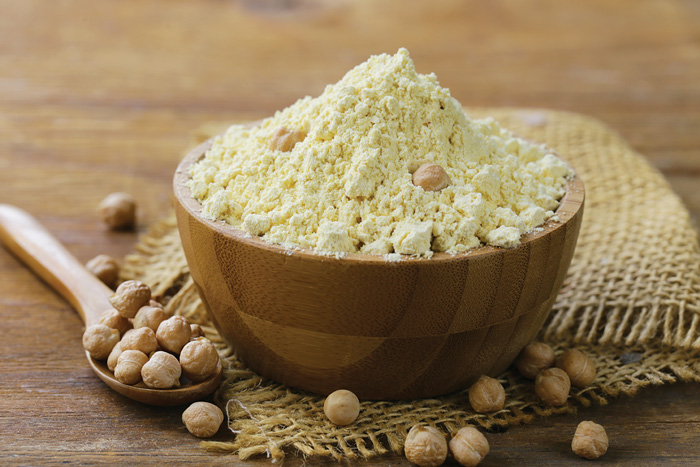
Flatbreads and crusts made from chickpea flour are expected to migrate from Italy and France into American frozen food sections, according to food trendologist Liz Moskow. © olgakr/iStock/Getty Images Plus
Sugar Rush. The mounting pressure from consumers to reduce sugar content in food products, as well as changes in FDA labeling requirements and food technology advancements, is paving a path for sugar replacer allulose as well as other efforts to maximize the efficiency of sugar.
Garbanzo: Good to Great. Look for chickpea flour and aquafaba (chickpea soaking water) to be springboards for future chickpea-based trends, including their use in flatbreads, crusts, dairy-free ice cream, macarons, and meringues.
CBD Adjacent. Copaiba, an essential oil derived from the resin of the Copaifera tree, contains terpenes that interact with the body’s endocannabinoid system to purportedly provide therapeutic benefits similar to CBD. When added to edibles, copaiba has a woodsy, sweet flavor and aroma said to promote relaxation.
Climatarians Are Coming! The growing popularity of low-environmental-impact diets will increase the emphasis on eliminating foods with a high carbon footprint, such as meat and cheese, and the addition of algae, seaweed, pulses, grains, and legumes, as well as invasive species of plants, fish, and insects.
“No Bones” About It, Carob Will Make a Comeback. Vegan diets can result in deficiencies in HYP (hydroxyproline), an amino acid crucial to collagen production. Enter carob, which is not only high in HYP but also provides fiber, calcium, iron, antioxidants, and protein. In addition, carob is gluten-free, caffeine-free, naturally sweet, and low carb.
Fats Forward. Expect a return to the liberal use of extra-virgin olive oil and a move away from coconut oil. Research points to two beneficial compounds olive oil offers: elenolide, a chemical component with proven anti-hypertensive properties, and tyrosol, a compound that protects against neurodegenerative diseases.
Everything in Moderation. With consumers vacillating between decadence and detoxification, 2021 will usher in a year of foodie bipartisanship in which blended foods, featuring both meat- and plant-based products, will win the day.
Ghosting Restaurants to Ghost Kitchens. Restaurants may adopt the ghost kitchen model, double up as grocery delivery stores, turn their offerings into meal kits and heat-and-eat meals, offer to-go cocktails, and even repurpose their parking lots into dining spaces to maintain social distancing guidelines.
The eight predictions are based on a variety of factors, including recent changes in society, technology, the environment, the economy, and the political landscape, according to Moskow. “Typically, these factors shift steadily, over the course of several years, manifesting changes in how people purchase and consume food and beverage products,” she said in a statement. “When COVID-19 hit, it caused and continues to drive dramatic changes in the way people view, engage with, and purchase food and beverage. The entire trajectory of consumer behavior changed almost overnight.”
News Bites
• ALDI received the 2020 Green Power Leadership Award and a 2019 GreenChill Store Certification, as well as a Re-Certification Excellence Award for select stores, from the Environmental Protection Agency.
• Cargill has made a commitment to supporting farmer-led efforts to regenerative agriculture practices across 10 million acres of North American farmland over the next 10 years. The initiative will focus primarily on row crop rotations of corn, wheat, canola, soybeans, and other staple crops.
• Enzyme Development Corp. released a new food-grade biocatalyst, a botanical protease, ENZECO FICIN 100.
• Equinom announced that it is the first seed-breeding company to open an R&D center housing all vital departments—biochemistry, applications, sensory, and breeding—in one location. The center is located in Givat Brenner, Israel.
• Eurazeo has completed a $25 million minority investment in Dewey’s Bakery, a clean-label cookie and cracker manufacturer based in Winston-Salem, N.C.
• Fiberstar announced the launch of a new eCommerce website (fiberstar.mybigcommerce.com), which will make Citri-Fi citrus fiber more widely available in the United States.
• Firmenich has developed what it terms the first AI-created flavor, a lightly grilled beef taste for use in plant-based meat alternatives.
• FONA was named the No. 1 workplace in the nation for manufacturing and production by Fortune magazine and Great Place to Work.
• IncuBev, a collaboration among four companies with beverage commercialization expertise—Haney, PTI, Symrise, and Califormulations—has been launched to help brand owners bring their beverages to market faster by offering a unique turnkey project management solution.
• Kraft Heinz has agreed to sell its natural cheese business to Lactalis for $3.2 billion. The brands included in the sale are Breakstone’s, Knudsen, Polly-O, Athenos, Hoffman’s, and Cracker Barrel in the United States, and Cheez Whiz outside the United States and Canada only.
• Molson Coors will begin distributing La Colombe Coffee Roasters’ ready-to-drink coffee products in drug and convenience channels in 2021.
• Neogen has launched Reveal 3-D for Gluten, a test that rapidly detects gluten in food products, raw ingredients, and environmental samples. The test screens samples at 5 ppm gluten in just five minutes.
• Nestlé inaugurated a new accelerator at its R&D center in Konolfingen, Switzerland, to drive innovation and speed-to-market of sustainable dairy products, as well as plant-based dairy alternatives.
• PepsiCo announced a target to source 100% renewable electricity across all of its company-owned and controlled operations globally by 2030 and across its entire franchise and third-party operations by 2040.
• Quality Custom Distribution, part of the Golden State Foods family of companies, opened four Midwest distribution centers—two in Illinois, one in Indiana, and one in Minnesota.
Authors
-
Margaret Malochleb
Categories
-
Food Business Trends
-
Food Health Nutrition
-
Food Policy
-
Mergers and Acquisitions
-
Global Markets and Trade
-
Novel Technologies
-
Labeling
-
Food Technology Magazine


