
IFT FIRST Expo: A World of Solutions

Food Technology’s editors toured a bustling 2024 IFT FIRST Food Expo floor in July, seeking out the top food ingredient trends and innovations on display. Exhibitors were asked to highlight the customer solutions-oriented products showcased at this year’s event. Five trends emerged, giving valuable insight into a world of solutions for product developers and manufacturers.
1. Catch the Rainbow
With the recent legislative activity around color additives, several exhibitors at IFT FIRST touted their regulatory-friendly hues and natural ingredients. The California Food Safety Act, which will go into effect in 2027, will ban four additives in food, including Red Dye No. 3. Stephen J. Lauro, chief executive officer at colormaker, said his labs are already preparing for the regulation change.
“Many companies are now coming to us and starting the research on how we take Red Dye No. 3 and Red No. 40 out of existing formulas and then put in, hopefully, an equally stable, somewhat comparable natural color,” he explained. “We have a full-service color lab with all kinds of fancy instruments, so we can quantify color for our customers and get them to appreciate and hopefully understand the subtle variances.”
Adding to the red color craze, Givaudan showcased its new Amaize orange-red color in anticipation of California’s new law. This ingredient is made using non-GMO corn with an orange-red shade like red radishes and can substitute for Red No. 40 in beverage, confection, and snack applications. Additionally, Givaudan believes that the ingredient delivers on consumer demand for natural ingredients.
“Aside from the shade, it has a completely transparent supply chain,” said Megan Jacobs, global marketing director of colors at Givaudan. “We developed this hybrid with our agronomy partners using traditional breeding practices. It’s grown in North America and is gently extracted using water at our natural color facility in Port Washington, Wis. Finding natural alternatives to synthetic colors is becoming increasingly important with the changing regulatory landscape from states that are looking to pass legislation on color additives.”
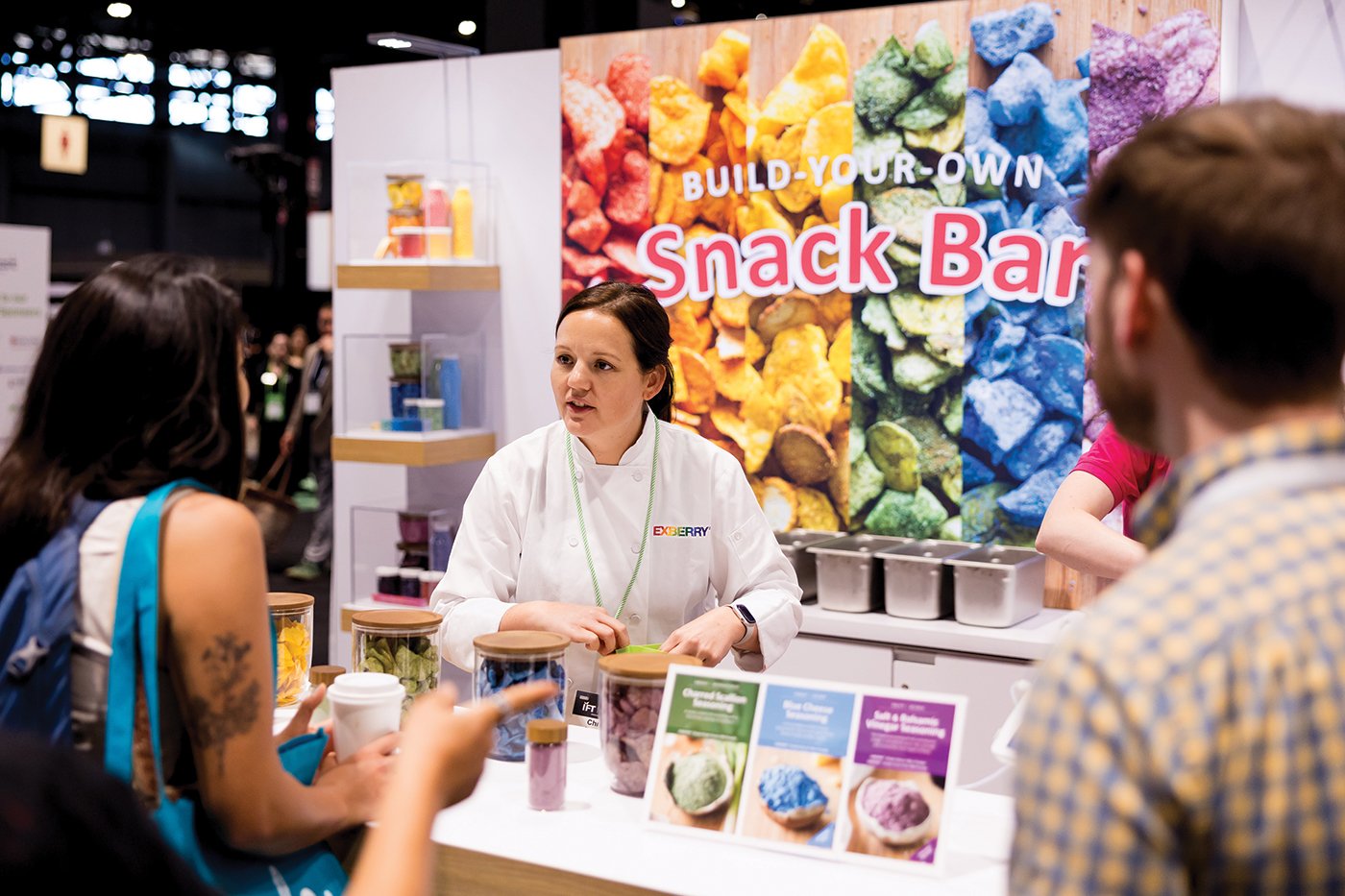
Attendees at the expo saw several applications of color, including GNT’s build-your-own rainbow snack bar. Each of the options in the snack bar was made with Exberry non-GMO plant-based colors. In a press release sent before the show, the company stated that this experience will demonstrate how color can convey flavor in a product and enhance the overall appeal of the product.
On the other end of the spectrum, some exhibitors also showcased processes that can maintain a natural color, so an additive isn’t needed. MicroDried, a dried fruits and vegetables supplier, uses a unique process that yields ready-to-eat ingredients that don’t need additional heat and that retain their bright color.
“There’s a five-log reduction in our process, so it’s a safe product to add if you’re not adding any additional heat in your processing,” said regional sales manager Greg Anchondo. “You get a brighter color retention and a stronger cell structure than with some other forms.”
2. For the Health of It
It’s no surprise that the demand for food and beverages with health-promoting functionalities continues to increase among consumers of all ages. Whether it’s brain, cardiovascular, digestive, or circulatory system health, ingredient manufacturers are heeding their customers’ calls for food-is-medicine style ingredients that can be easily incorporated into a variety of finished food products.
KSM 66 Ashwagandha, an ashwagandha root extract known primarily for its anti-stress and relaxation properties, is a good example of the movement of health-boosting ingredients from the supplement category to foods, explained Brian Kehoe, vice president of business development, North America, KSM-66 Ashwagandha. The KSM-66 Ashwagandha extract, which is backed by multiple clinical studies and is self-affirmed GRAS, is neutral in taste and can be used in a broad range of products, including gummies, honey, coffee, beverages, burgers, condiments and spreads, and even as a popcorn seasoning.
“I think we’re probably more well known in sports nutrition and sports supplementation, since ashwagandha helps with the physical recovery process,” Kehoe noted. “However, the traditional use of ashwagandha is more so in foods for stress and moods or relaxation and calming, which is a very strong emerging market right now and very much in consumer demand across the world.”
That movement from capsulized health aids to food-based health boosts is a leading ingredient trend this year, agreed Christopher Nolte, vice president of sales with Kyowa Hakko, which showcased Immuse, a novel postbiotic that is a patented strain of Lactococcus lactis shown in clinical research to provide immune support.
“The consumer is looking for things like more focus and attention, better brain health, and immunity,” Nolte said. “Our innovations are around ingredients for health. They’re all GRAS ingredients [and] we’re promoting the use of these functional ingredients in foods. Right now, you just find them in the supplement space, [but] we’re starting to find them in the food space.”
Folding in multiple health-promoting ingredients to boost the better-for-you properties of a particular food or beverage is another solution many food industry customers are seeking, added Vicki Gawlinski, director, content and communications, FutureCeuticals and Van Drunen Farms.
“We’ve got a beverage that features our Coffeeberry range for three ingredients: CognatiQ for natural brain performance, Coffeeberry Energy for natural caffeine, and then Coffeeberry Coffee Fruit Juice Concentrate,” she said. “So, there’s three different combinations of coffee fruit ingredients, and it tastes like root beer. We like stacking ingredients that offer different benefits but also work well together on products.”

3. Label Appeal
Ingredients that contribute to clean label or climate friendly, health and well-being, and other marketing claims continue to be in urgent demand by food manufacturers. Whether it’s a free-from, value-added attribute, or sustainability claim, food makers want innovative options that create an appealing label for consumers.
David Banks, head of marketing, Americas, Roquette, said that by focusing on clean label solutions, health and wellness ingredients, and taste modification, the company hopes to answer customers’ calls for ingredient solutions across several challenges.
“Another solution we are featuring this year is a pectin-based, vegan-vegetarian gummy in a pineapple flavor that uses no gelatin,” Banks added. “So, if you think about a lot of folks who have issue with the animal proteins in some of the gelatins, this product is definitely solving the problem for the vegetarian-vegan market, while providing a nice texture and really good bite … attributes that you would expect from a gelatin-based gummy.”
With consumers scouring the Nutrition Facts label like never before, label appeal means ensuring there is a value-add to products where possible, said Georgia Ackley, application scientist, Grain Processing Corp.
“For example, our steamed chickpea flour is a really good neutral flavor and our modified resistant corn starch provides fiber without impacting texture. These solve the problem that many people might face with gluten-free products, where they are compromising on flavor and texture, while at the same time, getting a higher intake of nutritional quality in the form of fiber. So, it’s a good way to add some extra nutrition to popular products that people are already eating.”
Daniel Kennedy, sales director, protein fortification, Ingredion, said that the company’s newest product is designed to solve issues for protein bar makers, who want affordable, label-friendly products that taste great but also want solutions that deliver performance over the shelf life of the bar.
“One of the biggest failures of many cold-pressed nutrition or protein bars is they get hard over the shelf life of the bar, so we’ve introduced Vitessence Pea 100 HD made from non-allergen plant-based protein isolates to solve this problem,” explained Kennedy. “This product will achieve softness in the bar over time, which means longer shelf life, wider distribution, less shrink, and ultimately, more consumer acceptance. And it’s label-friendly because you do not have to hydrolyze the protein, which can make bars chalky or gritty in texture.”
Sustainability also makes food labels more appealing to industry customers and their consumers, according to Netherlands-based revyve, which showcased how it uses brewers’ yeast upcycled from beer makers to produce clean label, animal-free ingredients that can replace eggs in product formulations. In a proprietary process, the company breaks yeast cells open and uses mild, low-temperature processing to obtain protein and fiber ingredients that deliver foaming, gelation, and emulsification benefits. This allows makers of meat alternatives, bakery products, sauces, and more to replace eggs in their formulations, noted Jordania Valentim, the company’s chief commercial officer.
“There is a huge need in the market for more sustainable ingredients and animal-free ingredients,” Valentim said. “We have taken something that is normally wasted in the beer-making process, [something that] is normally thrown away or used as feed … and we wash it to make it clean from the taste of the beer and then we treat it mechanically, not enzymatically or with chemicals.”

4. Solving for Zero
The no-sugar and low-sodium aspects of better-for-you trends remain strong, according to many IFT FIRST exhibitors. Sugar and artificial sweeteners are ingredients consumers are keen to avoid, while at the same time, interest in functional and health-focused beverages is exploding, explained Jennifer Berndt, associate marketing manager, beverage, Cargill. However, the same health-supportive ingredients that draw consumers to these products also come with flavor challenges, she noted.
“EverSweet plus ClearFlo is a game-changer when it comes to sugar reduction,” said Berndt, noting that Cargill showcased the stevia sweetener and natural flavor in a hydration beverage and protein smoothie at the expo. “It addresses many of the flavor challenges product developers face—especially in beverage formulation—from the bitterness and astringency associated with caffeine, to the earthy and vegetative notes often linked to plant proteins. In addition, the sweetener system enhances characterizing flavor profiles ... especially in no-sugar-added formulations.”
With sugar high on the list of consumers’ ingredients of concern, Gali Yarom, cofounder and CEO of Israel-based Better Juice, noted that the company’s patented sugar-reduction technology will appeal to manufacturers of ice cream and sorbet, as well as juice processors. Better Juice’s technology works by reducing the sugar content of fruit concentrates and purees, using enzymes from non-genetically modified organisms and microorganisms that naturally transform sucrose, glucose, and fructose in fruit juice into prebiotic oligosaccharides and other nondigestible fibers.
“We’re taking the natural juice and concentrate and reducing the sugar by enzymatic treatment,” Yarom said. “We can keep all of the natural value, all the minerals, vitamins, and organic acid,” she continued. “It is completely clean label because it [the enzymatic treatment] acts as a processing aid.”
Josue Vasquez, business development specialist, Edlong, noted that in addition to industry demand for the company’s Sweet Spot technology, a proprietary collection of flavors that amplify or impart sweetness without adding sugar, sodium reduction solutions are also highly requested by many of its customers.
“We are always looking to help the food and beverage industry find the solutions that will help them overcome the challenges they face today,” Vasquez said. “Sodium reduction is definitely a challenge because there aren’t any direct replacements for it in foods. At Edlong, one way we help customers is by using cheese flavors to boost that salty flavor without having to increase the actual sodium content in the product.”

5. Flavor Mask-erade
While some ingredients such as sugar substitutes and functional proteins can add value to a food, their taste may cause some consumers to turn away. Product developers are looking for flavor “masks” to cover up some of the unwanted aftertastes.
“We work with a lot of functional ingredients, and a lot of those functional ingredients don’t taste so great,” said Jasmin Masri, technical sales and marketing coordinator at Custom Flavors. “We are huge on masking the bitter, starchy proteins and other vegetable proteins and vitamin complexes [with] all those metallic, bitter notes. We offer a lot of solutions in our flavor library that helped me mask and neutralize those off-notes to help the actual flavor shine through.”
Custom Flavors showcased its top functional flavors for attendees, including vitamin D orange gummies, chocolate fudge brownie whey protein powder, and pineapple passion fruit gummies with a vitamin C and A-B complex. These combinations of function and flavor demonstrate a consumer demand for familiar, indulgent flavors with added nutritional benefits.
And companies are paying attention to consumer demands around off-notes associated with certain ingredients. Sweegen, known for its sugar-reduced non-nutritive sweeteners, introduced Tastecode, a portfolio of proprietary molecules aimed at overcoming taste challenges.
“We’ve learned through our working with our customers that just having the best added non-nutritive sweetener is not enough and that we also needed to work on the flavor piece,” said Casey McCormick, vice president of global innovation, Sweegen. “Some brands don’t accept added sweetener. They would only want natural flavor solutions, and often sugar or even sweeteners were being used to cover up astringency. So, we designed a line of flavors with modifying properties that meet those customer needs.”
Global flavors are still trending, as several exhibitors displayed applications of regional ingredients from around the world. Wixon highlighted lychee flavors in products ranging from lemonade to barbecue potato chips and cream cheese. A staple in Asian cuisine, lychee fruit has a sweet taste with some floral and acidic notes.
Products formulated with lychee address consumers’ growing interest in global, botanical flavors, said Wixon Executive Chef and Culinary Manager Ryan Kukuruzovic.
Lychee flavors satisfy consumers’ desire for global flavors that may sound a bit exotic but don’t take them too far outside the mainstream, Kukuruzovic said. “They want products that are familiar with a twist.”
Ingredion’s global culinology manager Maruja Harris agreed that customers are seeking global flavors and experiences through their food products.
“The world has become much smaller with the rise of social media,” she explained. “So, everyone wants that global flavor, the global textures, and the global experiences that they’re seeing across the world.”ft
Hero Image: © 2024 Axiom Media Group, all rights reserved.
Authors
-

Emily Little Associate Editor
Emily Little is associate editor, Food Technology (elittle@ift.org). -

Julie Larson Bricher
is Science and Technology editor of Food Technology magazine (jbricher@ift.org).
-

Mary Ellen Kuhn
is executive editor of Food Technology magazine (mkuhn@ift.org).
Categories
-
Food Health Nutrition
-
Culinary and Ingredient Trends
-
Food Product Development
-
Food Ingredients and Additives
-
New Product Development
-
Innovation
-
Marketing
-
Food Technology Magazine


