
The Power of the Pecan

 Mary Abowd
Food Technology Magazine
Achyut Adhikari has spent his career exploring how to make fresh food safer without the use of synthetic chemicals. An associate professor at Louisiana State University’s School of Nutrition and Food Sciences, he’s interested in sustainable alternatives, solutions that tap into natural compounds to reduce microbial risk.
For over a decade, Adhikari has focused on an overlooked agricultural byproduct: the pecan shell. “We’ve been treating pecan shells as waste,” he says, “but they’re actually an underutilized treasure, rich in phenolic compounds—natural substances containing antioxidant and antimicrobial properties.”
Adhikari’s earlier research showed that pecan shell extracts could significantly reduce Listeria on raw chicken, pointing to their potential as natural antimicrobials in meat processing. More recently, he has expanded his scope to include fresh produce. Just last year, his lab and collaborators from Poland’s Warsaw University of Life Sciences published the first-known study applying pecan shell extract as an antimicrobial coating on blueberries.
Why blueberries? “They’re a great test case,” he says: their fragility, high moisture content, and the fact that they are left unwashed after harvest make them especially prone to contamination. The study’s findings revealed that the natural coating reduced harmful bacteria and extended shelf life, demonstrating how food waste might be repurposed for food safety.
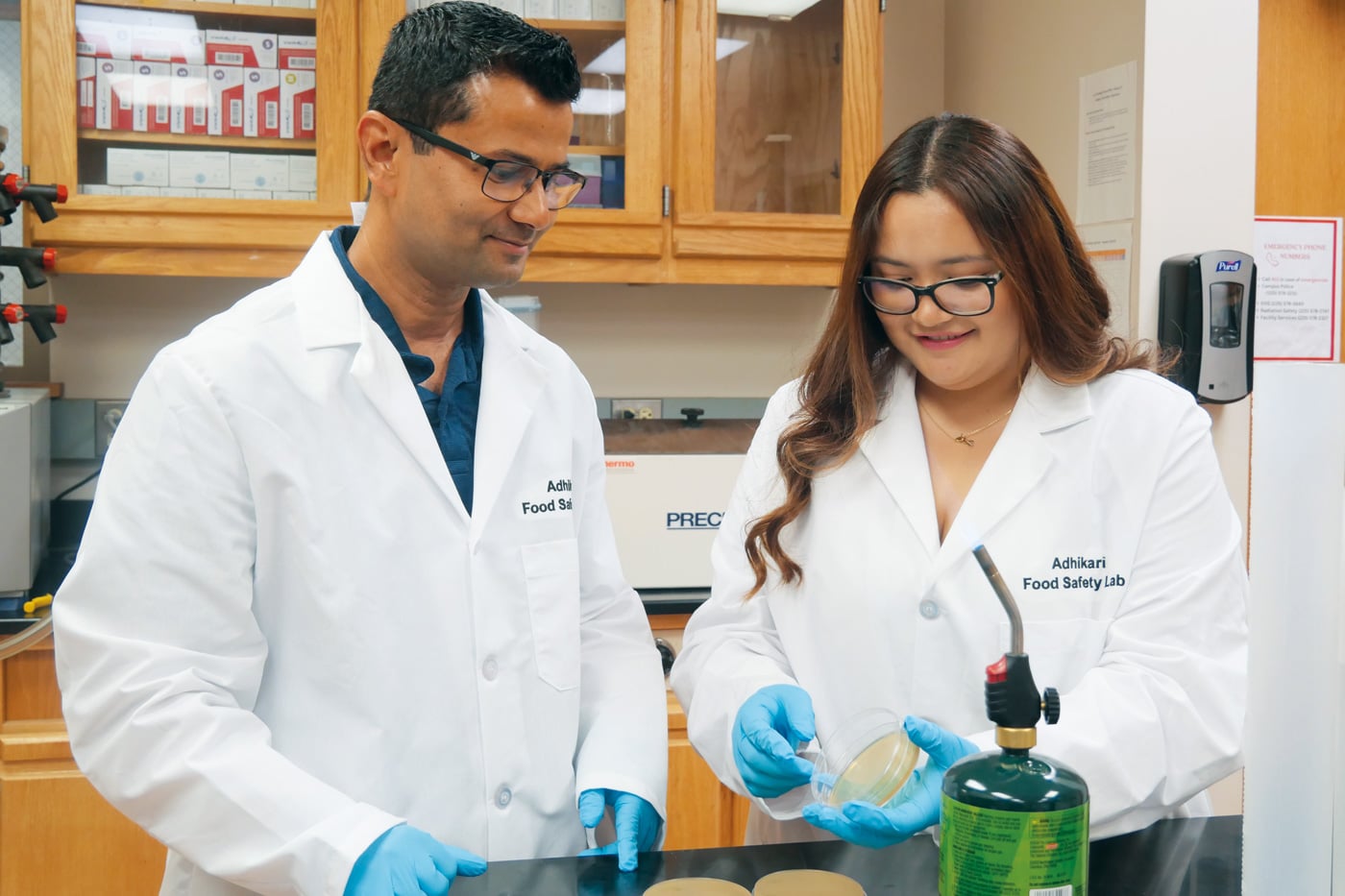
Louisiana State University doctoral student Ivannova Lituma (right) and Associate Professor Achyut Adhikari focus on the use of pecan shells for pathogen reduction. Photo courtesy of Louisiana State University
A Barrier for Berries
Adhikari and collaborators created their edible coating using pullulan—a biodegradable, tasteless polymer—combined with aqueous pecan shell extract. The coating was tested on blueberries inoculated with three foodborne pathogens: Listeria monocytogenes, Salmonella enterica, and Staphylococcus aureus.
The results were encouraging, especially against Listeria, according to the study, published in the April 2024 issue of the journal Heliyon. The coating reduced its levels by 99% immediately after application and helped maintain fruit quality over 15 days of refrigerated storage. Coated blueberries were firmer, had lower spoilage rates, and lost less moisture than untreated berries or those treated with pullulan alone.
While the impact on Salmonella and Staphylococcus was less pronounced, the findings support the idea that pecan shell extract may be a useful component in broader strategies for natural food protection.
The timing for such research is on trend. As more consumers seek clean label foods—products made with recognizable, natural ingredients—food producers are under pressure to find safer, sustainable alternatives to synthetic preservatives.
Because pecan shells are already a byproduct of food production, using them in antimicrobial coatings supports circular systems and reduces waste. (In 2023, alone, pecan production in the United States yielded around 163 million pounds of unused agricultural waste.) That kind of upcycling could benefit both processors and growers, says doctoral student Ivannova Lituma, a graduate research associate in Adhikari’s lab.
Lituma is taking pecan shell extract research in a new direction, exploring how the material’s pathogen-reducing power might be employed in hydroponic farming, her area of specialty. Hydroponic systems, which grow plants in water rather than soil, are especially vulnerable to microbial spread due to shared water circulation.
She is using pecan shell extract to coat and prime seeds against human and plant pathogens to keep these systems safer—and more sustainable. If successful, the process could reduce microbial contamination early in the growing process, using a natural alternative to chemical treatments.
“This could have a significant impact on food safety,” says Lituma, who is also engaged in outreach with local growers, “and it shows real promise for producers looking for natural alternatives.”
While the results thus far are encouraging, Adhikari emphasizes that more research on pecan shell extract is needed. Future studies will explore refining the extraction process, testing other foods and pathogens, and understanding how consumers respond to naturally coated products.
Still, the early findings suggest that what was once thrown away could become a powerful ally in the effort to keep food safe, Adhikari says: “We’re starting to see how something as simple as a pecan shell can help us rethink waste, safety, and sustainability all at once.”ft
Hero Image: © Luda311/iStock/Getty Images Plus
Authors
-
Mary Abowd Staff Editor
Mary Abowd, PhD, is a Food Technology magazine staff editor (mabowd@ift.org).
Categories
-
Food Sciences
-
Food Safety
-
Food Safety and Defense
-
Research
-
Pathogens
-
Food Microbiology
-
Food Technology Magazine


