
Digesting the Impact of Anti-Obesity Drugs

 Kayt Sukel
Food Technology Magazine
The use of anti-obesity medications (AOMs), led by glucagon-like peptide-1 (GLP-1) agonists like Ozempic (semaglutide), has skyrocketed over the past few years. These powerful drugs, prescribed for both type 2 diabetes and weight loss, work by mimicking a unique gut hormone that suppresses appetite and slows how fast the stomach empties after eating.
Unsurprisingly, as the number of people prescribed these medications continues to grow, eating and purchasing behaviors are changing. In a recent study, researchers at Cornell University and Numerator found that households with at least one GLP-1 user reduced grocery spend by between 6% and 9% within six months of starting the medication. And while Circana, a consumer insights and marketing firm, says its data suggests that spend will bounce back to a level close to users’ pre-medication baseline within a year, it’s clear that GLP-1 users are changing what goes into their grocery carts. Those taking AOMs appear to be steering away from items found in the center of the grocery store like savory snacks, sweetened beverages, and calorie-dense processed foods—and instead are opting for healthier products with greater nutrient density.
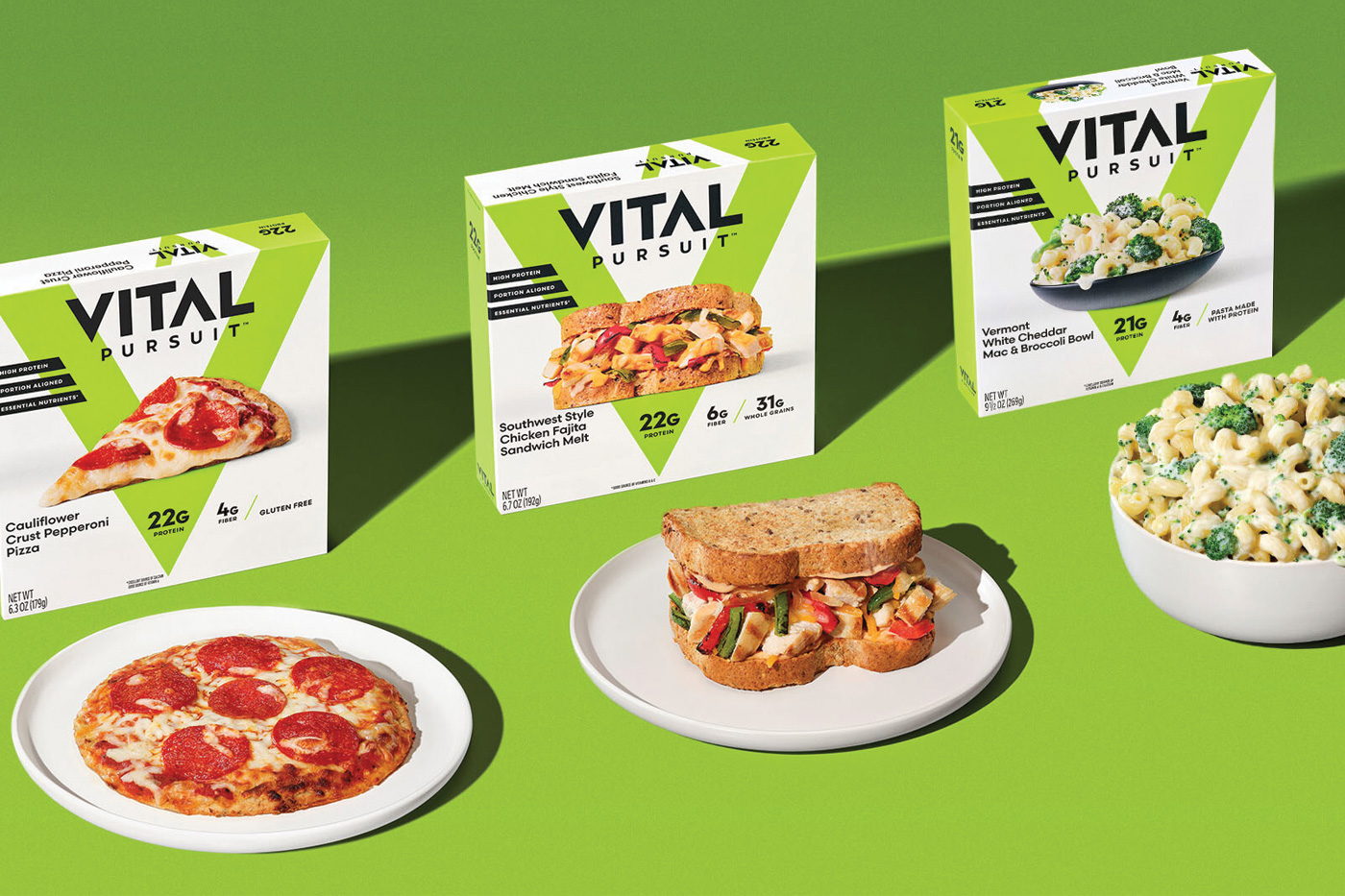
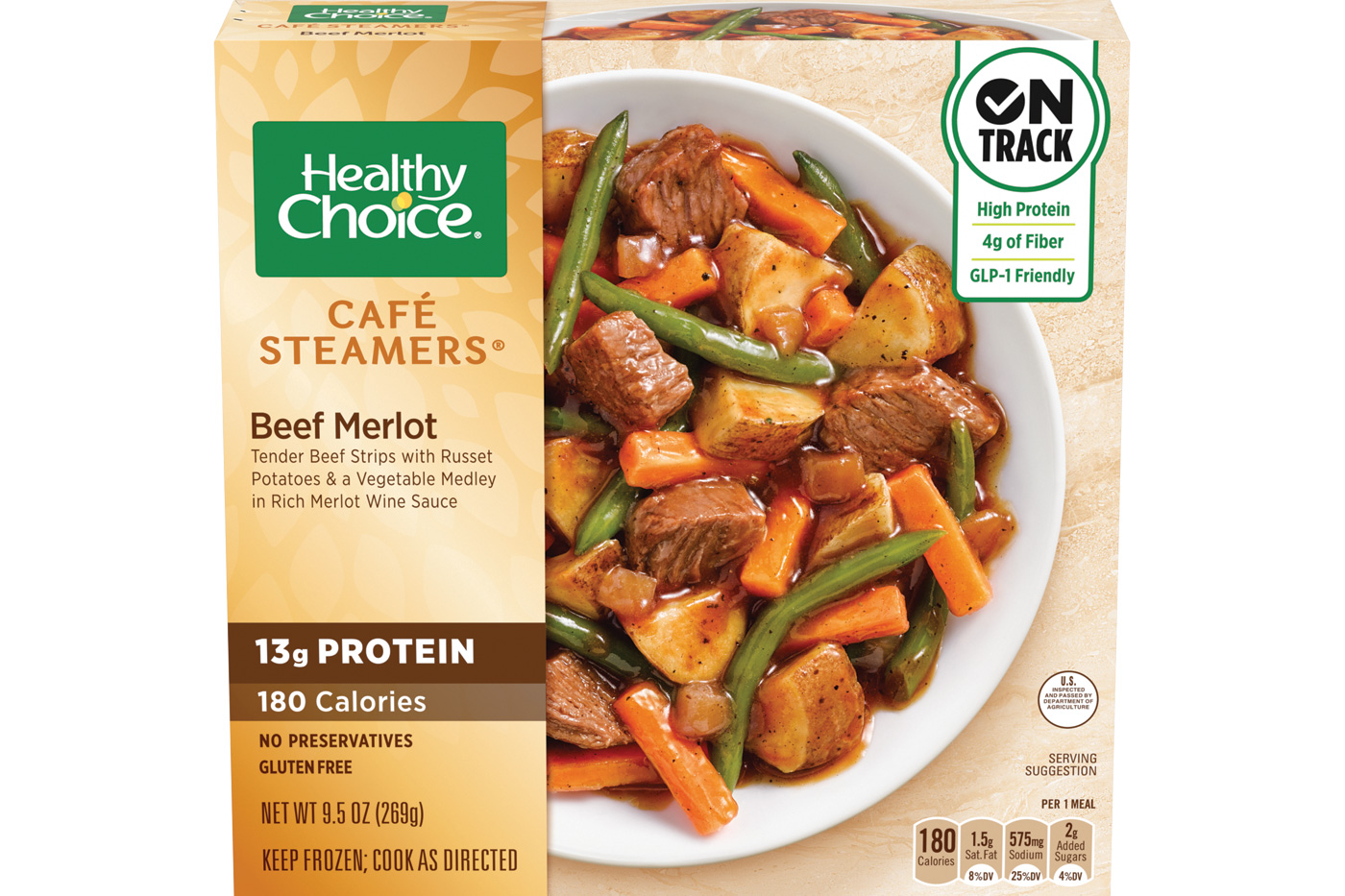
Food and beverage companies are trying to determine how to best respond to these shifts. Some are developing foods specifically for the GLP-1 set. For example, in September 2024, Nestlé launched a new brand, Vital Pursuit, which, according to a company spokesperson, provides a “convenient, real food solution to complement the needs of GLP-1 users.” Conagra has not created a new line, but announced in January 2025 that it will be adding an “On Track” badge to more than two dozen options in its Healthy Choice line, making it easier for GLP-1 users to identify offerings that better meet their new consumption needs.
Yet, other food and beverage manufacturers are taking a more cautious approach. To date, GLP-1 drug usage growth has been stifled by drug shortages, high out-of-pocket costs, and side effects including nausea, diarrhea, constipation, and headache. But given the drugs’ efficacy—and new studies demonstrating they have health benefits far beyond weight loss—the expectation is that, over time, pharmaceutical companies will increase manufacturing output, insurance coverage will expand, and costs will come down.
Jeff Grogg, founder and managing director of JPG Resources, says he also expects pharmaceutical companies to refine these game-changing drugs in ways that will reduce their side-effect profile, which should also facilitate greater adoption in the years to come.
“With any drug that brings in this kind of money, you see a similar trajectory,” he says. “Almost inevitably, costs will come down and performance will go up. Versions 2, 3, and 4 of the GLP-1s are going to have fewer side effects and be much easier for people to tolerate.”
Because of these anticipated changes, economic powerhouses like Goldman Sachs and Morgan Stanley forecast that the global AOM market will reach or even surpass $100 billion by 2030. That staggering growth, says Brad Schwan, vice president of marketing at ADM, a human and animal nutrition company, presents significant opportunities for product developers to find new ways to meet the tastes and needs of GLP-1 users today—and those who will be prescribed these medications in the future.
“Overall, GLP-1 users are highly open to trying new products, with 74% expressing willingness to experiment with novel foods and formats,” says Schwan. “This presents a wide canvas for innovation, from portable snacks to beverages that combine functionality with enjoyment.”
Changing Habits, Changing Needs
Individuals who take AOMs report significant alterations to their eating patterns, says Schwan, including eating meals with smaller portion sizes and reducing in-between meal snacking behaviors.
“According to ADM’s proprietary research among over 1,500 active AOM users in the United States, 78% report feeling full more quickly,” he says. “Taste preferences and expectations also evolve for AOM users, as many find previously enjoyable foods, especially those high in sugar, overly sweet or unappealing.”
Katie Hagan, chief innovation officer at Mattson, a food and beverage strategy company, found similar trends when Mattson did its own research on GLP-1 users. She adds that users report that the GLP-1s all but eliminate “food noise,” or constant, intrusive thoughts about food.
“These drugs have been nothing short of miraculous for so many people. They’ve worked when nothing else has, and for people who have struggled with their weight for their whole lives,” she says. “People who take them don’t seem to think about food as much. They are no longer thinking about, ‘What am I going to eat next; what am I going to make for dinner?’ In fact, they report not really thinking about food much at all when they are taking the drugs.”
As a result, those taking GLP-1 agonists are eating much less than they previously did—to the tune of 1,000 fewer calories per day. It’s no wonder that users report an average 9.6% reduction in body weight in the first few months of use.
That weight loss, however, does not just target excess fat. As the pounds melt away, so does lean muscle. That’s why GLP-1 users may need to look beyond their normal go-to foods and seek specific nutritional support to optimize health, says Bret Barhoover, category marketing manager, specialized nutrition, at Cargill.
“Beneficial ingredients, spanning fibers, biotics, proteins, salts, electrolytes, and reduced- and zero-calorie sweeteners, can help brands create foods, beverages, and supplements that address these unique dietary needs while still delivering an enjoyable sensory experience,” he says.
To start, GLP-1 drugs slow gastric motility, which can reduce thirst and fluid intake. This can not only exacerbate constipation symptoms but may even lead to dehydration if users are not drinking enough water. Beverages with salts, particularly electrolytes, can help AOM users stay not only regularly but adequately hydrated. Then there are the gastrointestinal issues that so many users face. Dietary fibers and biotics offer an avenue to keep unpleasant side effects at bay. And, of course, the loss of muscle means that any GLP-1-specific offering should also include a healthy dose of protein, as well as other vital nutrients, packed into a small portion.
While food and beverage companies are already hyper-focused on increasing protein levels in a wide variety of foods to target those who want healthier options, Arlin Wasserman, founder and managing director of Changing Tastes, a food strategy consultancy, says product developers should also keep an eye on fat and sugar levels. Foods higher in fat can worsen nausea and diarrhea for GLP-1 users. And many users also report that sweet treats are now a little too much for them.
“The fat goes through you first—and moves through you faster than you can imagine,” he says. “And users are more easily nauseated by overly sweet foods. They aren’t going to go for the same foods they always did, especially if they are really hit hard by the side effects.”
Product Development Potential
These shifts in nutritional needs and eating patterns present a unique opportunity for product innovation, Schwan observes.
“There is a need for functional and appealing options,” he says. “Research shows that 83% of GLP-1 users find products specifically positioned for people on AOMs appealing, and 81% are willing to pay a premium for such items.”
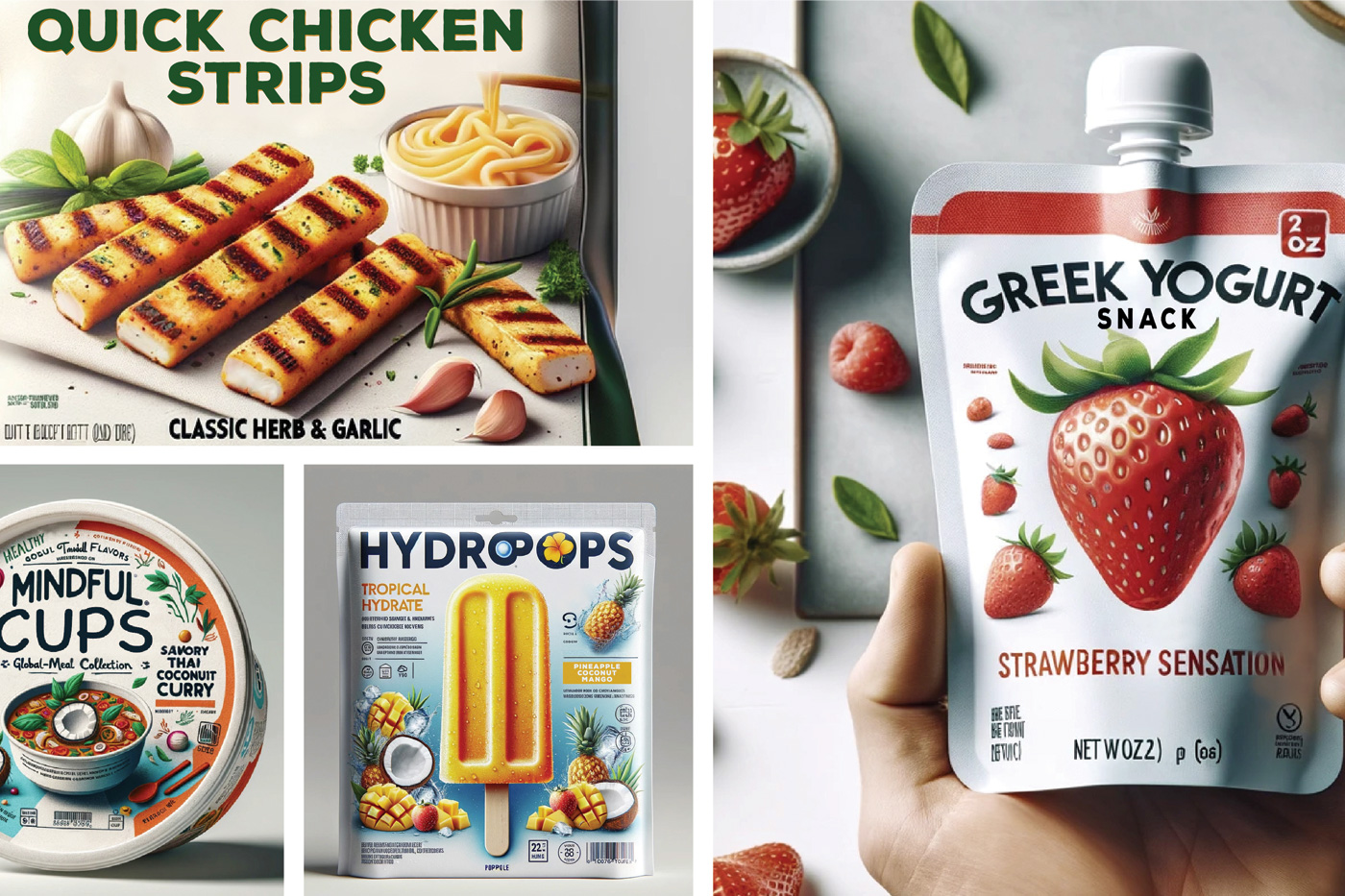
To better understand what type of products might appeal to this new segment of consumers, the Mattson research team, who are often called upon to brainstorm new product ideas for their clients, used the data from a survey of GLP-1 users to come up with 22 food and beverage concepts. They then leveraged artificial intelligence to generate brand names and packaging for each one.
“These ideas represented a span of different categories and eating occasions,” says Hagan. “But our emphasis was creating options that would appeal to regular Americans who still want convenience food and don’t necessarily want to spend a great deal of time cooking dinner.”
People taking GLP-1s still want the ability to put a good meal on the table quickly without much effort.

When they presented these different concepts to their GLP-1 cohort, Mattson discovered that the respondents were most interested in a 2-ounce grilled chicken strip modeled after a cheese stick, a 2-ounce Greek yogurt snack with 6 grams of protein, and hydrating popsicles with added electrolytes.
“People taking GLP-1s still want the ability to put a good meal on the table quickly without much effort,” Hagan explains. “They want whole food options in smaller portions. They want foods that have the nutrients they need in those small portions. And they want options that are both satisfying and easy.”
Yet, the top performer of GLP-1 concepts in the Mattson study, perhaps unsurprisingly, was a small brownie cube.
“It’s a brownie, but it’s maybe twice the size of a bouillon cube, and we added 2 grams of protein,” says Hagan. “Each cube is individually wrapped and people loved it. In fact, 61% of the people we surveyed say they would definitely buy it if it were available.”
Small bites appear to have big appeal for GLP-1 users—and other people looking to lower their consumption. Conagra reported sales of “mini” portioned food have jumped 31% in year-over-year consumption. What’s more, 84% of people report they are eating these small bites not as appetizers or snacks, but as full meals.
“This is great rationale for brands to downsize and put more of an emphasis on quality ingredients,” says Grogg. “This isn’t so much shrinkflation as much as a trade-off so GLP-1 consumers can have the smaller portions they want but with better quality proteins.”
We always need better products that are a little lower in fat, a little higher in protein and fiber, and don’t trade off flavor. That’s where the real opportunity is.

Many food and beverage companies are working to increase protein in their offerings—and to do so in smaller-portioned options. But Grogg says companies that find ways to offer those premium ingredients to increase nutrient density across the board will also be appreciated. Vital Pursuit is taking just this approach.
“Vital Pursuit was designed to accommodate diverse dietary preferences, delivering on flavors and formats we all love with thoughtfully proportioned products that offer at least 20 grams of protein, a good source of fiber, and essential nutrients,” says Nestlé. “Consumers can expect more soon, including a shelf-stable, high-protein beverage with essential nutrients and no added sugar.”
Then there’s the matter of changing tastes. Schwan says product developers may spark more GLP-1 innovation through flavor modulation technology, neutralizing the “off-notes” from certain functional or plant-based ingredients like alternative sweeteners to address altered taste perceptions of consumers. Ingredient resilience, he added, will also be of great importance.
“Functional ingredients, like probiotics, often require stability during processing to maintain efficacy,” he says. “Postbiotics and spore-forming probiotics can withstand harsh processing conditions like high heat and pasteurization that may otherwise damage conventional probiotics. These resilient biotics can pave the way for new functional food and drink developments that fit into this group of consumers’ adjusted dietary habits, like convenient, on-trend formats like gummies and drinkable yogurts.”
Wasserman also highlighted the importance of flavor for a GLP-1 audience. He believes companies that can find ways to preserve the flavor of naturally occurring ingredients so they can last on the shelf longer will win over consumers taking AOMs. This will make it easier to provide them whole, nutrient-dense foods that are still convenient and easy to prepare.
“This may be new drying and preserving technologies or new grinding processes to get more flavor distribution,” he says. “There’s a lot of opportunity there for healthier food options across the board.”
New Products or Enhanced Favorites?
Some might look at the marketing data that’s been collected thus far and say that GLP-1 users are looking for entirely new products to meet their needs. Certainly, ADM’s data suggests that these consumers are open to the idea of something new. Yet, Hagan says that people taking AOMs may still want the foods they’ve always enjoyed, just in smaller packages and with increased nutrient density. And this presents both a challenge and an opportunity to food developers who are looking to appeal to this unique consumer group.
“There are people who love specific kinds of snack foods but know they shouldn’t eat them while taking these drugs,” says Hagan. “Food companies could think about taking popular savory snacks and finding ways to add protein. They could enhance these items in ways so they are more nutritionally dense, maybe in smaller packages, so GLP-1 users can still enjoy them.”
If you look at the offerings from Vital Pursuit, as well as the badged items from Healthy Choice, they don’t seem remarkably different from other convenience meals in the frozen food aisle. You can find pizzas (albeit with cauliflower crust) and protein bowls that also feature high-quality ingredients.
The idea that people taking GLP-1 drugs are going to eat healthier across the board seems to me to go against human nature and the history of food in America.

Grogg says he, too, believes there is a place for innovation that enhances the foods that people already regularly consume. He adds that he’s seen a lot of people online theorizing that increased GLP-1 use will “hammer junk foods,” and make people turn away from processed or convenience foods. But he is skeptical.
“The idea that people taking GLP-1 drugs are going to eat healthier across the board seems to me to go against human nature and the history of food in America,” he says. “If companies can find a way to give people the foods they want and still be able to control their weight without awful side effects, I can’t imagine people won’t go for that.”
Like Hagan, he says the company that can bring a tasty, snackable protein chip so people who “want both a Dorito and higher quality protein” can have it, will not only engage those with a GLP-1 prescription, but also those who are not taking the drug.
Supporting an On-Off Cycle
Circana refers to greater adoption of GLP-1 drugs as the “early days of a revolution.” But others are a little more circumspect and acknowledge the situation is “evolving.”
“It’s like a living creature. There are still a lot of unknowns about how many people are really going to use them and for how long,” says Hagan. “There’s a lot to unpack as we make our way forward.”
While much of the focus has been on developing food products to better support consumers taking GLP-1 agonists, it’s clear that food and beverage manufacturers must also contend with providing options for those consumers when they stop taking the medication. A variety of new studies have come out highlighting that a significant proportion of those prescribed AOMs will stop taking them within a few months, or even a few weeks, due to their powerful side effects or high cost.
“Different people have tried these drugs for different reasons. If your doctor says you have to be on them to improve your health, you will probably stick with the drug despite the side effects,” says Wasserman. “For adults who just want to slim down to achieve a more optimal body type, I have to imagine they are finding that the side effects or the price tag maybe aren’t worth it.”
Hagan says more than two-thirds of the GLP-1 users Mattson interviewed were having positive effects on the medications. But others discontinued use, not only because of the costs and side effects, but also because the drugs interfered with their enjoyment of food.
“For these people, food was a joy in their life,” she says. “On the drugs, they found they didn’t care about food anymore and that was sad for them.”
It’s likely that, despite the bullish projections on future GLP-1 usage growth, there will be many people who will take GLP-1s for only a limited period of time until they reach their goal weight. Others may need to cycle on and off the drugs as needed for their health and well-being. Schwan says this is something that food developers should be thinking about as they develop products aimed at GLP-1 users in the future.
We need to support AOM users through their whole journey, including those tapering off medications.

“We need to support AOM users through their whole journey, including those tapering off medications,” he says. “GLP-1 medications help diminish persistent food-related thoughts, but when individuals stop taking them, they report a resurgence in their cravings.”
Given the studies showing that GLP-1 users tend to regain most of any lost weight within a year of stopping the drugs, food and beverage companies that are thinking about the different paths in the GLP-1 journey will be able to reach more consumers. There is great opportunity if organizations can develop new products that thread the needle, addressing the specific needs and tastes of GLP-1 users while also appealing to health-conscious consumers who are aren’t currently taking them or who have never used them.
“If GLP-1-friendly food is also food that can help the average consumer lose weight even if they aren’t taking the drug, I think there could be a new generation of reduced-calorie—but not reduced-flavor—foods,” says Wasserman. “While I don’t think we can assume that just because 30% to 40% of Americans are overweight, 30% to 40% of Americans will end up using GLP-1s, we always need better products that are a little lower in fat, a little higher in protein and fiber, and don’t trade off flavor. That’s where the real opportunity is.”ft
Hero Image: © KuznetsovDmitry/istock/getty images plus
Authors
-
Kayt Sukel Author
Kayt Sukel is a book author, magazine writer, and public speaker who frequently covers scientific topics.
Categories
-
Food Business Trends
-
Food Health Nutrition
-
Consumer and Marketplace Trends
-
Food Ingredients and Additives
-
Obesity and Weight Management
-
Diet and Health
-
Proteins
-
Issues & Insights
-
Food Technology Magazine
-
Prebiotics
-
Probiotics


