
3 Food Safety Tech Game-Changers

 Larry Keener
Food Technology Magazine
-
Safety Drivers
Learn about the public health and business reasons driving advances in game-changing food safety preventive and control technologies.
-
Nonthermal Technologies
Discover the benefits of using light-based technologies, atmospheric cold plasma, and hydroxyl radicals (OH*) in food processing operations.
-
Plant Applications
Gain insight into the practical application and uses of three nonthermal processing technologies to prevent microbial contamination in food plants.
In the United States, the Centers for Disease Control and Prevention (CDC) estimates that 48 million people get sick from foodborne illnesses each year, which is about one in seven Americans. The CDC also estimates that 128,000 people are hospitalized and 3,000 people die from foodborne illnesses each year. However, due to underreporting, the actual number of deaths is estimated to be much higher. In addition, the average cost of a single food recall is estimated at $10 million, but it can be much higher for larger enterprises. Even a nuisance lawsuit associated with foodborne illness can reach six figures. Simply put, foodborne illness outbreaks are costly in terms of human health and the financial health of food processing enterprises.
1. Light-Based Technologies
In the past decade, light-based technologies such as ultraviolet light (UV) and light emitting diodes (LEDs) have shown great promise for improved disinfection of fresh produce, water, and air. Ultraviolet-C (UV-C), a type of UV light with a short wavelength range of 100–280 nm, is also known as germicidal radiation since it can kill viruses and microorganisms. When coupled with LED technology, UV-C LED operates as a semiconductor device that emits UV light in the germicidal range when an electric current passes through it.
The past decade has seen incredible advances in UV-C LED technology. Early on in their development, UV-C LEDs offered only low power output, short useful life, and were extravagantly expensive, with a typical cost of several hundred dollars per individual diode. Recent developments at the industrial level have produced UV-C LEDs with higher output energy, lower input energy, increased longevity, and dramatically lower cost. These advances have been able to close the gap between efficiency and cost, making the technology more attractive to the prospective end users in the food industry.
Traditionally, UV-C has been leveraged to disinfect water, air, and in more recent years, a wide range of hard surfaces and foods. UV-C’s ability to disinfect without high heat, without inducing microbial resistance,and without leaving behind chemical residues (and for UV-C LED, without emitting ozone) makes it a powerful, chemical-freetool for hygienic processing operations. For example, UV-C LED has been used effectively to disinfect skinless chicken breasts, stainless steel, and high-density polyethylene inoculated with Salmonella enterica, achieving microbial log reductions (at 100% irradiance) of 3.0 log10 CFU/cm2, 3.48 log10 CFU/cm2, and 1.77 log10, respectively.
It is also notable that researchers have recently reported the development of a portable water treatment appliance that is based on filtration in conjunction with UV-C LED technology. The portable treatment appliance requires the availability of an electrical source to drive the equipment. It appears that this breakthrough light-based technology is possible because of the size and lower cost of LEDs as opposed to the lamps traditionally used for producing UV light.
ACP is considered an economical processing technology because it does not require heat, pressure, water, or additional chemical solvents.
2. Atmospheric Cold Plasma and Plasma-Activated Water
Plasma is commonly referred to as the fourth state of matter based on the levels of energy, after solid, liquid, and gas. It comprises electrons, ions, neutral species, photons, metastable, and other excited gaseous atoms. ACP is commonly generated at ambient temperature and pressure by the interaction between an electric field (usually a pair of electrodes) and gas molecules, which subsequently form charge carriers (a mixture of electrons and ions). The free charge carriers are further excited by the electric field and collide with atoms and molecules in the gas or with electrode surfaces, producing a large quantity of new charged particles. A steady-state cold plasma at atmospheric pressure is formed when the particles and charge carrier losses are balanced. Non-equilibrium or “cold” plasma, which are both types of nonthermal plasma, are states that are not in local thermodynamic equilibrium (usually less than 60°C).
While the exact composition of plasma-generated species depends on various conditions such as gas type, voltage, and humidity, it typically contains reactive oxygen and nitrogen species, free radicals, excited molecules, and UV photons. Within the food processing industry, some of the most common ACP generators are the dielectric barrier discharge (DBD), atmospheric plasma jet, radio frequency, spark and glow discharge, and gliding arc.
ACP has attracted substantial attention within the food industry in the past decade because plasma can be generated without the use of an expensive vacuum pump and still maintain similar properties. There are many potential applications for ACP in the food industry. It can be used to decontaminate the exterior surfaces of fresh produce or for inactivation of deadly pathogenic bacteria in the food plant and on food-contact surfaces. ACP is considered an economical processing technology because it does not require heat, pressure, water, or additional chemical solvents. Moreover, it utilizes less energy than conventional methods due to shorter treatment times.
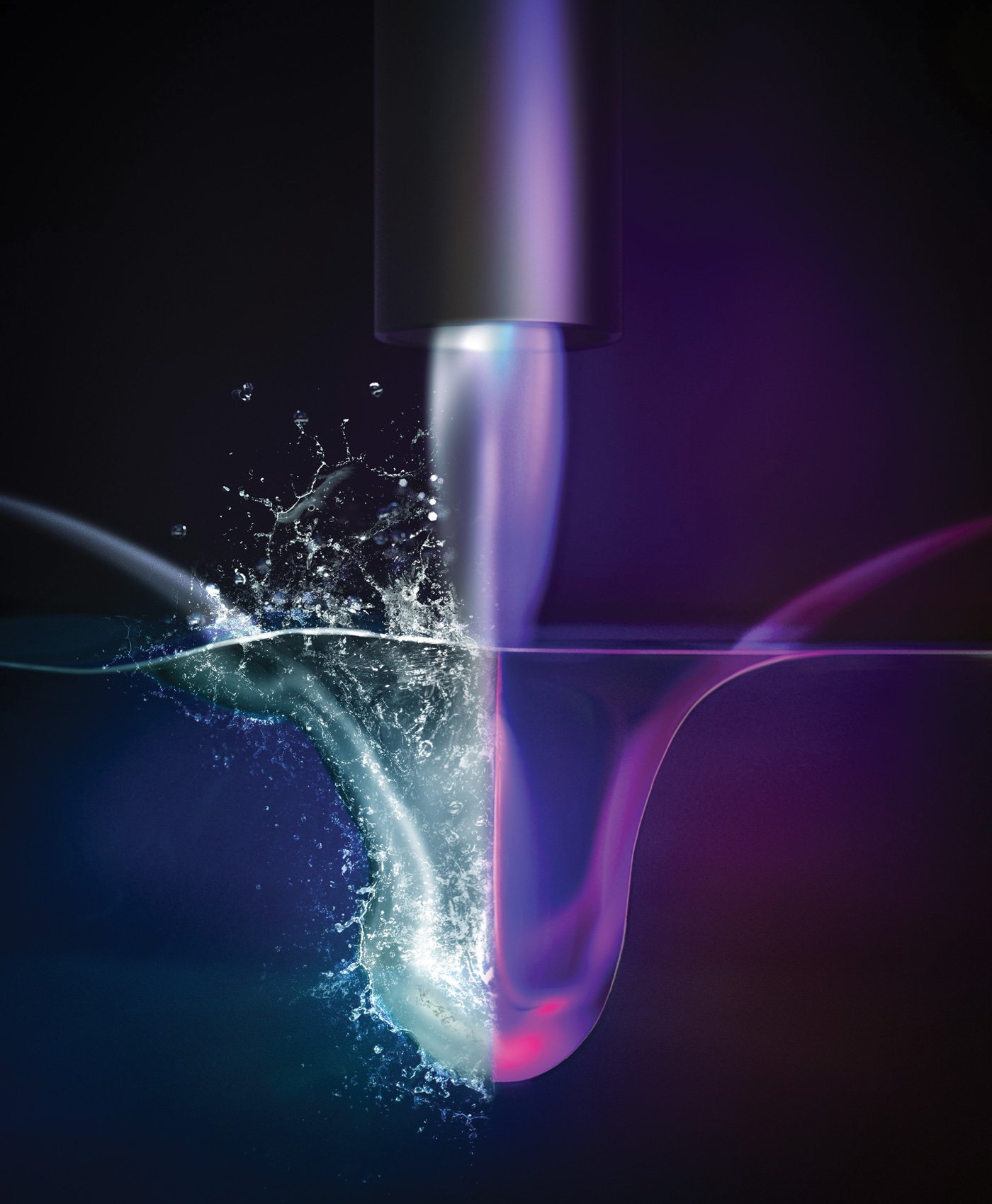
A plasma jet is created by applying high voltage to a nozzle as gas flows through it, which causes the gas to be weakly ionized and acquire freely-moving charged particles. Cavity formation at the water’s surface subjected to a neutral helium gas jet (left) and a weakly ionized helium gas jet (right). (From: Park, S., et al. (2021) Stabilization of liquid instabilities with ionized gas jets. Nature, Vol. No. 592, Issue No. 7852, pp. 49-53. https://doi.org/10.1038/s41586-021-03359-9). © Professor Wonho Choe, Korea Advanced Institute of Science and Technology (KAIST)
Plasma-activated water is an interesting and exciting technological development in which an ACP field is discharged directly onto the surface of water, thereby creating in the water a mixture of ionized particles, UV light, and assorted free radicals. The study of PAW has skyrocketed in the past five years, nearly eclipsing ongoing research of ACP. Aside from food safety applications discussed here, there is ongoing research into the use of PAW in agriculture. Perhaps some of the pathogens that have plagued leafy greens in the past decade or so can be alleviated by using PAW for crop irrigation.
Essentially, PAW has high disinfectant capacity while causing little to no modifications to the foodstuffs. PAW can be generated in three ways, with the most common being plasma discharge over the water surface. This involves the use of DBD, spark or glow discharges, and plasma jets. The ACP treatment process creates reactive species from plasma that are delivered to the water, increasing its oxygen reduction potential, conductivity, and pH. PAW contains radicals and other reactive species that have antimicrobial activity, and can be used to inactivate viruses and bacteria, as well as remove biofilms. These germicidal effects are derived from the plasma-induced acidification (pH 3.0) of the water, increasing content of reactive species such as ozone or hydroxyl radicals.
Plasma-activated water has been shown to be an effective surface disinfectant for fresh fruits and vegetables, poultry, meat, and eggs. It can also be used as a rinse for hard, food contact surfaces, such as stainless steel or other hard polymeric surfaces. PAW is reported to retain its antibacterial activity for up to seven days when it is stored at room temperature. It can be produced by using either tap water or deionized water.
3. Hydroxyl Radicals
OH* is a highly reactive molecule containing one oxygen atom and one hydrogen atom, with an unpaired electron (the asterisk in the chemical structure notation indicates the unpaired electron), making it a powerful oxidizing agent that readily reacts with many other substances. The natural molecule is often considered the “detergent” of the atmosphere due to its role in breaking down pollutants such as methane, pathogens, chemicals, and other organic compounds. Hydroxyls are present throughout the troposphere due to the sun’s UV energy reacting with ambient gases. The molecules rapidly decompose a broad range of aliphatic and aromatic volatile organic compounds (VOCs) via radical chain reactions that gradually oxidize individual carbon atoms and release them as CO2. They are nature’s way of safely keeping the air we breathe free of harmful levels of chemicals and pathogens.
The use of OH* for sanitizing the ambient air and hard surfaces in food facilities is gaining interest as the food industry seeks out new tools to further enhance hygienic operations. While OH* don’t exist naturally indoors, hydroxyl generators based on the UV scission of water vapor can continuously generate natural levels of OH* inside facilities to minimize unsafe levels of chemicals and microorganisms that otherwise accumulate. The OH* generated react within milliseconds with VOC, producing organic peroxyls, which are also powerful oxidants and cleanse and sanitize like OH*. Peroxyl radicals have a much longer lifetime than hydroxyl radicals—on the order of 12 min—enabling them to circulate throughout treatment spaces to sanitize air and surfaces. They decompose airborne and surface-bound microorganisms by reacting with the lipids, proteins, and carbohydrates that constitute the structure of pathogen cell walls. This causes structural changes that result in leakage of the contents of the cells and cell death. Airborne microorganisms are also exposed to UV radiation within the hydroxyl chamber, which is absorbed by cellular DNA preventing replication. The microbiological activity of OH* is also sufficient to kill bacteria in biofilms.
Generating atmospheric hydroxyl radicals indoors in a controlled concentration that results in high efficacy at scale while being safe is not trivial. In recent years, this technical challenge of producing OH* has been overcome. The technology’s unique ability to treat both air and surfaces makes it a unique fit for environments such as food processing facilities, where there is high risk from surface contamination and in which the air itself can be a pathogen carrier (and one that’s very difficult to detect or treat).
Many of the disinfectant techniques and technologies in use today in food processing are passive, can only be done at a point in time, and their effectiveness ends at the end of the treatment process (i.e., recontamination can happen immediately after treatment). OH* technology overcomes these challenges since these molecules can be applied continuously and in the presence of workers, as well as persist in the environment, which can delay or mitigate contamination.ft
Hero Image: © Oskanov/iStock/Getty Images Plus
Authors
-
Larry Keener Member
Larry Keener, CFS, is an IFT Fellow and president of International Product Safety Consultants, Inc., Seattle, Washington
Categories
-
Food Safety and Defense
-
Pathogens
-
Nonthermal Processing
-
Foodborne Illness
-
Applied Science
-
Food Technology Magazine
-
Food Processing and Technologies


