
100 Years of Freezing: Thanks, Clarence Birdseye

-
Freezing Fundamentals
Understand the history and advantages of the process of freezing food.
-
Freezing Process
Gain insight into the process of freezing food.
-
Freezing Equipment
Learn about the common equipment used in the food freezing process.
Next time you are in your local grocery store, take a walk through the frozen food aisle. The variety and breadth of what is offered is rather amazing. There are fruits and vegetables of all types and mixes, meats, poultry, fresh and battered fish, specialty meats, bakery items, ice cream of all kinds, pizzas, side dishes, and more. Humankind came to understand that cold will preserve and enhance foods as far back in time as 500 BC in ancient Egypt. And we can probably assume that Neanderthals living in cold climates figured out that snow and ice helped preserve food.
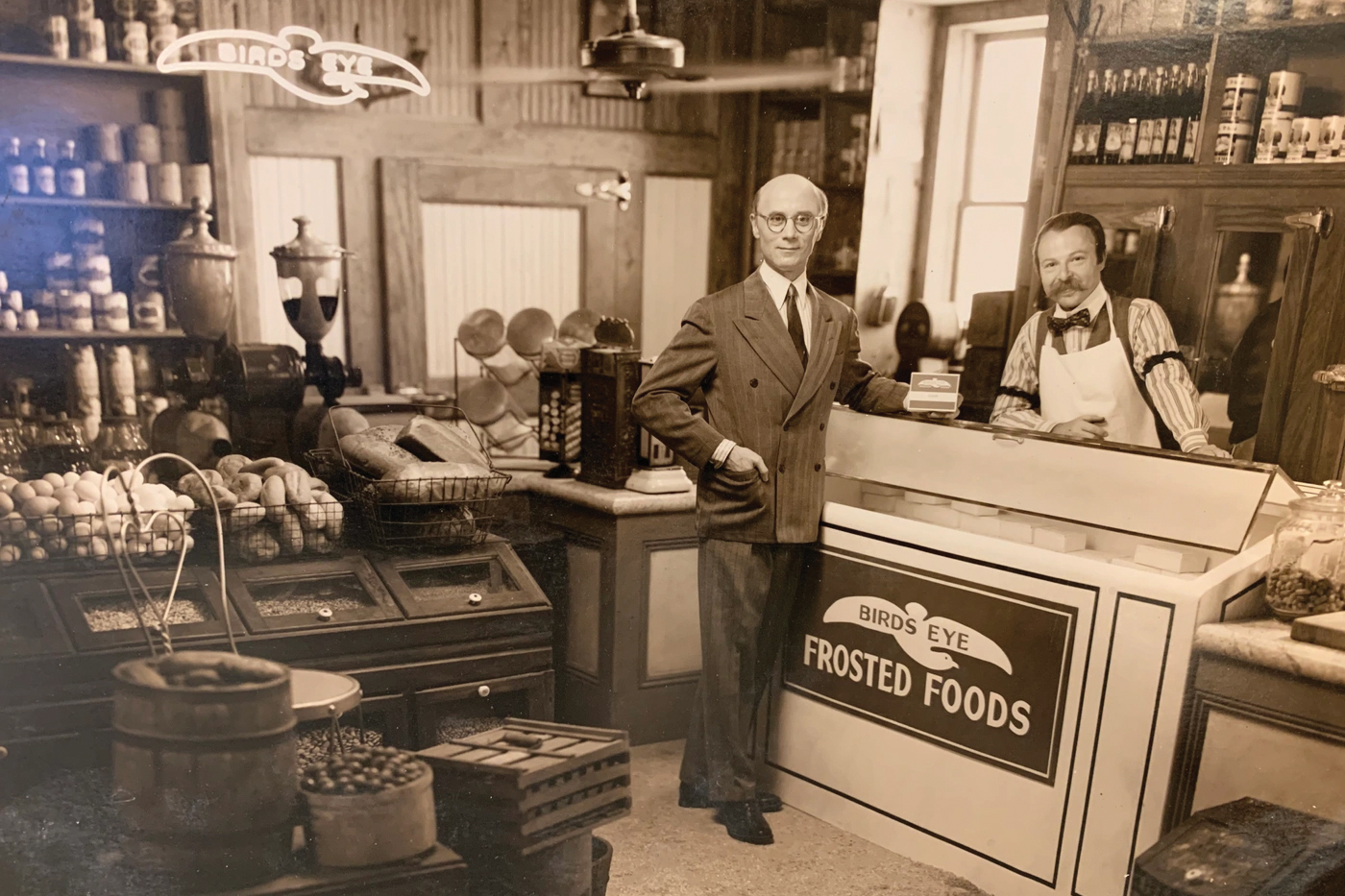
The mid- to late 1800s saw the development of several freezing technologies, including the use of ammonia as a refrigerant. In fact, a shipment of 30 tons of frozen meat from Australia to England is believed to be the first major use of mechanical refrigeration (Fennema 1976). However, it was the work of Clarence Birdseye and his laboratory in 1923 that heralded the start of commercial freezing. Birdseye, other scientists, and processors realized that frozen food quality depended upon several factors, including but not limited to proper selection of the product to be frozen, handling of raw materials (especially fruits and vegetables), preparation of the food to be frozen, the freezing process, and storage and distribution of the products.
Key Steps in Freezing
These same elements also play a role in assuring that frozen foods are not only of high quality and meet consumer demands but also are safe. Over the years, the food industry has worked to better understand and optimize the freezing processes for the hundreds of different products manufactured around the world. Let’s take a look at these different process elements through the lens of freezing strawberries and green beans.
The key is to harvest the products and get them to the freezing facility as quickly as possible. Strawberries are delicate and so they must be harvested by hand whereas green beans are generally mechanically harvested. Years ago, food scientist and University of Massachusetts-Amherst professor Fergus Clydesdale observed that his team had to use frozen vegetables for a vitamin-related project because out-of-season products did not retain the target vitamins—an example of how short the time frame is between harvest and freezing, which locks in essential nutrients.
Before the freezing process can commence, a few preparation steps will take place. With the delicate strawberry, the stem or cap is removed, which is a hand operation in some facilities but usually done by machine. The caps also may be removed in the field. The fruits are washed and may be sliced. Vegetables such as green beans are washed in a tank, trimmed or snipped, and conveyed to a blancher.
The importance of blanching prior to freezing vegetables such as green beans or spinach cannot be stressed enough. Blanching inactivates enzymes that deteriorate produce and results in enhanced quality and shelf life, stabilizes color, and reduces volume. The latter is especially important when dealing with leafy greens. (Try and put 16 oz of spinach into a can without blanching it first!) The blanched green beans are then chilled in a cooling canal, which conveys them to the freezer. Blanching also is a proven food safety measure since under appropriate time and temperature parameters there is sufficient heat applied to the product to serve as a pathogen kill step. One study demonstrated the efficacy of blanching as a kill step in broccoli, peppers, onions, mushrooms, and sweet peas (Mazzotta 2001).
The freezing process is rather simple. It utilizes low temperatures to remove latent heat from the product being frozen and converts water in the product to ice. The speed at which food is frozen is critical to end-product quality. Rapid freezing forms very small ice crystals while slow freezing produces larger ice crystals. Individually quick frozen (IQF) systems can reduce the temperature of food from ambient to -20°F (-29°C) or -40°F (-40°C) in a few minutes. The larger ice crystals formed during slow freezing tend to affect food microstructure in ways that become evident during thawing, such as causing the tissue to soften with accompanying loss of moisture, flavor, aroma, color, and texture. Freezing turns water in cells to ice, so it is not available for enzymatic reaction and more importantly, inhibits the growth of microorganisms. The water is not available to microorganisms in a frozen state (low water activity). However, freezing cannot be construed as a kill step as it is not lethal to pathogens.
Freezer Types
There are different types of freezers available to food processors. As noted, the speed at which freezing is conducted has a major effect on product quality, so let’s look at what is available to the freezing industry.
Batch freezer. This is the simplest and least expensive system to operate. There are two types of batch freezers: a cold storage room and a stationary tunnel. The former, a room in which the processor moves packaged products to be frozen, is not used very often in today’s industry. The stationary tunnel is an insulated enclosure with refrigerated coils and fans that circulate cold air over products. Products to be frozen are packed in cartons or spread over trays that are placed on racks that are moved through the tunnel. Air gaps must be maintained between each layer of cartons or trays to allow air circulation to occur between all items being frozen. The advantages of batch freezers are that they are easy to build and can accommodate a wide range of products. However, they are labor intensive, occupy a great deal of floor space, their poor heat transfer can cause slow freezing and compromise overall quality, and cleaning can be difficult and expensive.
In-line freezers. There are several kinds of in-line freezers, including push-through tunnels or trolley freezers. These are similar to batch freezers, except that the trolleys or carts are moved through the freezer on rails using a hydraulically powered mechanism. Another in-line system is known as a contact plate freezer in which product is compressed between two metal plates that are cooled by an internally circulating refrigerant. Pressing the cold plates against the packages of food provides good heat transfer and generally rapid freezing times. Liquids and semi-liquid products may be frozen between two stainless steel belts: one flat and the second corrugated in a continuous sandwich. When the frozen liquid emerges from the freezer, it is broken or cut into individual pieces and packaged as an IQF item. This is the first step in the process of producing freeze-dried coffee.
Fluidized bed freezer. Products such as fruits, vegetables, diced meats, and shrimp can be frozen using a system called a fluidized bed freezer. The products move through the system on a bed of cold air, completely enveloping the items. Fluidized bed freezers minimize clumping of products that may stick together and can freeze the foods very quickly (5 to 20 min). They also have excellent freezing capacity, usually between 2,000 and 20,000 pounds of product per hour.
Straight belt and spiral freezers. The former utilizes controlled vertical air flow up through the mesh belt and product layer to contact the product being processed. The air causes the product to become suspended or fluidized. These freezers usually consist of two belts with variable speeds creating two zones within the freezer: precooling or crust freezing and finish freezing. Straight belt freezers are used for products such as French fries, peas, sliced peaches, broccoli, whole baby carrots, and corn on the cob. Spiral freezers have a spiraling rail system that is driven by a central drum. These systems have a smaller footprint than others and can be designed to accommodate differing production capacities. Among the products that are frozen in spiral freezers are raw and cooked meat patties, fish fillets, pizza, and various packaged products.
Cryogenic freezer. These systems utilize liquid nitrogen or carbon dioxide, which is sprayed into the freezing zone and distributed using fans or sprayed directly onto the product as snow. Immersion in liquid nitrogen may also be used. The cryogenic gases will freeze products quickly and yield high quality products. The use of cryogenic freezing in the food industry is most often applied when freezing fragile products.
Freezing and Food Safety
Frozen foods do not support the growth of food pathogens or spoilage organisms, but they may contain potential pathogens since they can survive in these products. A major pathogen of concern in freezing operations and in frozen foods is Listeria monocytogenes. In one recent study, researchers found Listeria sp. and L. monocytogenes on raw spinach, corn, peas, green beans, and carrots destined for processing, suggesting that these microorganisms are being routinely introduced into processing facilities (Magdowitz et al. 2021). As noted earlier, a proper blanching operation can achieve significant pathogen reduction (kill step); processors need to be aware of post-blanching contamination such as chilling, dewatering, freezing, and packaging. Good sanitation, proper sanitary design of equipment, and handling and environmental monitoring should be adopted to minimize potential concerns.
Battered products that are frozen, such as seafood, shrimp or cheeses, also have the potential for contamination with Staphylococcal enterotoxin. Chapter 15 of the Seafood Hazards Guide describes control of S. aureus toxin formation that may occur because of time and temperature abuse at the hydrated batter mix storage or recirculation step (US FDA 2011). The key is making sure that batter is not exposed to temperatures of between 50 oF and 70oF for extended periods.
Frozen foods give consumers the ability to prevent food waste and further extend their food dollar.
Salmonella occasionally reared its ugly head with frozen foods. As an example, frozen, breaded chicken products have caused Salmonella outbreaks over the past two decades. There are two challenges here. First, the chicken is raw, and second, these products are pre-browned and may appear cooked. Consumers prepare the products from a frozen state, which increases the risk of the product not reaching the internal temperature needed to destroy Salmonella. Despite the fact that there are cooking instructions on the products, outbreaks have continued. For this reason, the U.S. Department of Agriculture’s Food Safety Inspection Service recently finalized policy to protect consumers from Salmonella in raw breaded stuffed chicken products, specifically, declaring the pathogen an adulterant in these products when they exceed a specific threshold (1 CFU/g or higher) for Salmonella contamination.
There have also been Salmonella outbreaks attributed to frozen foods. The products involved in these outbreaks were contaminated during processing. If they had been properly cooked at home, there may not have been a concern. This is why frozen dinners, meat pies, and other products have very detailed cooking instructions on the packages. Many recommend heating to at least 165oF and that the temperature is monitored using a thermometer.
Reducing Food Waste
In addition to the stated benefits of nutrition, convenience, and affordability, frozen foods give consumers the ability to prevent food waste and further extend their food dollar. With increasing attention to climate change and sustainability of food systems, there is growing data and recognition for the role of consumers in reducing household food waste. A recent survey by MITRE-Gallup showed 87% of households reported wasting edible food the prior week. In addition, 86% of households think Americans should do more to reduce the amount of food waste. No doubt, freezing at home and commercially available frozen foods offer an inherent solution to bring about this change—another reason to applaud Mr. Birdseye and the development of industrial food freezing more than a century ago.ft
Hero Image: © DigitalVision/Getty Images
Authors
-
Richard Stier Food Scientist
Richard F. Stier is a consulting food scientist with international experience in food safety (HACCP), food plant sanitation, quality systems, process optimization, GMP compliance, and food microbiology (rickstier4@aol.com).
Categories
-
Food Safety and Defense
-
Processing Equipment
-
Applied Science
-
Chilling and Freezing
-
Food Technology Magazine
-
Food Processing and Technologies


