
How Digitalization Impacts Sustainability

-
Terminology
Understand the distinction between digitization and digitalization.
-
Digital Technologies
Identify how digital technologies—such as IoT, ERP systems, and digital twins—enhance sustainability through improved data collection, analysis, and decision-making.
-
Value-Led Sustainability
Recognize that leading with operational and economic value creates the foundation for long-term sustainability gains.
Food systems face increasing pressure to reduce waste, decarbonize, and operate more transparently while remaining profitable in supplying safe foods amid economic uncertainties and supply chain disruptions. Digital technologies promise to fill critical gaps in the food industry. Whether the costs are justifiable, they are here to stay. As new demands intersect with legacy infrastructure, the industry is being pushed to rethink how information flows and decisions are made. This shift begins with understanding the difference between simply digitizing data and fully digitalizing operations.
Digitizing involves converting analog formats, such as inventory, which has long been the standard in the food industry, into digital formats as simple as spreadsheets, while digitalization entails a transformation of workflows, business models, and overall decision-making using digital technologies.
To illustrate, digitization occurs when a factory installs sensors to monitor water consumption at specific locations instead of relying on manual logs. Digitalization emerges as these sensors link to an artificial intelligence–enabled platform, often within an Enterprise Resource Planning (ERP) system, that predicts future water needs, identifies areas of excess use, and automatically adjusts wastewater treatment schedules for reclamation. In this context, ERP systems act as the digital backbone of a food operation, integrating production data, sustainability metrics, quality control, and compliance into a single decision-making paradigm.
When effectively integrated, digitalization transforms the food industry by enabling organized data collection, advanced analytics, and real-time (or near real-time) visibility across the supply chain, all of which are essential for achieving sustainability goals. Technologies such as the Internet of Things (IoT), blockchain, and, more recently, digital twins, promise to dramatically increase the capacity to monitor, analyze, and optimize resource flows and processing. This data visibility then supports sustainability assessments such as carbon footprinting and life cycle assessments (LCAs) in alignment with Environmental, Social, and Governance (ESG) goals, such as more sustainable packaging, circular value chains, and water and climate stewardship, which have emerged as key differentiators in a competitive market (Lu 2024). However, for many enterprises, operating within the food sector’s notoriously thin margins, the urgency of profitability can sideline long-term ESG ambitions. This raises questions about how inclusive and economically viable the sustainability mandates are.
Digitalization is often proposed as a pathway to bridge this gap, embedding sustainability into operations through traceability, optimization, and data-informed decision-making. Yet this surfaces a deeper dilemma; while digital tools promise greater efficiency and environmental gains, their implementation requires upfront investment and change management. Even when the long-term return on investment is clear, the company’s technical capacity may not always be feasible.
The way forward is not to pursue digitalization and sustainability as parallel ideas, but to integrate them through concrete, economically viable steps. In a margin-sensitive industry, leading with operational and economic value creates the foundation for long-term environmental and social gains because doing the right thing also has to work in our complex supply chains.
The way forward is not to pursue digitalization and sustainability as parallel ideas, but to integrate them through concrete, economically viable steps.
Data and Beyond
The journey starts with capturing the right data—not just more data, but meaningful data from pre-processing to post-production systems. Improving sustainability depends on understanding where resources are consumed, where waste is generated, and where decisions have downstream impacts. This data comes in many forms: structured formats like sensor logs or inventory databases, and unstructured sources such as images, videos, or operator notes. It also varies by source and function, from real-time IoT data and supply chain flows to consumer-centered records and end-of-life stages. These data are vital for sustainability tracking but also improving product quality, enhancing brand trust, and meeting regulatory and consumer expectations across the food chain.
Yet data alone is not enough. Many manufacturing operations run on instinct, routine, and spreadsheets; tools are often disconnected, reactive, and limited in their ability to capture operational and sustainability performance across systems and time. Historically, sustainability was tracked after the fact, by separate teams, in separate reports. A well-thought-out digital transformation changes this dynamic. By integrating diverse data streams into a unified system, organizations can begin utilizing data for connecting what they do with how they can do better across all three pillars of sustainability: economic, environmental, and social.
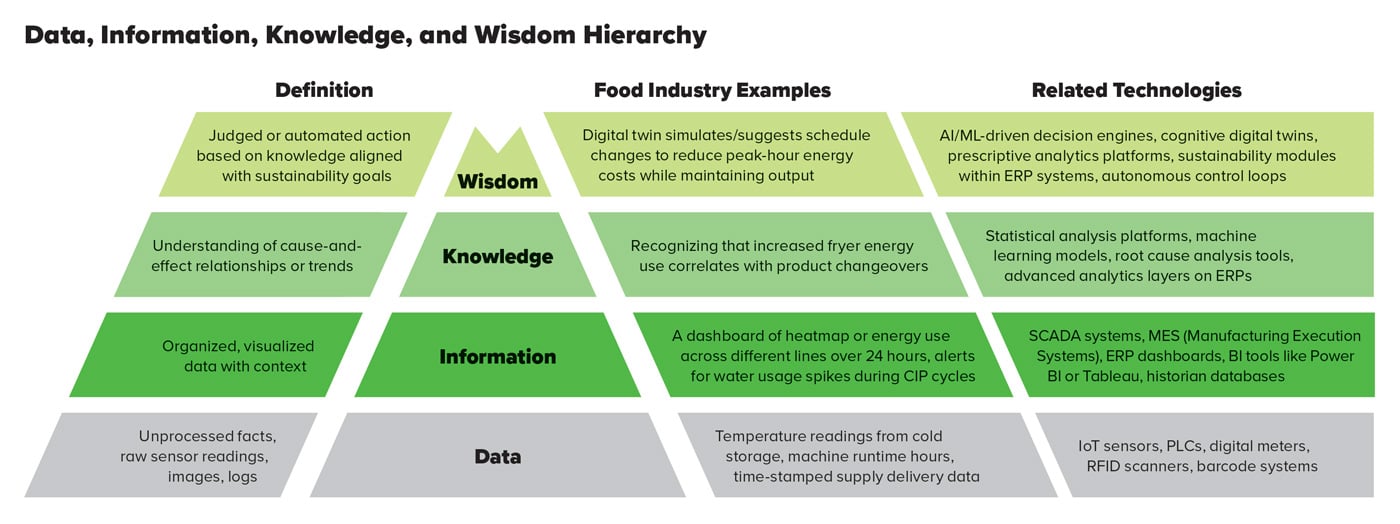
Hence, the turning point comes when data isn’t just collected but connected as a step toward the higher level in a hierarchy of data-information-knowledge, and, ultimately, wisdom as coined by R. L. Ackoff in 1989. This is where digitalization can find its operational need. This hierarchy can be likened to food production: data as raw ingredients, information as sorted and measured inputs, knowledge as the recipe, and wisdom as the formulation that balances ingredient function, flavor, and sustainability.
However, climbing that hierarchy isn’t automatic. As shown in smart manufacturing research by Lobov (2018), transforming data into wisdom requires more than tech; it demands the right combination of models, tools, and approaches. Without this, companies end up with isolated smart features that do not scale or guide meaningful change.
Worse, focusing too early on tools, rather than goals, can lock organizations into rigid systems that struggle with adaptation. For instance, a food processor may deploy IoTs on fryers or refrigeration units to track energy use. This provides useful data, but without interpretation, such as correlating spikes to specific product runs or ambient conditions, it never turns into knowledge. Even when such patterns are understood, true wisdom only emerges when the system recommends or automatically enacts changes, such as scheduling high-energy batches to off-peak hours. Similarly, in packaging lines, machine vision systems might flag anomalies in seal integrity. Recognizing a recurring flaw tied to material variation is knowledge. But wisdom means adjusting procurement parameters or switching material batches before the problem recurs, not just detecting it after the fact.
Transforming data into wisdom requires more than tech; it demands the right combination of models, tools, and approaches.
Wisdom Through Models
Turning data into wisdom includes aligning systems, standards, and decisions toward a common purpose, as well as stacking technology. To get there, digital wisdom must be operationalized. That means ensuring the insights generated from digital tools, like energy dashboards, predictive maintenance systems, or LCA models, can inform real decisions across procurement, production, and product design. In food manufacturing, this increasingly involves modeling and simulation tools that translate raw inputs into actionable strategies. Mechanistic models, grounded in physical laws and domain knowledge, are especially effective for building knowledge; they help explain why systems behave as they do, guiding process optimization with predictable outcomes. Cognitive or data-driven models like machine learning support operational knowledge by detecting trends and forecasting behavior from large, complex datasets, even when mechanisms are poorly understood.
However, wisdom, the ability to make context-aware, adaptive decisions, emerges when these models are combined. Hybrid modeling approaches synthesize structured theory with real-time learning, enabling systems to simulate scenarios, evaluate trade-offs, and recommend actions aligned with broader goals like energy savings and environmental impacts. When combined with mental models, which are intuitive frameworks that experts use to interpret complex systems, mathematical models become essential for equipping decision-makers across all levels with tools combining human judgment and data-driven insight toward operational wisdom.
Humans Own the Loop
And while technology is often the focus, people are the linchpin. The food industry has always been deeply human-centric, relying on the judgment of operators, the foresight of decision-makers, and the influence of consumers. Whether it is fine-tuning the recipe or responding to a shifting consumer demand, people are central at every stage of the system. Sustainable digital transformation depends on a workforce that understands both the systems and the goals. From operators interpreting dashboards to engineers refining algorithms, digital literacy and cross-functional collaboration are critical. Even in highly digitalized industries, the most advanced tools still require human judgment to align technical decisions with environmental goals.
However, meeting this challenge requires more than technical upgrades and training; it requires human upskilling and reskilling. Many in the food sector, from plant floor technicians to quality managers, were never trained in digital tools, sustainability metrics, or systems thinking. Yet, they are the ones expected to operate new platforms, interpret real-time analytics, and make decisions with downstream sustainability impacts.
Developing such a workforce requires tackling a broad set of challenges across technical, managerial, and ethical domains. Plant technicians may need to learn how to integrate data from IoT-enabled chillers into centralized dashboards or how to calibrate machine vision systems for automated quality checks. Engineers working with digital twins might need to simulate packing line changes before committing to physical upgrades, while analysts refine models to forecast demand volatility using historical datasets. On the managerial front, supervisors must learn to implement agile planning cycles, rethinking production schedules around dynamic carbon targets. Companies also face pressure to train staff on how data is handled, or how environmental claims are substantiated.
Hence, workforce development in food science and technology must evolve accordingly. This includes training programs that bridge food science with digital literacy, hands-on exposure to smart systems, and opportunities for continuous learning.
IFT is beginning to map these needs through workshops with experts and cross-sector collaborations. The workforce development will require buy-in not only from IFT but also from its membership—from the food sector to funding agencies.
Sustainability and digitalization are the interdependent drivers of transformation. Achieving one without the other is a loss of opportunity and resources. Without integration, sustainability remains aspirational and digitalization risks becoming an expensive exercise in efficiency without impact. When aligned, they not only optimize but redefine operations.ft
Hero Image: © 1971yes/iStock/Getty Images Plus
Authors
-
Ziynet Boz
Ziynet Boz, PhD, is an assistant professor in the Department of Agricultural and Biological Engineering, University of Florida (ziynetboz@ufl.edu).
Categories
-
Sustainability
-
Artificial Intelligence
-
Novel Technologies
-
Applied Science
-
Food Technology Magazine
-
Food Processing and Technologies


