
Cornell Food Solution Is Easy to Swallow

Food scientists at Cornell University apply novel technologies to product development projects.
It’s estimated that one-third of those aged 65-plus suffer from dysphagia, which is difficulty swallowing, often the result of muscle and nerve damage. People with dysphagia can choke on food and can suffer from malnutrition and dehydration, as well as related issues like depression.
There are food products available for those with dysphagia, but they are mostly liquids or purees, explains Aamir Iqbal, a postdoctoral researcher in the Rizvi Lab at Cornell University’s Department of Food Science. However, such products have drawbacks: They require refrigeration and they get low marks for taste and texture. “The elderly can get nutrition from these products, but taste-wise, they don’t like them,” Iqbal says.
Researchers at the lab set out to solve the problem. They invented a novel way to make a puffed product that is nutritious, tasty, and dissolves quickly in the mouth so those with dysphagia can swallow it easily.
While there are no similar products on the market targeted to older consumers, there are puff snacks for babies. But those are starch-based with a high sugar content. The lab had previously created a puff snack for the toddler and baby market based on milk proteins, making it a healthier product. The key is supercritical fluid extrusion, a process created by the Rizvi Lab.
Using that as a guide for creating a puff for those with dysphagia, the researchers first mixed lactose-hydrolyzed skim milk powder, milk protein concentrate powder, and fresh apple pomace, which had been dried and ground into a powder. Then the Cornell team used supercritical fluid extrusion, using either water or concentrated acid whey during extrusion. The puffs were dried in a hot air convection oven for several hours at 70°C until the moisture content was optimal.
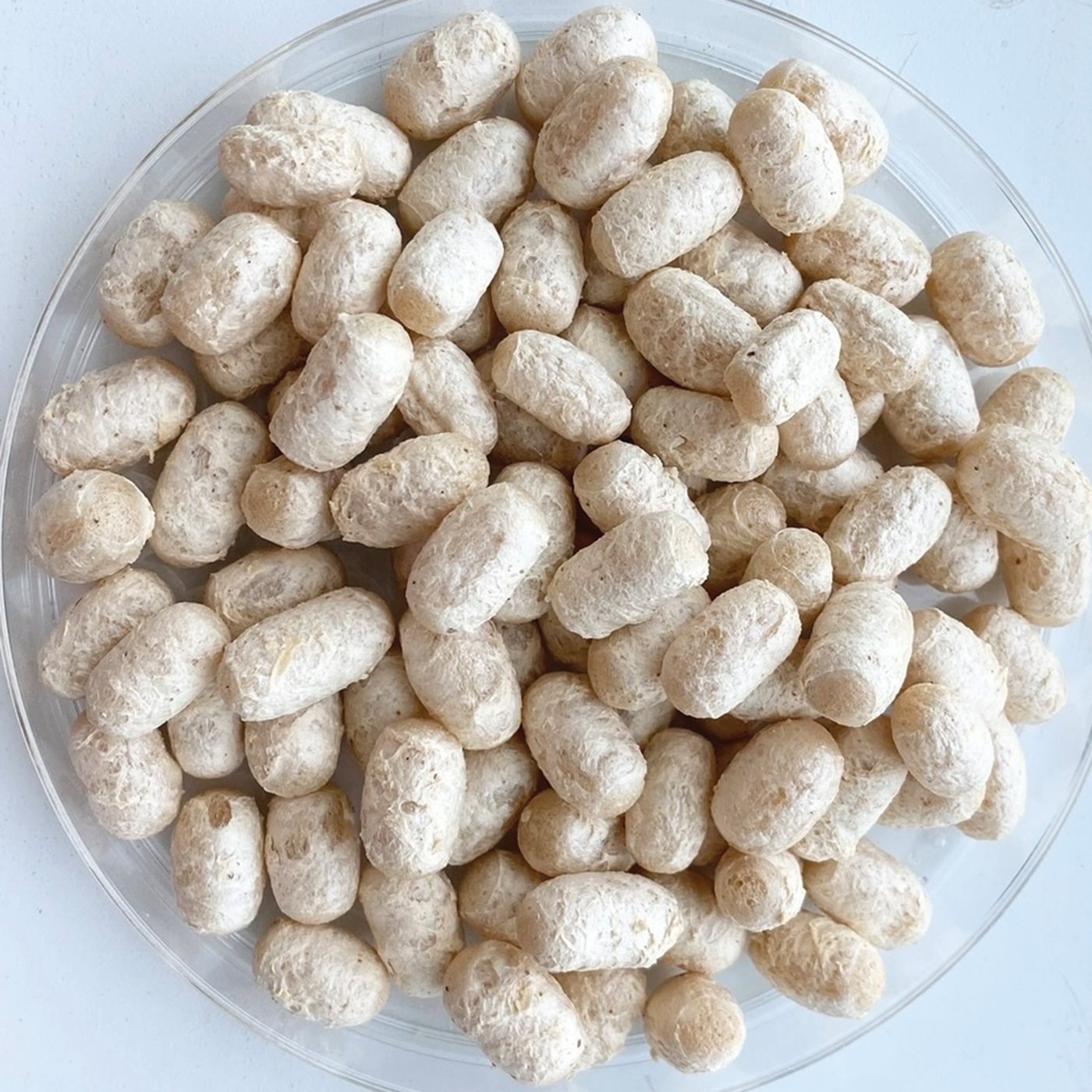
Easy-to-swallow puffs offer a food solution for those suffering from dysphagia. Photo courtesy of Aamir Iqbal
A sensory panel of 91 tasters sampled the puffs, using a commercial baby puff product as a control. The snacks were evaluated for shape, taste, texture, and the way in which they disintegrated in the mouth. The panelists liked the lab’s product better than the commercial product, although they thought the lab-produced puffs weren’t sweet enough. “We were good in all our criteria, except that sugar one,” says Iqbal.
After the sensory testing, the researchers added more sugar to the formulation. They have also created savory versions of the puffs, experimenting with a variety of seasonings.
The puffs have several nutritional advantages. Because they are milk protein–based, they contain 55% protein, and thanks to the fruit pomace, 10% to 15% fiber. Both fruit pomace and whey give the puffs added nutrients, including vitamin C, antioxidants, and magnesium. The supercritical fluid extrusion process creates gut-friendly prebiotic galacto-oligosaccharides, and the lactose-hydrolyzed skim milk powder can be digested by those with lactose intolerance.
And there’s another advantage to this formulation. Fruit pomace and whey are both major waste products from the juice and dairy industries, respectively. Using them in a food product would be a good way to reduce waste and profit from an otherwise mostly unused resource, Iqbal points out.
Existing snack puff products are made with a conventional extrusion process, which uses steam as a blowing agent. But steam would caramelize the sugars in the milk proteins, and destroy their nutrients, explains Iqbal. For that reason, the team opted to make them using supercritical carbon dioxide. Supercritical fluid extrusion uses extrusion technology and supercritical fluids combined to create a new technology, explains Syed Rizvi, professor of food process engineering at Cornell and head of the eponymous Rizvi Lab.
“That has enabled us to make puff products at lower temperature and lower shear,” Rizvi says. “Conventional extrusion technology uses high temperature and high shear to make puff products, and a lot of heat-sensitive ingredients do not survive.”
New Processes and Products
The Rizvi Lab has been innovating new food processes for over a decade. “My lab is dedicated to developing new processes for making novel products,” he says. “Food process engineering is our focus, and we look at new ways of doing things.”
The puffs are just one of a variety of product development efforts underway at the lab. The lab’s areas of focus, apart from supercritical fluid extrusion, include cryogenic freezing and physical and engineering properties of food biomaterials.
Cryogenic freezing is a process the lab has used to make ice cream on demand. Ice cream takes a lot of energy to make and transport—it’s reliant on a cold chain of -20°C from processing through to distribution and storage using refrigerated trucks, which generate a lot of emissions.
Maintaining the safety and creamy consistency of ice cream requires a consistent temperature, but that doesn’t always happen. The smooth texture of ice cream comes from small crystals. But when ice cream melts and is refrozen, larger crystals are formed, and that creates a grainy texture. Additives like gums and other thickeners can address that problem, but that means the ice cream isn’t clean label.
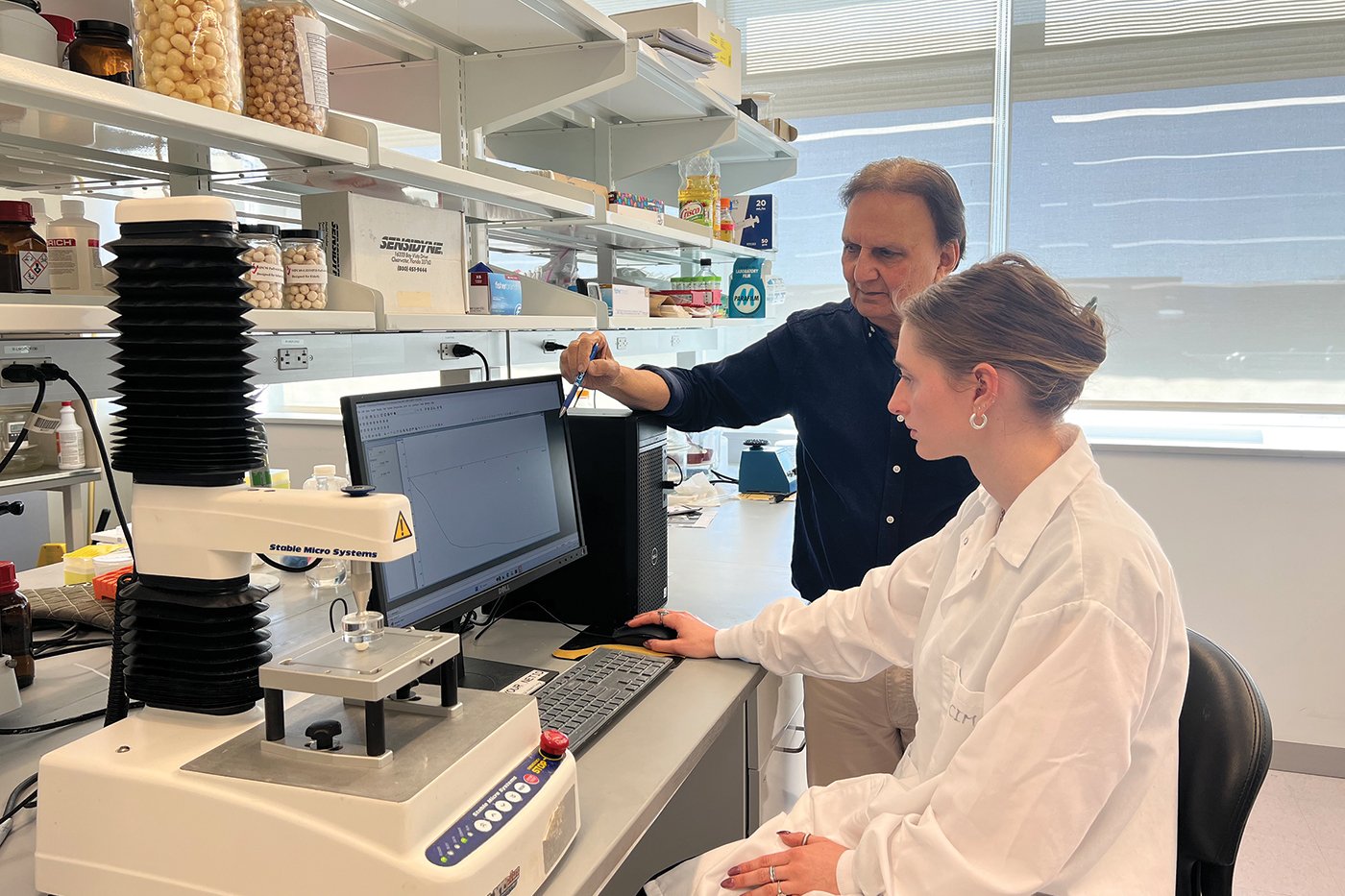
Professor Syed Rizvi, who leads a Cornell University lab focused on developing novel processes for new food products, and PhD student Jessica Uhrin, a researcher in the lab, analyze one of the puffs the lab group created. Photo courtesy of Syed Rizvi
“The process by which it’s made has a lot of moving parts and requires maintenance and requires a refrigeration system,” Rizvi says. “So, our motivation was [this]: Can we make ice cream on demand?”
What they figured out was that when carbon dioxide goes from high pressure to low pressure, it cools down rapidly. The researchers got the carbon dioxide down to -70°C and created a vacuum that sucks in the ice cream mix. When combined with the carbon dioxide, it immediately makes ice cream.
“We can make a scoop of ice cream in like three seconds,” Rizvi says. And, he adds, because “quality is a function of the rate of freezing, it happens so fast that our texture is very, very smooth.”
Rizvi envisions this process being most useful in warmer countries and places that don’t have cold chain infrastructure. Compare ice cream consumption in the United States where, he says, an individual eats about 14 liters a year to the 1 liter per capita consumption in India, which doesn’t have an efficient cold chain.
The Cornell researchers are also working on using liposomes in food products as a way to deliver bioactive compounds. Liposomes are used frequently in biomedical and pharmaceutical applications but less so in food because heating them up causes the phospholipids inside them to break down. But milk fat phospholipids don’t break down; they can be heated to 121°C and maintain their structures.
So, Rizvi Lab scientists took the phospholipids found in buttermilk and made a stable liposome that can be heated to 90°C for up to 30 minutes without degrading. That could create a new type of bioactive product that can deliver nutrients. “This has opened up a new possibility of liposomal-based delivery via food,” says Rizvi.
The products and processes the Rizvi Lab has developed have found favor with the food industry. Adapting existing extrusion processes to make the nutritional puffs, for example, isn’t difficult to do, Rizvi says, and there’s interest from food companies in commercializing the product.
Although the lab has innovated a variety of novel ideas over the years, there’s one commonality that defines the work: “We had to think differently,” says Rizvi.ft
Authors
-
Danielle Beurteaux Journalist
Danielle Beurteaux is a journalist who writes about science, technology, and food.
Categories
-
Food Categories
-
Research
-
Novel Technologies
-
Baby Foods
-
Extrusion
-
Food Technology Magazine
-
Frozen Foods
-
Refrigerated Foods
-
Food Processing and Technologies


