
How To Manage Food Allergens

-
Allergen Control
Understand the food manufacturer’s responsibility to manage and control the Big Nine food allergens.
-
Allergen Labeling
Gain insight into food allergen labeling and management to ensure food safety.
-
Cross-Contact Prevention
Get tips on how to develop, document, implement, and maintain programs to prevent cross-contact between allergen-containing and non-allergen foods.
Food allergens are a significant food safety hazard. For the many people who are allergic to a food, the only thing that they can do to protect themselves is to avoid the food in question. People with a food allergy must therefore rely on the food manufacturer to do two things:
- Properly label the food so that the person with an allergy can avoid that product.
- Develop, document, implement, and maintain in-plant programs to prevent cross-contact between foods or ingredients containing allergens and those that do not.
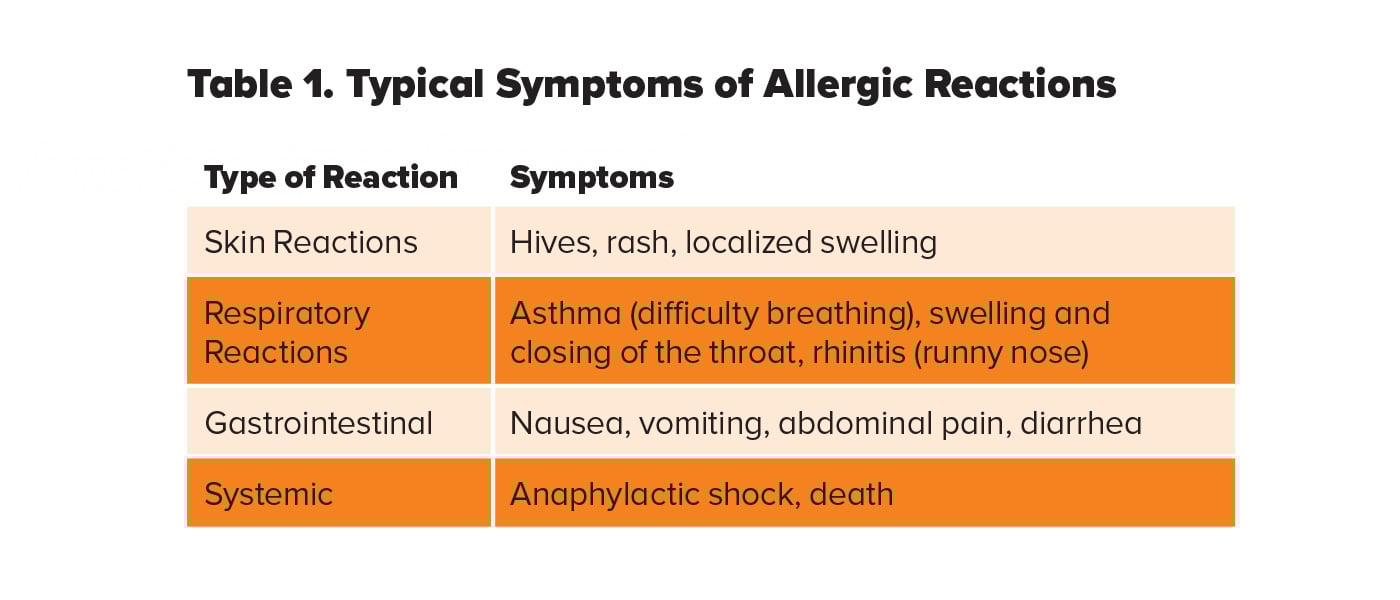
It is now a little over 20 years since the U.S. Food and Drug Administration (FDA) enacted the Food Allergen Labeling and Consumer Protection Act of 2004 (FALCP). The regulation was enacted to protect the approximate 2%–3% of the population who are allergic to certain foods. The allergic reaction is an immunological reaction to proteins that can manifest itself in different ways as summarized in Table 1. The FALCP mandated labeling of eight foods that cause 90% of the allergic reactions. These allergens, known initially as the Big Eight, are milk, soy, fish, crustacean shellfish, wheat, eggs, tree nuts, and peanuts. Sesame was recently added to the list, so it’s called the Big Nine (FDA 2025).
Allergen Labeling
Allergen labeling and management is now a global issue when it comes to ensuring food safety. The European Union has identified 14 allergens. These include the Big Nine plus sulfites, molluscan shellfish, lupine, mustard, and celery. If you are interested in how allergens are identified and addressed in other places around the world, check out the Food Allergy Research and Resource Program (FARRP) website where you will find the Food Allergens International Regulatory Chart (FARRP 2025).
In reality, there are well over 160 foods that have been found to elicit allergic reactions, some rather unexpected. As an example, the author has two friends who are allergic to strawberries. The efficacy of the regulation, however, depends on one thing: people who know that they have a food allergy must read the label.
The regulation mandates that the allergen’s food source must be declared at least once on the food label in one of two ways. As detailed in the regulation, the name of the food source of a major food allergen must appear either 1) in parentheses following the name of the ingredient (examples: “lecithin [soy],” “flour [wheat],” and “whey [milk]”), or 2) immediately after or next to the list of ingredients in a “contains” statement (example: “contains wheat, milk, and soy”).
The goal is to ensure that the food label clearly identifies that allergen or allergens in question. As an example, a product that simply includes the listing whey, could well be interpreted as a milk-free food, but whey is a milk-based ingredient, so the label should mirror the examples shown above. Therefore, food processors must develop, document, implement, and maintain programs to ensure that food labels are not only accurate and up to date but that the food being processed and packaged is packaged in the proper container.
Each company must ensure that their labels meet all government labeling requirements. This work may be done internally or with an outside expert in packaging and labeling requirements. Master labels must be verified for accuracy and reviewed for legal compliance and accuracy. In other words, if the food contains an allergen, is it on the label? The master then goes to the printer who prints labels, rollstock, or whatever form the label takes. Whenever a new lot of labels is received by the processor, a program should be established to evaluate the new lot to ensure its accuracy and compliance using the master as a reference.
The labels are now ready to use, and it is up to the production staff to ensure the correct label goes on the food. There are occasional errors made as the labels used by a company often are very similar in design. There are different tools to aid the processor when it comes to proper labeling. These tools include scanners to verify the labels being used, software programs to ensure the correct labels are delivered and utilized, and others. After several mislabeling issues, one food processor installed a scanning system that scanned both the label and the can code. If they did not match, the production line was immediately stopped. One commonly used program mandates that the production staff collect a label at set intervals throughout a production run and append them to the production records to show compliance. The date and time the label was collected are noted on the label itself so there is a record that demonstrates that the proper label was used throughout the run.
Allergen labeling and management is now a global issue when it comes to ensuring food safety.
Managing Risk
One element of many food labels addressing allergens is what is known as a “May Contain” statement. There are many different iterations of this statement, but it is basically a warning to sensitive consumers that the product may have been exposed to other allergens. For example, a product containing peanuts may be manufactured in a facility that processes and packages other tree nuts and perhaps some flavored products that contain other allergens such as dairy and soy. The peanut product will have a label containing a statement that reads something like: “Produced in a facility that processes walnuts, almonds, pistachios, pecans, soy, and milk.” Ideally, there should be no cross-contact between the other allergens, but it could happen. There are companies that conduct extensive risk assessments on operations and sparingly employ a May Contain statement. One concern is that companies may not be as diligent as they should be and utilize the statement as a cover.
There are labeling failures, however. Products do make it out into distribution without the proper label. Processors may not have vetted a lot of new labels, may have simply applied the wrong label, or may have used an old lot. With regard to the latter issue, food processors should establish a program to ensure that old labels are destroyed whenever they become obsolete.
But what happens with restaurants and foodservice establishments when it comes to allergen labeling? This is very “hit or miss” in the United States. Supermarkets that sell prepared entrées often identify the allergens in the offering, but it is not common practice in restaurants. It is a different story in the European Union, however. Restaurants there usually include a listing of their 14 regulated allergens and either a letter and/or color to identify the allergen. Different entrées, appetizers, and desserts are listed with the letter or color informing the customer what allergens are in that item. This is an excellent practice and should be adopted around the world. However, cross-contact concerns may be present in the preparation areas or kitchen.
Preventing Cross-Contact
Food processors whose products contain food allergens must develop, document, implement, and maintain programs to prevent cross-contact between foods with no allergens and foods or ingredients that contain allergens. There are several programs that should be included as essential elements of a food safety management system. These include, but need not be limited to, vendor selection and quality programs, receiving, storage, sanitary design of equipment and the physical plant, validated cleaning protocols, proper identification of materials and work-in-process, production scheduling, dedicated utensils, research and development, and employee education.
The scope of this article will not allow all these issues to be addressed, but we can look at a few. Each of these programs would be deemed preventive controls according to the Food Safety Modernization Act and 21 CFR Part 117, Current Good Manufacturing Practice, Hazard Analysis, and Risk Based Preventive Controls for Human Food.
Purchasing/Vendor Selection and Quality. Food processors must develop a program to select, approve, and maintain relationships with their vendors. The selection and approval process should include whether the company produces foods that contain allergens and how they are managed. Every facility that supplies ingredients should be subject to the vendor approval program. If working with a large company that produces ingredients at multiple locations, each venue should be approved, or the contract must mandate that they be supplied only by approved facilities.
Failure to follow these basic rules can lead to problems. For example, one processor decided that they did not need to approve suppliers who sold them less than $5,000 per year of ingredients. Guess which facility ended up being the cause of a multimillion-dollar recall? Another plant was provided with ingredients by an approved supplier who had multiple plants producing that material. They were supplied with materials from an unapproved plant and had to initiate a recall.
Receiving. Processors must also implement programs for receiving raw materials, ingredients, and packaging. We have already alluded to the importance of ensuring that packaging is evaluated upon receipt. Companies must also ensure that required certificates of analysis are provided and that the paperwork indicates that the materials being delivered not only match the bill of lading but also come from an approved facility. The second example alluded to above should never have happened if the receiving crew had confirmed the source of the ingredient.
The receiving crew may also be responsible for ensuring all materials containing allergens are flagged with an allergen tag and properly stored in designated areas in the warehouse where they will not pose a cross-contact risk. Never store an ingredient or other material that contains allergens above other materials. Any spills should be cleaned immediately to minimize the potential for cross-contact.
Validated Cleaning Programs. Processors that produce foods with allergens should establish cleaning programs that remove any allergic residue. Cleaning should ensure that the equipment is not only visibly clean but quantifiably clean; that is, the units may be verified as clean by testing. When developing cleaning programs for allergens, this means that the equipment is clean using total protein tests, enzyme-linked immunoassay (ELISA) tests for allergens, adenosine triphosphate tests, or lateral flow testing. The preferred testing method is ELISA tests for specific allergens. If there are questions about what test to use, work with outside experts or the test manufacturer.
When conducting validation tests, the operator should run the tests on at least two, and preferably three, production runs. There should be no positives. And, when doing validation runs, swab or test hard-to-reach areas. If testing a filling machine used for beverages, each filler head should be swabbed, which may be a great deal of work since some fillers may have up to 48 heads. Once the program has been validated, it is up to the processor to utilize that same procedure for cleaning. Records verifying that the validated procedure was employed must be maintained. It is also a good idea to redo validation trials on a yearly basis.
Production Scheduling. Processors manufacturing products that contain allergens must manage production to minimize the potential for cross-contact and for maximum efficiencies. Maximum efficiency means scheduling production runs that minimize the frequency of full-blown allergen cleanups. Processors manufacturing organic products schedule these items at the start of a run and process nonorganic items only after the organic products have finished. The same basic principle applies for allergen scheduling. A product that contains no allergens should be run first, followed by products with a single allergen such as soy, and then moving onto a product that might contain soy and milk.ft
Hero Image: © fcafotodigital/iStock/Getty Images Plus
Authors
-
Richard Stier Food Scientist
Richard F. Stier is a consulting food scientist with international experience in food safety (HACCP), food plant sanitation, quality systems, process optimization, GMP compliance, and food microbiology (rickstier4@aol.com).
Categories
-
Food Safety and Defense
-
Applied Science
-
Allergens
-
Food Technology Magazine
-
Food Processing and Technologies
-
Instrumentation
-
Process Control


