
Employees Prioritize Work/Life Balance and Flexibility
Food science professionals are rethinking what matters most in a job—beyond compensation alone.

 Mary Ellen Kuhn
Food Technology Magazine
“Money isn’t everything,” conventional wisdom holds—and food science professionals appear to agree.
Work/life balance topped the list of workplace priorities in the 2026 IFT Compensation and Career Path Survey, outranking compensation, which fell to No. 6. In IFT’s 2024 research, compensation/benefits headed the list, and work/life balance came at No. 3.
Work/life balance has shifted from a “nice to have,” to a decisive factor for job seekers, noted Laurie Hyllberg, vice president at food and beverage recruitment firm Kinsa Group, in a recent blog. Its importance is expected to grow as younger generations make up a larger share of the workforce.
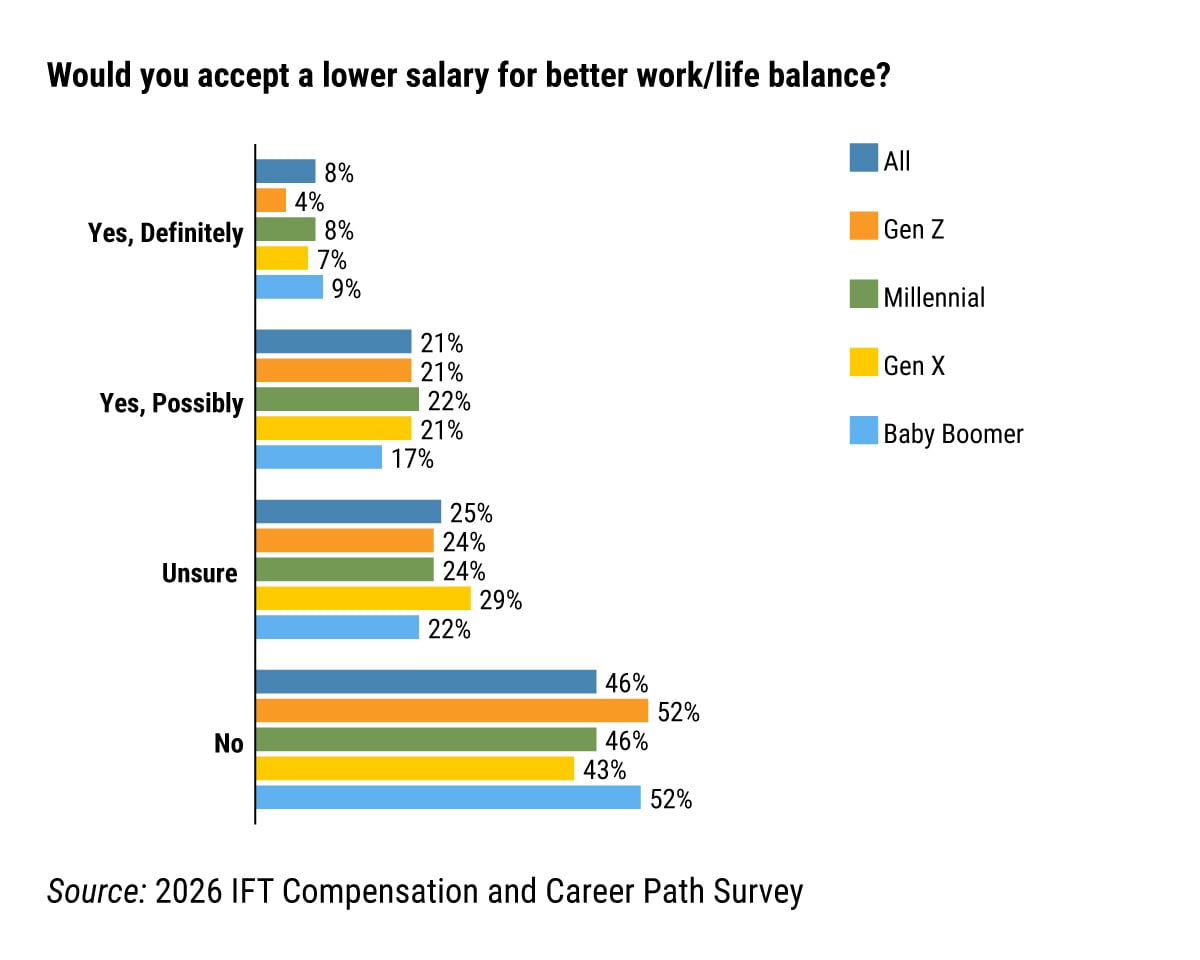
Money still matters, of course. Just 8% of respondents said they would accept a lower salary in exchange for better work/life balance, while nearly half (46%) said they would not. Gen Z and baby boomers were the most likely to reject a pay cut.
Figure 1.
The Remote Divide
Across generations, employees continue to value remote and hybrid work options. This year’s survey showed some directional shifts: The share of U.S.-based respondents with telecommuting options dropped to 61%, down from 65% two years ago. Yet, those who do have remote arrangements are working from home more frequently—an average of 2.3 days per week, up from 2.1 in 2024.
Remote work or hybrid schedules aren’t always feasible, particularly in manufacturing or laboratory environments, but employers are building flexibility in where it’s possible to do so, recruiters say.
“There's a big push that I'm seeing in industry to bring people back to work with fewer remote [options], but there has been more of an increase in flexibility,” says recruiter Hunter Prater. “So, let's say, oh, hey, your kid's sick and you need to stay home. That's fine. … But I'm seeing less desire on the business side to hire people in a remote or hybrid capacity and more of a desire to hire somebody who's going to be there on-site at the facility."
The tension is clear: “The talent wants to work remote, so there’s a tug of war going on there,” he adds.
Employers who adopt flexible work policies will have a hiring advantage, says Hyllberg. She points out that flexibility isn’t a one-size-fits-all proposition for employers whose roles span everything from the production floor to the executive suite.
“Flexibility in food and beverage doesn’t default to remote work,” she wrote in a recent blog. “It shows up in predictable schedules for plant employees, compressed workweeks for operations roles, hybrid arrangements for corporate and sales positions, and schedule autonomy for R&D or quality functions.
“The form it takes matters less than whether it’s real, consistent, and matched to the role,” she summarized.
Hero Image: © Maca and Naca/E+/Getty Images
Authors
-
Mary Ellen Kuhn Executive Editor
Mary Ellen Kuhn is executive editor of Food Technology magazine and director of content and creative services at the Institute of Food Technologists (mkuhn@ift.org).
Categories
-
Food Sciences
-
Food Technology Magazine
-
Issues and Insights


