
Challenges Spark Solutions at IFT FIRST

 Kelly Hensel
Food Technology Magazine

While the experts presenting at IFT FIRST spoke on a variety of topics and hailed from diverse environments—academia, regulatory, startups, and large corporate entities—the discussions often centered around common challenges and revealed the need for innovative solutions.
Supply Chain Woes
One of the largest hurdles currently facing the food industry is the stressed supply chain, which came into the limelight because of the COVID-19 pandemic. However, many experts believe the issues we now face with ingredient shortages and transportation interruptions were a long time in the making. “We see little things start to happen, and the first domino fell and caused a cascade of events that has really put us in a bad situation,” said panelist Gary Iles, senior vice president of marketing and business development for TraceGains, during a Business FIRST session focused on supply chain challenges that took place at the IFT FIRST Annual Event & Expo.

Walt Whitman and the Soul Children of Chicago choral group helped get IFT FIRST off to a powerful start.
Also speaking on the panel, Jeff Grogg, managing director of JPG Resources, hoped that the solutions to meeting the supply chain disturbances won’t require returning to a “transactional” business structure. Instead, Grogg would like to see solutions that create a more “robust and interconnected ecosystem.” To get there, “a more rapid integration between all phases of the supply chain is going to be an important part of the solution,” stressed panelist David Godfrey-Thomas, president and CEO of Afina International.
Food Safety Risks
Hiccups in the supply chain not only result in headaches for consumers in the grocery store but can also increase food safety risks for manufacturers. “Risk management from a food safety perspective needs to be much more connected in this day and age with the supply chain challenges that we are seeing,” said Sean Leighton, Cargill’s global vice president of food safety, quality, and regulatory affairs. Speaking on a panel of food safety experts in the featured session “Recalls, Outbreak Response: The Current Food Safety Landscape,” Leighton noted that food safety risk assessment, management, and communication by themselves are no longer enough.
“A piece of paper like a third-party audit or a certification or documentation sent from a supplier is not going to be enough to identify and protect high-risk ingredients,” agreed fellow panelist Stacey Popham, vice president of quality, food safety, and regulatory, Americas, at Barry Callebaut. “You need to be in the factories—yours and [your] suppliers.’ It is the boots on the ground that identify and stop the issues.”
One of the food safety challenges that can arise without proper risk management is food fraud. “Fraud is enabled in chaos,” said Tim Lombardo, senior director for EAS Consulting Group, during an IFT FIRST multi-session conversation about emerging areas of food fraud. “We look at the last several years of this pandemic and now the supply chain shortages, and out of this chaos comes fraud.”
The panelists explained that fraud often occurs when an ingredient is substituted or added without disclosing the information to the manufacturer or consumer. While tests exist to detect adulterants, John Szpylka, chemistry R&D manager at Food Safety Net Services, explained that food safety professionals can only detect those that they know about. “So, we in the analytical world are playing catch-up with the fraudsters,” he said.
In order to protect against food fraud, the panelists suggested that manufacturers and ingredient suppliers know the entire supply chain. “Having a vulnerability assessment that is more than just looking at the ingredient but looking at the entire process and the logistics that it takes to get that ingredient is important,” said Lombardo.
In an environment that requires manufacturers to shift their sourcing with little warning due to supply chain shortages, it becomes that much more difficult—and, at the same time, much more vital—to keep a close eye on every step.
Cultivating Consumer Acceptance

Food professionals gathered outside of McCormick Place in Chicago for the annual Fun Run + Fitness event, raising money for student scholarships.
Stories of food fraud contribute to an erosion in consumer trust in the food system. This distrust has long been present in the debate around processed foods (see Processed Foods Debate sidebar on this page) and extends today to products like cultured meat, which are created using novel technologies. Even before the days of GMOs, consumers had a tendency to prefer “natural” products, so cultivating and maintaining consumer acceptance continues to be a challenge for the food industry.
“Research shows that people have a very deeply held belief that ‘natural’ is morally better; even if something natural is chemically identical to something genetically modified, people prefer natural,” said Sydney Scott, assistant professor of marketing at Washington University in St. Louis, in the featured session “Consumer Acceptance as Barrier and Opportunity for Novel Food Technology.”
“Because people think it’s wrong to tamper with the natural way of doing things, food companies have to recognize that consumer acceptance is a moral issue,” continued Scott. “We need to have a moral conversation and talk about moral responsibility and consequences.”
For example, instead of focusing on how cell-cultivated foods are genetically identical to their natural counterparts, Scott advised that companies should stress how the products avoid harmful environmental, labor, and animal treatment practices of conventional meat production.
“We have to do our part to educate consumers about these new products, but food is cultural, emotional, and experiential,” said fellow panelist Andrew Moyes, head of global communications and public affairs at GOOD Meat, a company that already is serving cell-based chicken in Singapore.
And while greater transparency in the food industry continues to be vital, experts across multiple sessions stressed the importance of not just dumping information on consumers, but instead, carefully considering what form the information takes and who presents it.
“You cannot lead with facts when it comes to pretty much anything these days. There’s so much distrust,” said Tia Rains, vice president of customer engagement & strategic development at Ajinomoto Health & Nutrition North America. Her presentation, “What to Do When People Believe Misinformation,” is available on-demand for registered attendees. Rains shared these thoughts during an IFT FIRST multi-session conversation with fellow presenters and attendees. “You have to lead with something that’s emotional,” she advised.
David Lundahl, CEO of InsightsNow, a behavioral research firm, agreed with Rains. “People don’t need more information,” he said. “They need stories. That’s where the emotional connection is.”
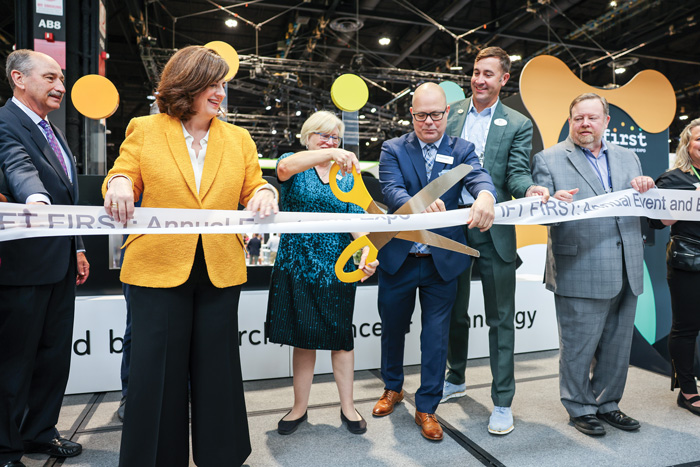
IFT President Vickie Kloeris cuts the ribbon at the ceremony to open the IFT FIRST food expo.
Seeking Solutions
As is the case with each annual event and expo, the goal of IFT FIRST was not only to facilitate engaging conversations about pressing challenges facing the science of food, but to accelerate the development of innovative solutions. The featured session “Cultivating Curiosity: The Key to Unlocking Innovative Solutions to Complex Problems” and the Innovation Lab that followed challenged attendees to approach problem-solving from a different angle.
“Businesses are great at articulating business problems such as falling revenues,” said featured session keynoter Evette Cordy, CEO of Agents of Spring. “But what is the customer problem you are trying to solve? This is why we must first learn to problem-find before we problem-solve, and curiosity is the tool we can use to solve our most [challenging] problems.”
Whether the challenge is food security, the obesity epidemic, the sustainability of the food system, or even developing food with a long shelf life for a mission to Mars, “these challenges are complex, and their solutions are not straightforward,” said Gulden Yilmaz, director of the Health and Safe Food Systems Program at Wageningen University & Research, in the featured session “The Role of Food Science in Global Food and Nutrition Security.”
And professionals in the science of food have a major role to play in pushing the boundaries of food development, said Dorit Donoviel, executive director at the Translational Research Institute for Space Health and moderator for a keynote session that featured NASA space travel experts. “We’re looking to you,” she said. “We’re here to ask you to please engage and help us solve these problems.”
Equinom Makes the Winning Pitch
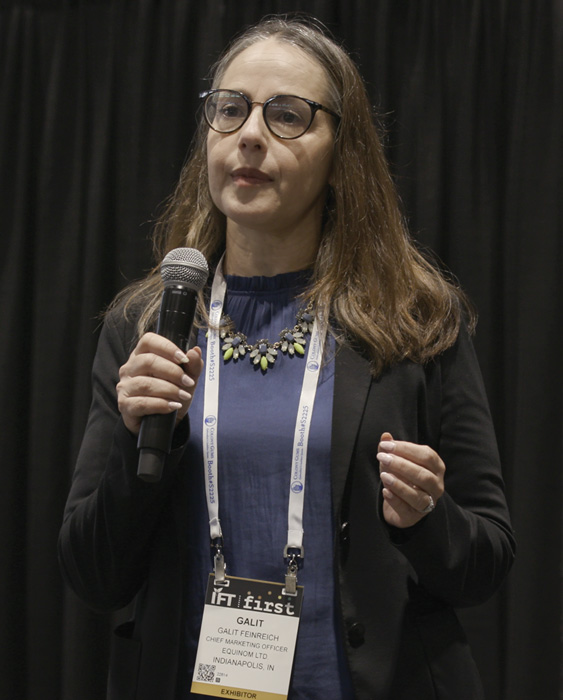
Seed development and plant-based ingredient supplier Equinom bested 25 other startups in a pitch competition at IFT FIRST, earning the title Best Startup of IFT FIRST 2022.
The products and services presented for the audience ranged from fermented grain flour to a sports nutrition product targeted to women to an anaerobic food digester. Following the 60-second pitch presentations, which took place on the final day of IFT FIRST, audience members voted via an online poll for the company they believed had the best pitch and represented the best startup.
Founded in 2012, Equinom supplies plant-based ingredients to a variety of manufacturers, with nutrition built into the seeds of the ingredient. Because the seeds are bred for food uses, the crop doesn’t need additional heavy processing.
“We are partnering with ingredient processors and suppliers to cultivate better food from the ground up,” said Chief Marketing Officer Galit Feinreich (pictured). “We’re able to use our technology to understand the genomics of a seed and which parts relate to the various traits that we’re looking for.”
The ingredients Equinom supplies using its Manna database platform include yellow peas, soybeans, and sesame seeds. The Manna platform employs artificial intelligence to produce high-yield, non-GMO ingredients in half the time of traditional crop cycles.
Equinom already has partnered with companies such as Meatless Farms, GoodMills Group, and Sabra to help develop high-quality, plant-based products, and hopes to continue to grow and develop more partnerships to keep the plant-based revolution going.
“Food is only as good as its source ingredients,” Feinreich said. “I’m so excited to help make sure that the ingredients we’re using to feed our families and people all over the world are ones that were very intentionally bred to be nutrient dense, to make food more delicious, and to help the plant-based movement continue its momentum.”
The Pitch competition took place adjacent to the IFT FIRST Startup Pavilion, which included 48 exhibitors, prominently featuring startups in the food technology space. The Pitch was sponsored by Catapult Commercialization Services, the Upcycled Food Association, and Schreiber Foods.
As The Pitch winner, Equinom will receive a six-month trial group membership with IFT. Feinreich says she is looking forward to the collaboration that IFT membership will bring.
Emily Little is associate editor of Food Technology (elittle@ift.org) Debating the Merits of Processed Foods
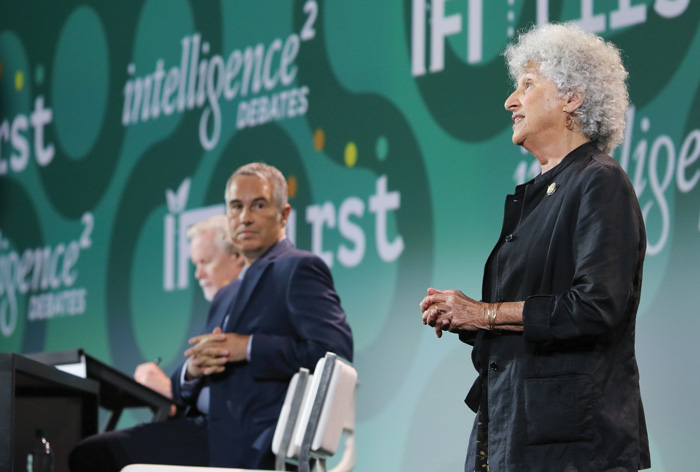
IFT FIRST kicked off with a riveting keynote debate around the topic of processed foods. The question: Should we eat more processed foods? Organized by IFT and Intelligence Squared, a media company that conducts live debates, the session featured industry experts who made the case for or against processed foods.
On the pro-processed foods side, Amy Webb, CEO of Future Today Institute, and Michael Gibney, emeritus professor of Food and Health at University College Dublin, presented an argument that as climate change, political upheavals, and supply chain woes escalate, the world will need more processed foods to ensure a safe and accessible food supply.
Arguing that society needs to eat less processed food due to the increasing rates of obesity and related health ailments and the link of those issues to consumption of highly processed foods was Marion Nestle (pictured, right), Paulette Goddard professor of Nutrition, Food Studies and Public Health, Emerita, at New York University, and Kevin Hall (pictured, left), senior investigator at the National Institute of Diabetes & Digestive & Kidney Diseases at National Institutes of Health.
Arguments on both sides centered around the NOVA classification system, which categorizes all foods into four groups according to their level of industrial processing—from unprocessed or minimally processed to ultra-processed. The system itself has been hotly debated in the industry and that undercurrent of contention was present throughout the debate.
Prior to the debate, attendees were asked to submit their response to the debate question: “Should we eat more processed foods?” At the conclusion of the debate the audience was polled again to see if opinions had shifted. While the same percentage (52%) of the audience responded “yes” both before and after the session, the number of “nos” went from 28% to 33%, with the remainder voting undecided.
Debate moderator John Donvan, author and correspondent at ABC News, may have said it best at the end of the debate, summarizing that the pro side seemed to be arguing for more “good processed foods” while the con side seemed to be pushing for less “bad processed foods.” Perhaps the two sides of the processed food debate aren’t that far apart after all.
More IFT FIRST Coverage
Top 5 Trends in Flavors and Ingredients
And the 2022 Student Competition Winners Are…
Kudos to the IFT Division Competition Winners
Register now for online access to IFT FIRST on-demand content
Authors
-
Kelly Hensel Deputy Managing Editor
Kelly Hensel, deputy managing editor, print and digital, leads Food Technology’s digital strategy and web-first publishing initiatives.
Categories
-
Food Business Trends
-
Consumer and Marketplace Trends
-
Food Safety and Defense
-
Food Fraud
-
Supply Chain Management
-
Professional Development
-
Food Technology Magazine


