
IFT Looks to the Future at FIRST

 Mary Ellen Kuhn
Food Technology Magazine
Insight. Innovation. Inspiration. Ideation. IFT FIRST: Annual Event & Expo delivered all of that this summer when more than 16,000 members of the science of food community gathered in Chicago for IFT’s annual scientific conference and food exposition.
This year’s event challenged attendees to think deeply and creatively with sessions built around the theme, “Innovation in a Time of Crisis: Can We Future-Proof the Food System?” Keynoter Duncan Wardle, former head of innovation and creativity at Disney, helped get the creative juices flowing with a high-energy presentation titled “Embedding Innovation Into Everyone’s DNA.”
Our educational system can be a creativity killer, Wardle pointed out, noting that one of the first lessons kids are taught is “to color in-between the lines.” And at work, it can be easy to focus on the challenges that making a change presents rather than the opportunities a new idea creates.
“Don’t let ‘no, because’ be the first words out of your mouth” when a team member presents a new idea, Wardle said. Instead, he urged leaders and workplace colleagues to respond with “yes, and,” thus encouraging idea generators to build and expand on their creative impulses. “Don’t be the Eeyore in the room,” he said, referencing the pessimistic fictional character in Winne-the-Pooh books.
We don’t get our best ideas at work, Wardle continued, because most employees are too busy with the routine requirements of the job to devote any time to creative thinking. “’I don’t have time to think’ is the No. 1 barrier to innovation,” he observed.
Wardle’s recommendations for fostering innovation include the following:
• Get playful. Creating an atmosphere of playfulness in the workplace is critical to creative thinking, he said, noting that people tend to be at their most creative when they’re away from work and relaxing or doing something enjoyable.
• Build a diverse team. “Diversity is innovation,” said Wardle. “If someone doesn’t look like you, they don’t think like you.” It’s a mistake to rely on the same-old experts, he noted, citing the value of tapping into the wisdom of someone who isn’t part of the established culture, someone he described as a “naive expert.”
• Think differently about challenges. To do that, said Wardle, first write down the rules of the challenge you’re facing and then ask yourself how you might approach it if the rules no longer applied.
• Be brave. “The opposite of bravery is not cowardice. It’s conformity,” he emphasized in conclusion.
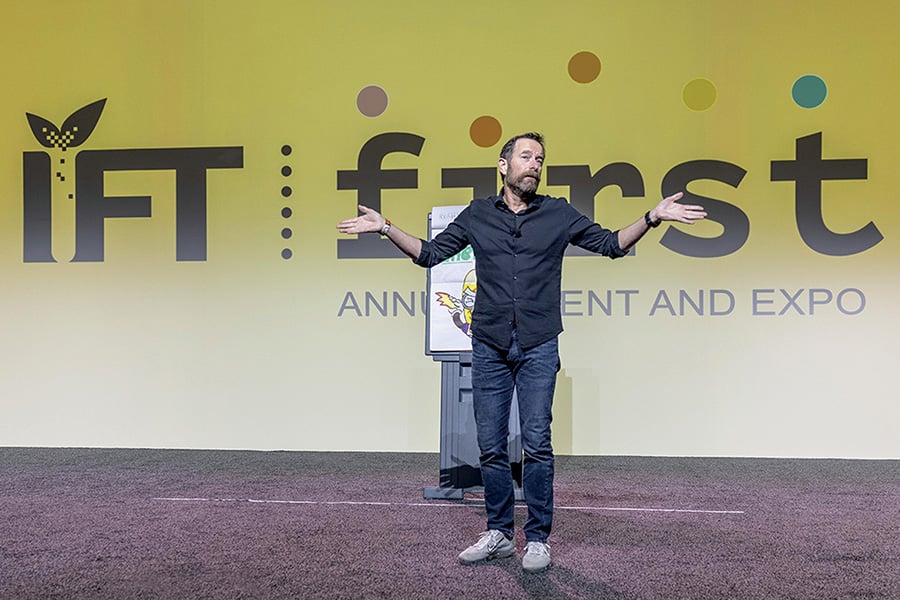
Keynoter Duncan Wardle encouraged IFT FIRST attendees to break out of their comfort zones and think more creatively.
The scope of the educational, networking, and Food Expo exhibits at IFT FIRST make it impossible to fully cover the event here, but some highlights follow.
• More Options for Learning. Two additional keynotes and five featured sessions kept the focus on big-picture themes ranging from food waste to the impact of crisis on consumer behavior.
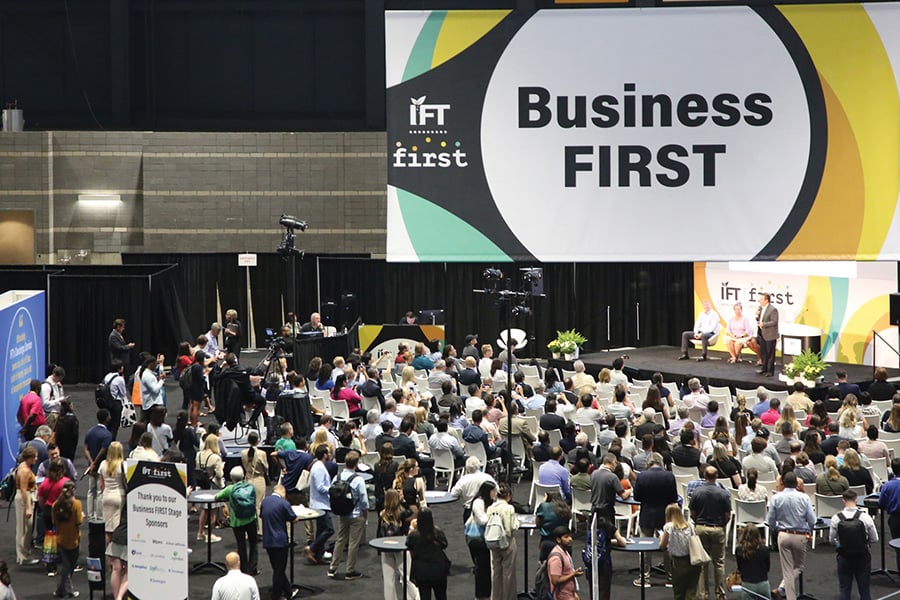
The Business FIRST stage brought together panelists and presenters who focused on topics related to the intersection of science and business.
In addition to the featured sessions, 25 carefully curated Scientific & Technical Forums allowed attendees to engage with subject matter experts on topics ranging from sensory and consumer research mistakes to cost-saving new technologies for product developers. These multidisciplinary discussions were organized around five focus areas: novel technology and innovation, sustainability and climate, health and nutrition, food safety, and consumer insights and education.
• Expo Exploration. In the FIRST Food Expo hall, more than 1,000 exhibitors showcased the latest ingredients, products, and technologies, with exhibits that sprawled across 213,700 net square feet of floor space. Hundreds of product samples and food and beverage prototypes ranging from savory snacks to sweet treats introduced attendees to new taste sensations and product concepts.
Market intelligence partners Innova Market Insights, Mintel, and SPINS kept event participants engaged with daily presentations on industry trends.
• Talking Business. With four provocative panel discussions curated and moderated by Food Technology editors, Business FIRST was back this year. Panelists talked regenerative agriculture, disruptive technologies, supply chain, and product development.
In addition to the panel discussions, the Business FIRST stage was home to 10 sponsored presentations by food expo exhibitors who addressed industry issues and shared solutions on topics ranging from plant proteins to shelf-life extension, among many others.
• Celebrating Startups. Entrepreneurial innovation was on display in the bustling Startup Pavilion on the Food Expo floor. It was home to 86 exhibitors from 14 countries who shared information on products ranging from cell-cultured seafood to upcycled ingredients.
• Research in the Spotlight. Research is at the heart of scientific innovation, and IFT FIRST provided access to lots of it, including more than 400 poster and research showcase presentations by students, faculty, and industry scientists.
• Running for Fun—and Fundraising. The Feeding Tomorrow Fun Run + Fitness Fundraiser, a 5K run, one-mile walk, and outdoor yoga session, is a cherished tradition for fitness-oriented early risers. This year’s event drew more than 250 participants and raised more than $70,000 to fund student scholarships.
• Fireside Chats. These 20-minute sessions on the expo floor delivered a quick infusion of information in an informal setting with discussions focused on topics including intellectual property, sustainable food products, artificial intelligence, and much more.
• Immersive Ideation. One of the FIRST highlights was the Innovation Lab, which took place on the final day of the event. More than 900 Innovation Lab visitors participated in immersive product development journeys, which offered prompts to help them develop product concepts for specific target consumers. Participants reported that it was a productive and enjoyable experience, and many said they are already looking forward to discovering what’s planned for next year’s Innovation Lab activities.
• Making Connections. FIRST organizers built ample time for networking into the event schedule. Opportunities for interacting included topic-focused morning meetups and hour-long daily networking sessions, many sponsored by IFT’s resource groups as well as a Professional Networking Event that included access to 19 division socials.
• Specifically for Students. The IFT FIRST schedule offered a full slate of activities for students, including multiple product development competitions, PepsiCo-sponsored meet and greet events, and a fun-filled closing ceremony featuring the final rounds of the College Bowl Competition.ft
Helaina Wins Pitch Competition
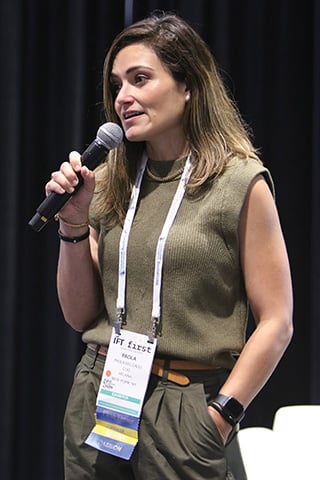
Paola Delgado
Helaina, a biotech company specializing in precision fermentation, earned top honors at The Pitch Competition held during IFT FIRST. The startup was awarded the $10,000 prize while runners-up unClassic Foods and SnapDNA each received $2,500. All prize money was awarded by Seeding The Future Foundation.
Founded in 2019 in New York City, Helaina uses precision fermentation to produce bioactive proteins, starting with lactoferrin, which is found in breast milk. This ingredient can regulate iron levels, improve nutrient absorption, and support cognitive health, the company claims. Helaina’s first targets will be the sports and prenatal nutrition markets.
Paola Delgado, chief operating officer at Helaina, presented to the judges. She said the rate and effects of anemia on the world’s population inspired her work with the startup.
“My mother was a nutritionist in a soup kitchen, where I saw firsthand the effects of anemia,” she said in her winning two-and-one-half-minute pitch. “This is the future of food as medicine.”
The final round of The Pitch included 12 finalists from two preliminary rounds. In addition to the three winning startups, the finalists included BlueNalu, ClimatePartner, Digestiva, Fuddis, Fusion Foods Group, Lemnature AquaFarms, MontBlancAI, RedLeaf Biologics, and Sustain-A-Grain.
Five judges scored the final round of pitches: Angela Cauley, founder and executive director of the George Washington Carver Food Research Institute; Pete Speranza, CEO of Wicked Kitchen; Staci Seibold, senior director of client and technical services at Partners in Food Solutions; Dan Ripma, vice president, S2G Ventures; and Chris Downs, IFT 2022–2023 president and director of the Food and Beverage Accelerator at the University of Queensland.
unClassic Foods makes oyster mushroom products with enhanced protein for use as meat replacements. The mushrooms are frozen and can be cooked on a stovetop within minutes. SnapDNA developed a technology to speed up food pathogen testing times. The SnapDNA system can test samples in as little as one hour.
The Pitch Competition was open to startups that exhibited in the IFT FIRST Startup Pavilion.
Emily Little is associate editor of Food Technology magazine (elittle@ift.org).
Authors
-
Mary Ellen Kuhn Executive Editor
Mary Ellen Kuhn, executive editor and assistant director of publications, oversees the editorial content of Food Technology magazine.
Categories
-
Food Product Development
-
Food Ingredients and Additives
-
Professional Development
-
Networking
-
Food Technology Magazine


