
NEWS
Improving Spinach Juice Safety and Quality; Child Food Insecurity to Rise Due to COVID-19
Improving the quality and safety of spinach juice
Nonthermal technologies like ultrasound and pulsed electric field are being used to enhance the nutritional quality and stability of fruits and vegetable juices. A study published in the Journal of Food Science analyzed the combined effect of the two techniques for improving the quality and microbial safety of spinach juice. The juice was treated with ultrasound at a frequency of 40 kHz, a radiating power of 200 W, and a temperature of 30°C ± 2°C for 21 minutes in an ultrasonic bath cleaner. For the pulsed electric field treatment, the spinach juice was pumped at a flow rate of 60 mL/min, with a pulse frequency of 1 kHz, a pulse width of 80 µs, a temperature of 30°C ± 2°C, a time of 335 µs, and an electric field strength of 9 kV/cm.
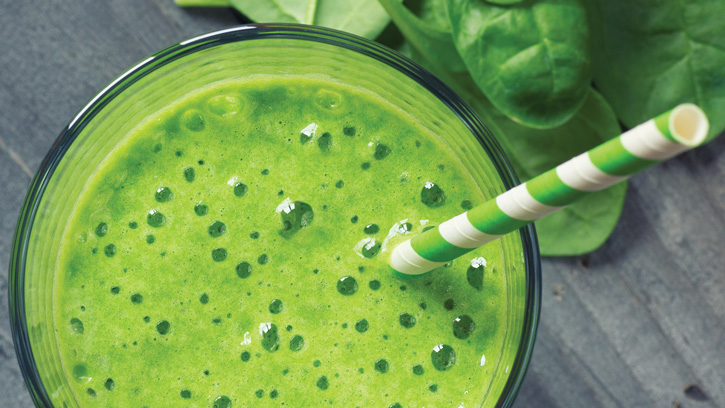
A combination of ultrasound and pulsed electric field treatment can be used to enhance the quality of spinach juice at an industrial scale. © Lecic/iStock/Getty Images Plus
Results showed the combined ultrasound-pulsed electric field treatment attained the highest value of minerals and total free amino acids as compared with each treatment alone, significantly reducing total plate count (3.83 to 1.97 log CFU/mL), E. coli/Coliform (1.90 to 0.75 log CFU/mL), and yeast and mold (4.23 to 2.22 log CFU/mL). Fourier-transform infrared spectroscopy spectra showed that all nonthermal treatments led to a higher concentration of carbonyl compounds rather than generating new carbonyl compounds. In addition, the combined treatment significantly reduced particle size.
The researchers concluded that the rheology of spinach juice was drastically changed by all nonthermal techniques, indicating non-Newtonian modal accompanied by a decrease of consistency index (K) and apparent viscosity (η), and an increase of flow behavior (n). Overall, the improved quality of spinach juice shows the suitability of both technologies for industrial applications despite variations in rheological properties.
Child food insecurity to rise due to COVID-19
The number of children experiencing food insecurity could rise to 18 million due to the COVID-19 pandemic, according to a report by Feeding America. The number is the highest ever reported by the U.S. Department of Agriculture since it first began measuring food security 25 years ago.
Among the factors driving the prediction are projected annual changes to poverty and unemployment. Using a variety of scenarios, the analysis showed that an increase in the unemployment rate of 7.6%, coupled with a 5% increase in the child poverty rate, would result in a 9.3% increase in the child food insecurity rate, potentially leading to a total child food insecurity rate of as high as 24.5%. If the scenario plays out, 25% of American children could face hunger in 2020.
“Whether the food insecurity rate rises to one in four or remains at one in seven, as it currently stands now, it is too many children facing hunger in our country,” said Claire Babineaux-Fontenot, CEO of Feeding America, in a press release. “This report should mobilize everyone from our elected officials to the public at large to provide all the resources families need to get through this crisis.”
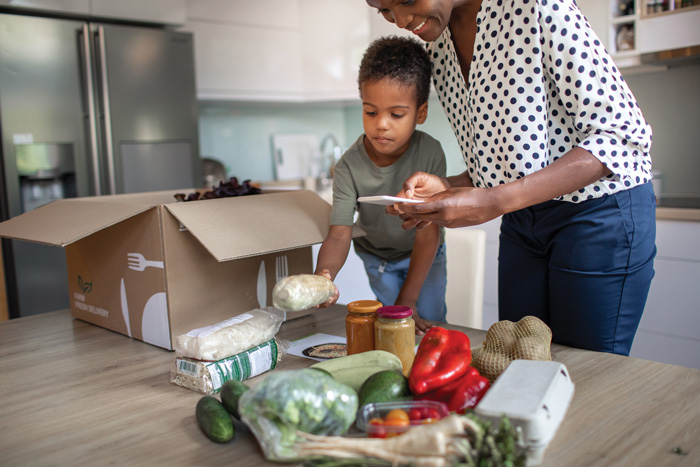
Consumer buying patterns related to COVID-19 are one of the factors influencing growth in the online grocery market. © vgajic/E+/Getty Images Plus
Online grocery market to reach $1.1 trillion
A study conducted by Grand View Research predicts the global online grocery market will expand at a compound annual growth rate (CAGR) of 24.8% over the next seven years, reaching $1.1 trillion by 2027. Increased smartphone use, shopping convenience and discounts, and consumer buying patterns related to the coronavirus outbreak are influencing the shift from in-store purchasing to online shopping.
Among the segments projected to experience significant growth is the breakfast and dairy segment, which is expected to expand at a CAGR of approximately 24% from 2020 to 2027. Fresh produce is another segment anticipated to experience substantial growth, with a projected CAGR of over 22.0%, due to increased buying of fruits and vegetables via e-commerce platforms.
The rising popularity of online shopping in developing countries will also play a role in furthering market expansion, with the number of online shoppers in India estimated to reach 220 million by 2025, according to the India Brand Equity Foundation. The large number of younger consumers is expected to be an influential factor in the Asia Pacific region, which is estimated to record the highest CAGR during the forecast period.
Although customers’ concerns about product freshness could impede market growth, fast delivery and bigger discounts could offset the concerns. In addition, real-time data provided by the internet of things (IoT) may help e-commerce organizations better manage and maintain inventory and analyze consumer demand for products.
The link between selenium and COVID-19 recovery
An international team of researchers studying COVID-19 data from patients in China has discovered a connection between cure rates and regional selenium status. Selenium is a trace mineral with antioxidant properties, and can be found in fish, meat, and certain cereals.
In an analysis of data from provinces and municipalities with more than 200 COVID-19 cases and cities with more than 40 cases, the researchers found that COVID-19 patients from areas with high levels of selenium were more likely to recover from the virus. The city of Enshi, in the Hubei province, which has the highest selenium intake in China, experienced a cure rate nearly three times higher than the average for all other cities in the same province. Conversely, the province with one of the lowest intakes of selenium experienced a death rate from COVID-19 nearly five times as high as the average of all other provinces outside of Hubei.
The study results, published in the American Journal of Clinical Nutrition, are significant because China’s population reflects both the lowest and highest selenium status in the world, due to geographical differences in the soil that affect the amount of the trace element that enters the food chain. Ramy Saad, a doctor at Royal Sussex County Hospital, Brighton, UK, commented in a press release, “The correlation we have identified is compelling, particularly given previous research on selenium and infectious diseases. As such, a careful and thorough assessment of the role selenium may play in COVID-19 is certainly justified and may help to guide ongoing public-health decisions.”
Changes in buying habits likely to continue
The rise in at-home consumption of food and beverages is likely to continue, according to results of a new survey from Nielsen in which 79% of Canadians and 71% of Americans indicated that they believe the spread and intensity of COVID-19 will increase in their country.
Among the impacts of increased at-home food consumption is an upsurge in fresh produce buying, as well as an increase in purchases of frozen and pantry-friendly fruits and vegetables. With consumers acclimating themselves to restricted living, cooking and eating at home have gained popularity, with four in 10 Canadians and five in 10 Americans indicating that they cook or eat at home more often than they did before the pandemic.
Although fresh foods remain popular, healthy shelf-stable foods are also a priority for consumers. In both Canada and the United States, frozen and shelf-stable fruit purchases showed three to five times the growth rate of fresh fruit in the year-to-date period ending April 4. An example is fresh pineapple sales, which are down 3% in the United States, while sales of frozen and shelf-stable pineapple are up 39% and 29%, respectively.
However, producers of fresh produce may find new opportunities with the potential rising demand for products of local origin. Fifteen percent of Americans and 14% of Canadians indicated that they purchased local products more frequently after the COVID-19 outbreak. This represents an opportunity for local growers and suppliers to offer transparency to consumers who fear the risks associated with products that have had multiple global touchpoints.
News Bites
• AeroFarms announced it will build a 90,000-square-foot facility in Abu Dhabi to advance R&D, strategic partnerships, and the commercialization of local crops, utilizing the company’s proprietary indoor vertical farming technology.
• Aleph Farms announced plans to eliminate emissions associated with its meat production by 2025 and reach the same net-zero emissions across its entire supply chain by 2030.
• Diageo announced that its brands have won a collective 79 medals for exceptional quality liquids at the 20th annual San Francisco World Spirits Competition.
• General Mills set a goal to source 100% renewable electricity by 2030 as part of the RE100 global corporate initiative.
• The Hershey Company announced a commitment of $1 million to acquire, install, and staff a new manufacturing line dedicated to the production of face masks. The line will be capable of producing up to 45,000 masks per day.
• Ingredion and PureCircle have reached agreement on the terms for Ingredion to acquire a controlling 75% stake in PureCircle, a producer of stevia sweeteners for the global food and beverage industries.
• Vertical farming company Kalera plans to open a new state-of-the-art growing facility in Atlanta in early 2021.
• Laird Superfood has closed a $10 million financing round, funded entirely by Danone Manifesto Ventures, the corporate venture arm of Danone, to support its growth initiatives.
• Neogen has acquired the assets of Chile-based Magiar Chilena, a distributor of food, animal, and plant diagnostics, including Neogen products.
• Nestlé Purina PetCare has acquired natural pet food brand Lily’s Kitchen, a leading UK producer of premium wet and dry natural foods for dogs and cats.
• PepsiCo and Vital Pharmaceuticals, the manufacturer of Bang Energy drinks, have entered into an exclusive alliance for PepsiCo to distribute the portfolio of Bang Energy beverages in the United States.
• Prinova has partnered with Agrumaria Reggina to be the exclusive distributor of the company’s essential oils in the United States, Canada, Mexico, Australia, Southeast Asia, and Asia Pacific.
• Royal DSM completed its acquisition of Glycom A/S, a leading supplier of human milk oligosaccharides (HMOs).
Authors
-
Margaret Malochleb
Categories
-
Food Business Trends
-
Food Health Nutrition
-
Mergers and Acquisitions
-
Global Markets and Trade
-
Food Technology Magazine


