
Processing Education Options Await in Las Vegas

The 2017 IFT annual event promises to be both exciting and educational for those who wish to learn more about food processing. Compared with last year’s annual event, this year has significantly more scientific sessions focused on food processing, and this column will provide a brief overview of sessions that will reveal new research related to food processing. In addition to the symposia previewed here, there are numerous excellent poster sessions sponsored by IFT’s many divisions. Posters also support understanding food processing and offer the means to interact directly with the researchers who performed the studies, providing a unique opportunity to delve deeper into their work and share knowledge and experience to further science.
Before highlighting specific scientific sessions, it is important to note that there will be a short course, Food Science for the Non-Food Scientist, on Saturday and Sunday, June 24–25, that will include several sections on food processing. The sessions are titled “Food Engineering and Processing,” “Impact of Processing on Nutritional Quality of Foods,” and “The Role of Processed Foods in Delivering Nutrition.” Having basic knowledge of food processing and its effects on nutrition is critical to being an informed food scientist, and this course supports development of that critical knowledge base.
Food processing scientific sessions begin very early in the morning on Monday, June 26. At 7:45 a.m. the session “Cold Plasma: Opportunities and Challenges in Food Processing” begins. This is the first of two sessions on cold plasma. Cold plasma was reviewed in Food Technology’s March 2016 Processing column, where it was described as a nonthermal technology positioned to be a flexible, effective sanitizing method for the food processing industry in the near future.
At 9 a.m. on Monday, June 26, there will be a featured session that you will not want to miss. Titled “Processed Foods: The Good, the Bad, and the Science,” it will be moderated by The Washington Post columnist Tamar Haspel. This panel discussion will bring together a wide range of perspectives for a lively conversation on the pros and cons of processed foods.
The second session on cold plasma, “Cold Plasma for the Inactivation of Human Pathogens and Bacterial Spores and Regulatory Status in the U.S. Food Industry,” will begin at 10:30 a.m. on Monday, June 26, and will provide additional information on applications, as well as the regulatory status of this technology. “Technological Advancements in Food Processing and Packaging to Improve Sustainability in the Food Industry,” which promises to be a visionary session, will take place at 3:30 p.m. on Monday, June 26. This important session will highlight recent advances in food processing and ways they can provide solutions to the wide array of challenges that result from world population growth. This session is cosponsored by the Food Science and Technology Honorary Society Phi Tau Sigma. Finally, on Monday at 6 p.m., the Food Engineering, Food Packaging, and Nonthermal Processing Division event, which will take place in San Polo 3502–3503, will provide an opportunity to socialize and learn more about these important topics.
Opportunities to learn about food processing continue on Tuesday, June 27, beginning at 11 a.m. with the session ‘“Is Degree of Processing a Useful Way to Direct Food Selection and Dietary Guidelines?” Newly adopted Food and Agriculture Organization descriptors to categorize processed foods will be discussed, as well as the pros and cons of using this classification system. The session promises to be enlightening around the role of processed foods in the diet and dietary guidelines. Concurrent with this session is a session titled “Commercially Trending Technologies for Beverage Processing” during which applications of new processing technologies to beverages will be discussed.
In addition, a session at 11 a.m. on Tuesday, June 27, “Technology Transfer from Academia to Industry: Approaches and Case Studies,” will highlight four success stories by scientists who have bridged the gap between academic research and commercialization.
At 2 p.m. on Tuesday, June 27, high pressure processing for preserving extended shelf-life or ambient stable low-acid foods will be reviewed during the session “Emerging Applications of High-Pressure Processing.” Also at 2 p.m. that day, advanced drying technologies will be discussed in the session “Advanced Drying Technologies for Efficient Manufacture of Dried Products and Ingredients.” A variety of technologies will be compared, not only for impact on final product quality parameters, but also for energy and cost-effectiveness of the process.
You may also wish to join the session “Advances in 3D Printing: Exploring the 3D Printer” at 3:45 p.m. Tuesday, June 27, on the IFTNEXT Stage. 3D food printing was the topic of the April 2017 Processing column in Food Technology, where it was described as an exciting new method for fabricating foods.
On the last day of the 2017 IFT annual event, Wednesday, June 28, there will be two more interesting food processing–focused sessions. The first begins at 10:30 a.m. and is titled “Novel Dehydration for Phytonutrient Stabilization.” This is a topic of great importance to the food industry in our quest to preserve the nutritional status of foods during processing. A variety of ways that processing can be enacted to produce final products with optimal nutritional quality will be discussed. Finally, on Wednesday, June 28, at 1 p.m., a final session on advanced microwave processing will take place; it is titled “Advanced Microwave Processing of Food.” This session will describe the latest advances in microwave equipment design and applications to foods.
A wide range of novel research topics related to food processing will be presented during the scientific and poster sessions at this year’s annual meeting. I hope that you seize this opportunity to understand more about food processing through them. See you in Las Vegas.
Exhibitor Information
The following are brief descriptions of some of the processing-related exhibits that will be on display at the IFT17 food expo.
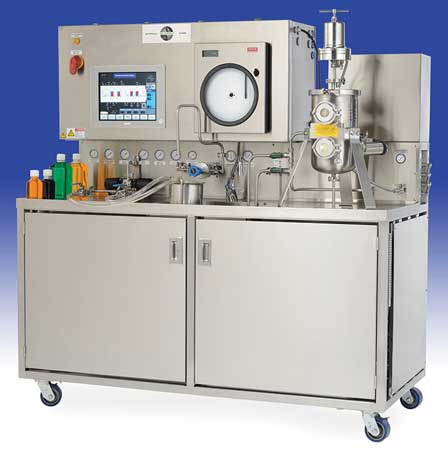 Custom small-scale pasteurizers, more powerful control systems, and aseptic laboratory fillers are new from MicroThermics. The company’s small-scale UHT/HTST/aseptic processors and pasteurizers increase R&D efficiency, eliminating failed plant trials, reducing costs, and speeding time to market. Tubular, plate, steam injection, and microwave processors and pasteurizers are available with homogenizers, custom hold tubes, ultra-clean fill hoods, and fillers. MicroThermics’s equipment, services, and process matching technology mean that lab processes are the same as those used in the plant. Clients work with MicroThermics on the development of juices, milks, dairy beverages, soymilk, yogurts, puddings, sauces, and more. MicroThermics, microthermics.com, Booth 3440
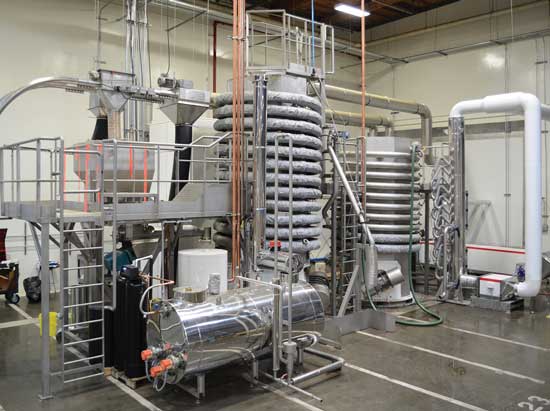 Heat treatment of dry ingredients is available from Revtech. This unique technology is based on the following simple principles: gentle transport and homogeneous mixing in a closed spiral tube via vibrations; heating by direct contact with an electrical impedance tube; and heat treatment in a confined and controlled atmosphere. Revtech can supply continuous units from 400 lb/hour to 10,000 lb/hour. Applications include steam pasteurization of herbs, spices, botanicals, seeds, and nuts; stabilization of cereal products such as germs, brans, and flours; enzymatic inhibition of seeds and beans; and toasting and roasting of nuts, seeds, malt, and flours. Revtech, revtech-process-systems.com, Booth 4472
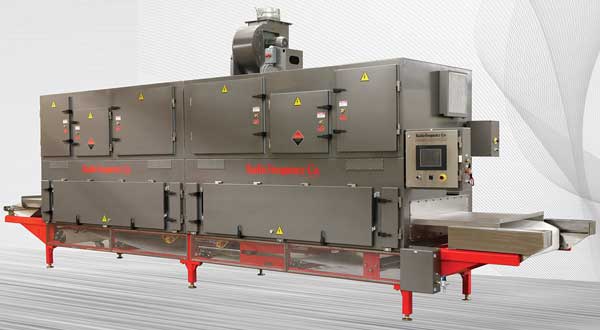 Pasteurizing systems for the treatment of nuts, spices, cereal grains, xanthan gum, and other food ingredients as well as finished products are available from Radio Frequency Co. The company’s line of energy-saving Macrowave Pasteurization Systems operate at 40MHz, where depth of penetration and uniformity of heating are optimized, thus ensuring effective microbe kill without affecting product quality. Suitable for batch or conveyor applications for bagged or bulk product, the systems convey the product to be treated through an electrode array where an alternating electric field causes polar molecules in the material to continuously reorient themselves to face opposite poles. The friction that results from molecular movement causes the material to heat rapidly and uniformly. Radio Frequency Co., radiofrequency.com, Booth 2509
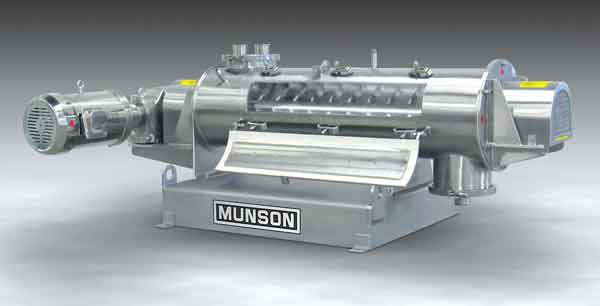 Sanitary, high-intensity stainless steel continuous blender, model HIM-124-S316 from Munson Machinery provides low-to-high shear for high-speed blending and/or homogenizing of dry solids, agglomerates, slurries, or pastes. Homogeneous blends can be achieved in as little as 20 seconds residence time at throughput rates to 200 cu ft/hr. Liquids may be added through optional injection ports for dedusting and agglomerating of dry materials as well as for producing pastes, emulsions, and slurries. Munson also offers a stainless steel ribbon blender, HD-3.5-7-S316, which meets sanitary standards and blends up to 65 cut ft of powders, pastes, or slurries. The blender’s 2:1 length-to-diameter ratio enables it to distribute ingredients uniformly during loading, blending, and discharge. Munson Machinery Co., munsonmachinery.com, Booth 5036
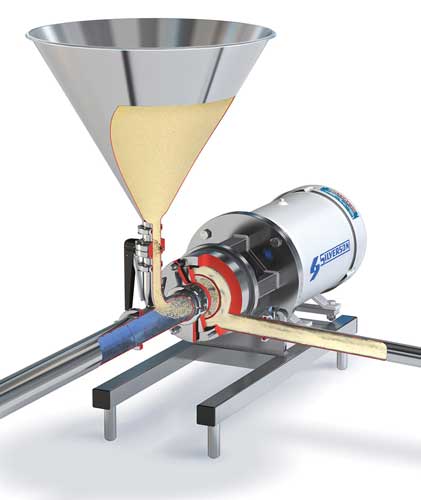 High-shear mixing technology will be on display in the Silverson Machines booth at the food expo. Now twice as fast, the Silverson Flashmix Powder Incorporation Mixer allows powder to be incorporated into liquid at a rate of 500 lb/min. New technology makes it possible to use it at higher temperatures and with higher viscosity mixes than was previously possible. Also from Silverson, the stainless steel BX60 Batch Mixer, available on a portable stand, performs a wide variety of applications, including mixing, emulsifying, homogenizing, disintegrating, and dissolving; capacities range from 1 gal to 8,000 gal. With a capacity of from 1 mL to 12 L and the ability to mix in-line with flow rates up to 20L/min, the Silverson L5M-A laboratory mixer offers an easy way to forecast the performance of larger Silverson machines under full-scale conditions. Silverson Machines, silverson.com, Booth 4920
An extensive portfolio of processing solutions from GEA Group are tailored to the client’s requirements for applications including flavors, proteins, colors, stabilizers, enzymes, and other products in liquid and powder form. GEA expertise encompasses extraction, mixing, clarification, filtration, homogenization, pasteurization, cleaning, product recovery, concentration, and drying. Engineered to meet high standards of hygiene and quality, GEA food technology also operates efficiently and sustainably. Project management, planning, and cost-control services augment GEA’s technical expertise. GEA Group, GEA.com, Booth 1839
 Tara McHugh, PhD, Contributing Editor
Research Leader, USDA Agricultural Research Service, Albany, Calif.
tara.mchugh@ars.usda.gov
Authors
-
Tara McHugh
Categories
-
Food Processing and Packaging
-
Food Sciences
-
Food Engineering
-
Food Technology Magazine


