
Community
Remembering Peter Barton Hutt, Architect of Modern Food Law
Distinguished food law attorney and former U.S. Food and Drug Administration legal counsel Peter Barton Hutt passes away at 91.

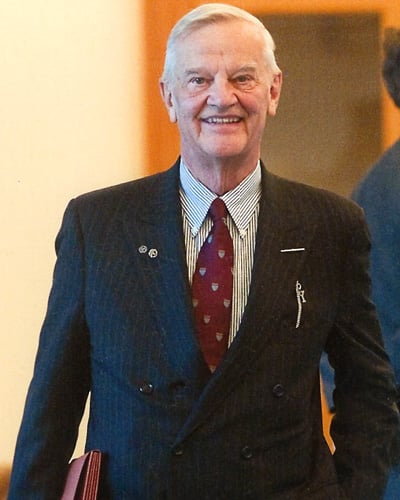 Peter Barton Hutt, the food and drug attorney widely regarded as the dean of food and drug law and a key architect of the modern U.S. food regulatory system, died Sept. 2, 2026. An IFT Fellow and longtime IFT member, he was 91. Over a career spanning more than six decades, Hutt helped shape many of the regulatory frameworks that continue to govern the food industry today.
Best known within the food sector for establishing the first nutrition labeling format while serving as chief counsel of the U.S. Food and Drug Administration (FDA) from 1971 to 1975, Hutt transformed the agency's approach to regulation. Rather than relying primarily on enforcement actions against individual companies, he championed rulemaking as a means of creating clear, industry-wide standards. That shift laid the foundation for many of the food regulations that followed.
During his FDA tenure, Hutt oversaw initiatives that required nutrition labeling on much of the U.S. food supply, promulgated regulations governing Generally Recognized as Safe (GRAS) ingredients, redefined standards for imitation foods, modernized food standards, and strengthened controls for low-acid canned foods. Colleagues and industry observers frequently pointed to these efforts as milestones in the evolution of modern food regulation.
Hutt's influence extended beyond food policy. He helped shape regulation of over-the-counter drugs and medical devices, promoted government transparency by bringing the FDA into compliance with the Freedom of Information Act, and contributed to developments that legitimized off-label drug use. Throughout his career, he testified before Congress more than 100 times and served on advisory boards and committees involved in some of the most significant health and biotechnology issues of the late 20th century.
Hutt's connection to the food industry began early. The son of a dairy owner, he worked in the family dairy business, making milkshakes and delivering dairy products to customers. His interest in food law emerged while he was a student at Harvard Law School, when his father began seeking advice on legal issues affecting the dairy business.
In 1960, Hutt joined Washington, D.C.-based law firm Covington & Burling, where he would spend nearly his entire professional career. Aside from his four years at the FDA, he remained with the firm for more than six decades, representing major food, pharmaceutical, biotechnology, dietary supplement, cosmetic, and medical device companies, as well as leading trade associations. He retired in 2025 after serving as one of the most prominent food and drug lawyers in the United States.
Just as significant as his regulatory and legal accomplishments was Hutt's role as an educator. He coauthored Food and Drug Law: Cases and Materials, the field's most widely used casebook, first published in 1980. At a time when only a handful of law schools taught food and drug law, Hutt sought to establish the discipline as a recognized area of legal study. The book became foundational to generations of attorneys working in food and drug regulation.
Beginning in 1994, Hutt taught Food and Drug Law at Harvard Law School, where he became renowned for his energetic teaching style, student debates, and practical simulations. Former students recalled his enthusiasm for the subject and his commitment to mentoring young lawyers long after they left the classroom. In a tribute following his death, Harvard Law School's I. Glenn Cohen described Hutt as a pioneering teacher whose influence could be found throughout government, academia, and private practice.
Many in the food industry credit Hutt with helping create the legal and regulatory framework under which today's food companies operate. Writing after his death, food safety attorney Bill Marler observed that professionals throughout the food sector have spent their careers "standing on ground Peter graded, whether or not they knew his name." The observation captures the breadth of Hutt's impact on food regulation, food safety, and consumer information over the past half-century.
Hutt is survived by his wife, Catherine Adams Hutt, also an IFT Fellow and longtime IFT member; four children; and nine grandchildren. A memorial service will be held Oct. 24, 2026, at the Cosmos Club in Washington, D.C.
Hero Image: © Dedraw Studio/iStock / Getty Images Plus
Author
-
Food Technology Staff
Categories
-
Food Policy
-
Food Laws and Regulations
-
Labeling
-
Food Standards
-
Food Technology Magazine
-
Community


