

Three Lessons I Learned Building a Startup
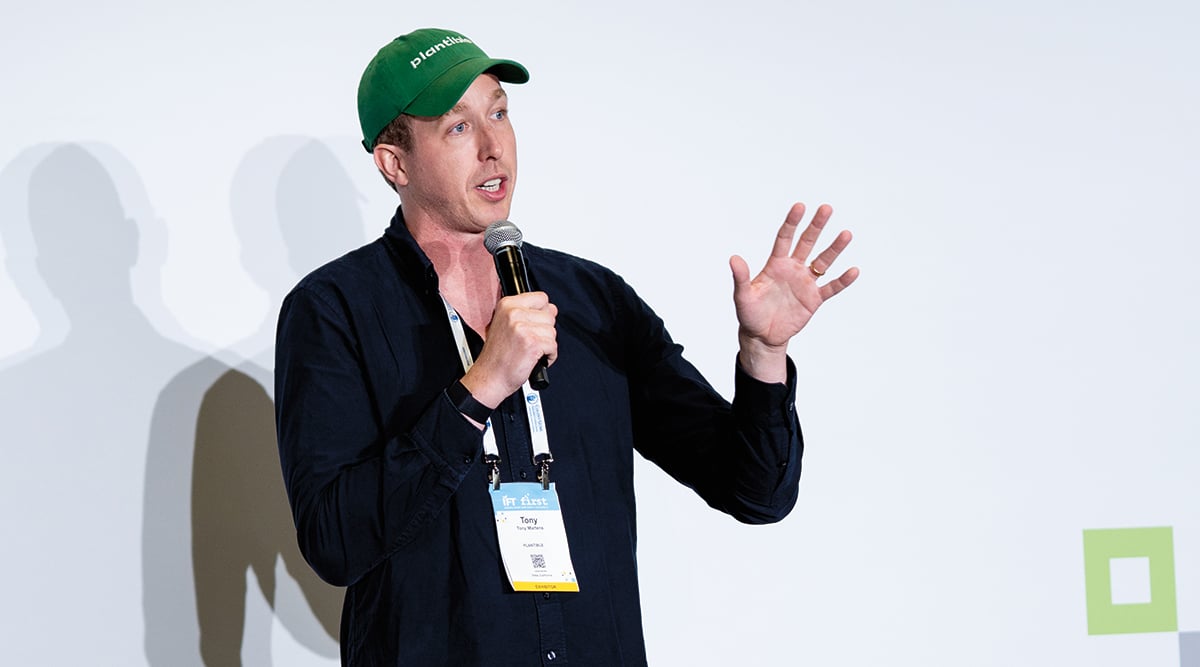
Plantible cofounder Tony Martens at IFT FIRST.
When IFT FIRST The Pitch! competition winner Plantible Foods began developing Rubi Protein, the company set out to bring a highly functional, neutral-tasting protein to market using Lemna, a fast-growing aquatic plant. The vision eventually led to a 140-acre production facility in West Texas and commercial supply agreements with major food manufacturers.
The journey to get there required years of experimentation, long stretches of uncertainty, and a willingness to abandon conventional assumptions. Martens says the experience shaped his view of what it takes to build a startup. The lessons he took from that journey apply to many types of early-stage companies, not just those in the food system.
1) Question the assumptions everyone else takes for granted.
Martens and his cofounder, Maurits van de Ven, began by examining the food system from first principles.
“There has been no real disruption in our food system over the past 3,000 years,” Martens says. “We kept mechanizing and optimizing the crops we already had and forgot to ask how today’s technology could unlock novel, more sustainable, more nutrient-dense plants and ingredients.”
Their exploration led them to Rubisco, one of the most abundant and functional proteins in nature, and ultimately to Lemna, which grows rapidly, can be harvested daily, and maintains high Rubisco integrity because it continues photosynthesizing until processing.
Martens says this reinforced a point that applies broadly: the biggest opportunities often appear when founders step back and reconsider fundamental assumptions rather than follow established industry paths.
2) Success in a lab does not guarantee success at scale.
Rubisco had been studied for decades, and many companies had produced promising results at bench and pilot scale. Yet few had succeeded in commercializing it. Martens says that pattern taught him an important lesson.
“In the lab or at pilot scale, things look great,” Martens says. “But as soon as companies went to commercial scale, they suddenly started to see a lot of issues.”
He identifies the three problems Plantible saw repeatedly in past attempts:
Rubisco degrades quickly once a plant stops photosynthesizing, with a half-life of about four to eight hours.
Seasonal crops lead to idle facilities due to infrequent harvesting cycles, which break unit economics.
Insecticides and pesticides concentrate in leaf material, compromising ingredient safety.
Plantible realized the business model had to be designed around these constraints. Lemna offered daily harvests and enclosed cultivation without pesticides, and Plantible built processing directly beside its greenhouses to preserve protein quality.
Martens believes founders in any sector face the same truth: a concept that works in controlled conditions often needs a different system to work at scale.
“You really have to think about how to maintain the integrity of your material before you extract it,” he says. “Rubbish in, rubbish out.”
3) Expect to do things that feel uncomfortable and impractical.
The earliest stages of Plantible required a level of persistence that Martens admits was difficult to anticipate. He and van de Ven arrived in the United States with few connections and tried to raise money while operating in a free, abandoned greenhouse in San Diego.
“You can imagine how two Dutch guys on a deserted farm, growing duckweed, might not be the most appealing pitch to people,” Martens says. “The hit rate was pretty low.”
The challenges intensified in 2020. One week after raising their seed round, the state went into lockdown due to COVID-19. Instead of pausing work, the team moved onto the farm.
“We bought a couple of RVs and turned our office trailer into a bedroom,” Martens recalls. “We basically lived on the farm with our five employees for nine months. We slept on the ground on a mattress, ate microwave food, and used the garden hose as the main shower.”
The difficult circumstances strengthened the team’s focus and accelerated technical progress, allowing Plantible to advance from lab to pilot scale more quickly than expected.
The company later built its commercial site, Ranchito, in Schleicher County, Texas. The facility employs about 35 people and has contributed to a 61% increase in median household income in the county, according to recently published Census data.
Martens says working alongside a rural community has become one of the most meaningful aspects of the company’s growth.
“You have people from oil and gas or animal agriculture learning new forms of agriculture, food safety, and protein extraction,” he says. “Being able to empower these communities has been incredibly rewarding.”
He believes the experience reflects a broader truth for startups in any field. Progress rarely follows a predictable plan, and the work often looks inefficient or unconventional from the outside. Founders must learn to make decisions without perfect information, adapt to rapidly changing conditions, and stay committed even when the path forward feels unclear. Those qualities, Martens says, matter as much as the idea itself.
Looking Ahead
Martens still relies on the mindset that guided the company’s earliest years: examine the root problem, design around scientific realities, and stay resilient when circumstances are unpredictable.
“Entrepreneurship is always an uphill fight,” he says. “If you stay curious and stay committed, you can keep moving forward toward something that creates real value.”
Want to learn more?
Plantible’s Lemna-based protein helped the company win The Pitch startup competition at IFT FIRST Annual Event and Expo this past summer. Read the full story.
To hear Martens go deeper into Plantible’s journey, the science behind Rubi Protein, and the challenges of scaling an idea into a company, listen to his interview on the Omnivore podcast.
Are you a food startup? Join us at IFT FIRST in July 2026.
The Startup Pavilion at the IFT FIRST Annual Event and Expo in Chicago features around 100 emerging food and food tech companies at various stages of growth. It is one of the most visited destinations at the event and offers a place for innovators and entrepreneurs to connect with peers, partners, and potential customers.
Startups can also apply to participate in The Pitch, a rapid-pitch competition where six standout companies compete live for cash prizes presented by the Seeding The Future Foundation.
If your company is working to transform the global food system, this is your chance to get in front of leaders across industry, academia, and government.
Learn more and stay tuned in early 2026 for your chance to apply to exhibit.
Hero Image: Axiom Media Group
Categories
-
Food Business Trends
-
Food Product Development
-
Food Ingredients and Additives
-
Startups and New Ventures
-
Proteins
-
Brain Food Blog


