
Snack Bar Boosts Nutrition in Congo
World Food Programme support increases efficiency of nutritious mbala pinda snack bar production in the Republic of the Congo.

The World Food Programme’s rapid development of food processing and supply chain infrastructure for a children’s nutrition bar in the Republic of the Congo highlights a new approach to humanitarian relief—one that lays the foundation for long-term food security. Already active in the country, the World Food Programme (WFP) expanded its support to schools in 2019, just ahead of the COVID-19 pandemic reaching Africa, with a program to boost the production of mbala pinda—a savory peanut and cassava bar made with local ingredients.
Situated just west of its larger neighbor, the Democratic Republic of the Congo, the Republic of the Congo is a Central African nation that straddles the equator, with 65%–70% of its land covered in dense tropical rainforest. As part of the Congo Basin—the world’s se cond-largest rainforest—this biodiversity hotspot is known for its unique wildlife, including the bongo antelope, okapi (the zebra giraffe), and African forest elephant.
With an estimated 70% of its food imported, the country felt pandemic-related food supply disruptions acutely: food prices rose and household incomes plunged, particularly for farmers, as markets closed. The WFP aimed to improve children’s nutrition and strengthen local food systems by providing schools with cash vouchers to purchase mbala pinda from local producers, mainly women’s cooperatives.
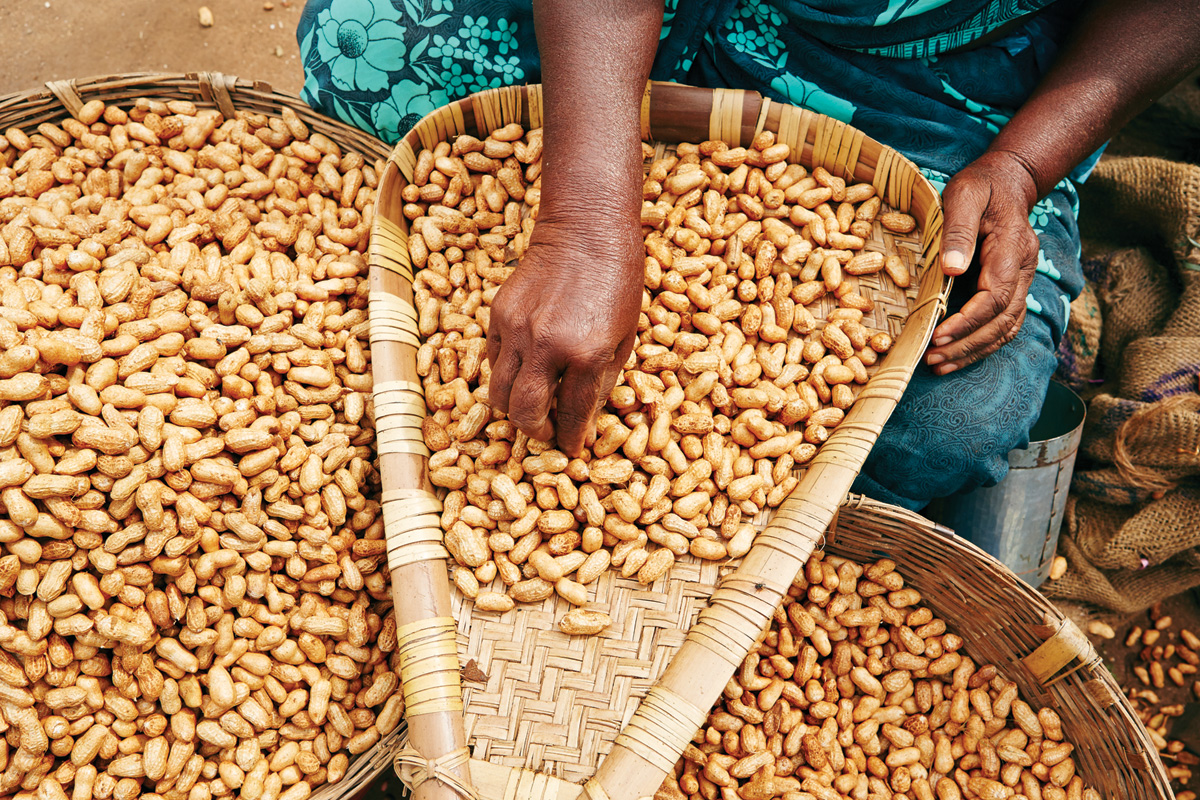
Peanuts, which are used to make mbala pinda, are sorted to reduce aflatoxin risk. © Chalabala/iStock/Getty Images Plus
Making Mbala Pinda
A traditional Congolese snack, mbala pinda is made by mixing peanut paste and cassava flour in roughly equal proportions, adding salt, chili pepper, or fish, and forming the dough into handheld portions that are wrapped in the leaves of the Marantochloa purpurea plant and steamed for 30 minutes. The leaves, which are tear-resistant and retain moisture well, serve as biodegradable packaging. Produced with locally grown peanuts, cassava, and Marantochloa leaves, each 50 gram mbala pinda bar contains about 210 calories, 6 grams of protein, and 15% of the Daily Value for magnesium, with a shelf life of up to one week.
The WFP received funding from Stop Hunger, Sodexo’s philanthropic foundation, and collaborated with Canadian nonprofit Tailored Food to adapt traditional, labor-intensive mbala pinda production to efficient commercial methods—including the introduction of mechanical grinders—while building on current systems rather than replacing them.
With insights from Tailored Food, WFP also developed a food safety guide for mbala pinda. Key steps include reducing the risk of aflatoxin contamination by hand sorting peanuts to remove moldy or damaged nuts and ensuring thorough sun drying, and lowering naturally occurring cyanogenic compounds in cassava through soaking, fermenting, and drying.
In June 2020, the project provided training on food safety, new equipment, and operations management to 160 women in 16 co-ops (Kazaks and Ho 2025). By October 2020, about 3,400 children were regularly receiving nutritious mbala pinda bars at school, amounting to more than 33,000 mbala pinda bars by 2021 (Kazaks and Ho 2025).
Although the WFP intended funding for the program to be a short-term, pandemic-relief effort, its strategic, future-oriented approach has raised the bar on production efficiency, food safety, and logistics in the Republic of the Congo—supporting improved food access, nutrition, health, and income opportunities.
Hero Image: © Chalabala/iStock/Getty Images Plus
Authors
-
Miranda Grizio
Miranda Grizio, MS, is a member of IFT and a case study writer for IFT’s Food Science for Relief and Development Program (miranda.grizio@gmail.com).
Categories
-
Food Security
-
New Product Development
-
Diet and Health
-
Food Technology Magazine
-
Innovation


