
AI Tool Predicts Mouthfeel, ‘Fingerprinting’ Procyanidins, and More


© diane555/digitialVision Vectors/Getty Images Plus
AI tool predicts mouthfeel
A student research group in the Purdue University Department of Food Science has developed an artificial intelligence (AI) model that can predict mouthfeel, according to a study published in the March 2025 issue of Food Research International. Paul Kraessig, the paper’s lead author and investigator, was an undergraduate majoring in computer science and honors mathematics when he developed the sensory-based autoencoder—a type of neural network designed to learn how humans perceive texture—under the auspices of faculty supervisor Carlos Corvalan. This tool “allows us to pave the way for smarter food design,” explained Corvalan, an associate professor of food science at Purdue, in an article on the university’s website.
The product development process normally involves much trial and error and is labor-intensive and time-consuming, the researchers stressed. The process is also subjective; with each incremental recipe adjustment, tasting panels of human testers typically sample and rate the product. Mouthfeel can be particularly unpredictable and difficult to get just right. “Using the autoencoder, food developers and scientists can work much more efficiently,” the Purdue article emphasized. “The model predicts how texture will be perceived without having to undergo continuous rounds of development and testing.”
The recently published study, which built on prior research and focused on liquid foods, analyzed the relationship between rheology (how materials form and flow when subjected to stress or a force) and perceived texture. The autoencoder was able to “effectively identify non-linear, non-injective relationships between shear-thinning properties and perceived thickness, even when trained on a small dataset,” reported the peer-reviewed article. “This strategy offers a promising approach for advancing food product development by aiding the design of carefully tailored sensory experiences.”

© MariuszBlach/iStock/Getty Images Plus
Healthier hotcakes
Pancakes are a family-favorite breakfast food, typically indulged in on weekends, but they are not known for their nutritional profile or health halo. Washington State University food scientists aim to transform hotcakes into a much more healthful option without compromising their taste or texture, reports an article in Cereal Chemistry.
“We wanted to see if it’s possible to make tasty pancakes with whole grains that add some fiber and protein,” says Girish Ganjyal, a professor and extension food processing specialist, in an article on the university’s website. In the study, the researchers replaced refined flour with quinoa, buckwheat, millet, and whole wheat flours in percentages ranging from 25% to 100%, while keeping constant the amount of sugar, oil, flour, salt, and leavening agents.
The research team found that buckwheat, quinoa, and whole wheat flours can be integrated into pancake recipes without substantially altering the taste or texture. Millet flour, however, tends to crumble, so it needs to be precooked slightly before it can be added effectively to the pancake recipe. “Further research on the optimization of the pancakes with alternative grains, based on their functional properties and pancake sensory assessment, is recommended,” state the Cereal Chemistry article coauthors.

© Devonyu/iStock/Getty Images Plus
Soft electrons, safer eggs
Tsinghua University in Beijing and a Chinese tech company have developed a new radiation technology that uses soft (low-energy) electron beams to disinfect eggs, the International Atomic Energy Agency (IAEA) reports on its website. Research data indicated that untreated samples had approximately 100,000 bacteria per egg, but soft electrons reduce the bacteria count to less than 10 per egg, according to the IAEA.
The new technique involves brushing a curtain of soft electrons over the eggshell, destroying harmful microbes without damaging the yolk or white. “Unlike traditional chemical washes that require significant energy to dry the eggs, this method is more efficient, cost-effective, and factory-friendly, offering a safer alternative for large-scale egg processing,” the article states.
The IAEA and the Food and Agriculture Organization (FAO) of the United Nations support initiatives such as this as part of the Atoms4Food initiative, which aims to leverage innovative nuclear techniques to enhance agricultural productivity, reduce food losses and waste, ensure food safety, and improve nutrition. “Food irradiation is underutilized, but we are working to raise its profile as the benefits it provides will serve consumers and producers and help meet many food safety issues,” said Carl Blackburn, an expert in food irradiation at the Joint FAO/IAEA Centre, who is quoted in the article.

© Liudmila Chernetska/iStock/Getty Images Plus
‘Fingerprinting’ procyanidins to predict texture and taste
Pennsylvania State University (Penn State) scientists have developed a way to analyze procyanidins, or condensed tannins, in some food and beverages—such as red wines, ciders, and dark chocolate—to predict taste and texture. Previous techniques could assess the total amount of procyanidins in a food or beverage but could not distinguish between them, according to the study, published recently in the Journal of Agricultural and Food Chemistry.
The article describes an advanced analytical chemistry method called “condensed tannin fragmentation fingerprinting,” which is based on a technique known as in-source fragmentation, in which molecules from a food or beverage sample are identified using a mass spectrometer. In a nutshell, the analytical process involves separating compounds in the sample and then applying different voltages to break the procyanidins into fragments that the researchers can match to known standards and then identify and quantify.
“Drinking red wines, sometimes that tannic element is really harsh, like dragging sandpaper across your tongue, and sometimes it is velvety or smooth—and yet those two wines can have the same absolute amount of procyanidins, also referred to as condensed tannins,” said research team leader Misha Kwasniewski, an associate research professor of fermented beverage science and technology in Penn State’s College of Agricultural Sciences, in an article on the university’s website. “We wanted to understand the biological activity of taste and mouthfeel, but this goes beyond taste and mouthfeel because procyanidins also are responsible for antioxidant activity and health-related benefits, and current analytical methods often show a lack of correlation with biological activities and health-related benefits.”

© bergserg/E+/Getty Images Plus
Coffee Rx: Addressing folic acid deficiency
As one of the most widely consumed commodities in the world, known to help protect against such conditions as obesity and type 2 diabetes, coffee is an untapped vehicle for delivering micronutrients, according to an article recently published in Food Chemistry. The study’s coauthors propose fortifying coffee with folic acid.
A deficiency in folic acid can cause pregnancy complications such as neural tube defects, as well as homocysteine imbalances (increasing the risk of blood vessel damage and blood clots) and megaloblastic anemia. “However, the concept of folic acid-enriched coffee is relatively new and under-explored, necessitating further research to evaluate its efficacy, stability, and consumer acceptance,” state the article’s authors.
© Nadiia Borovenko/Getty Images Plus
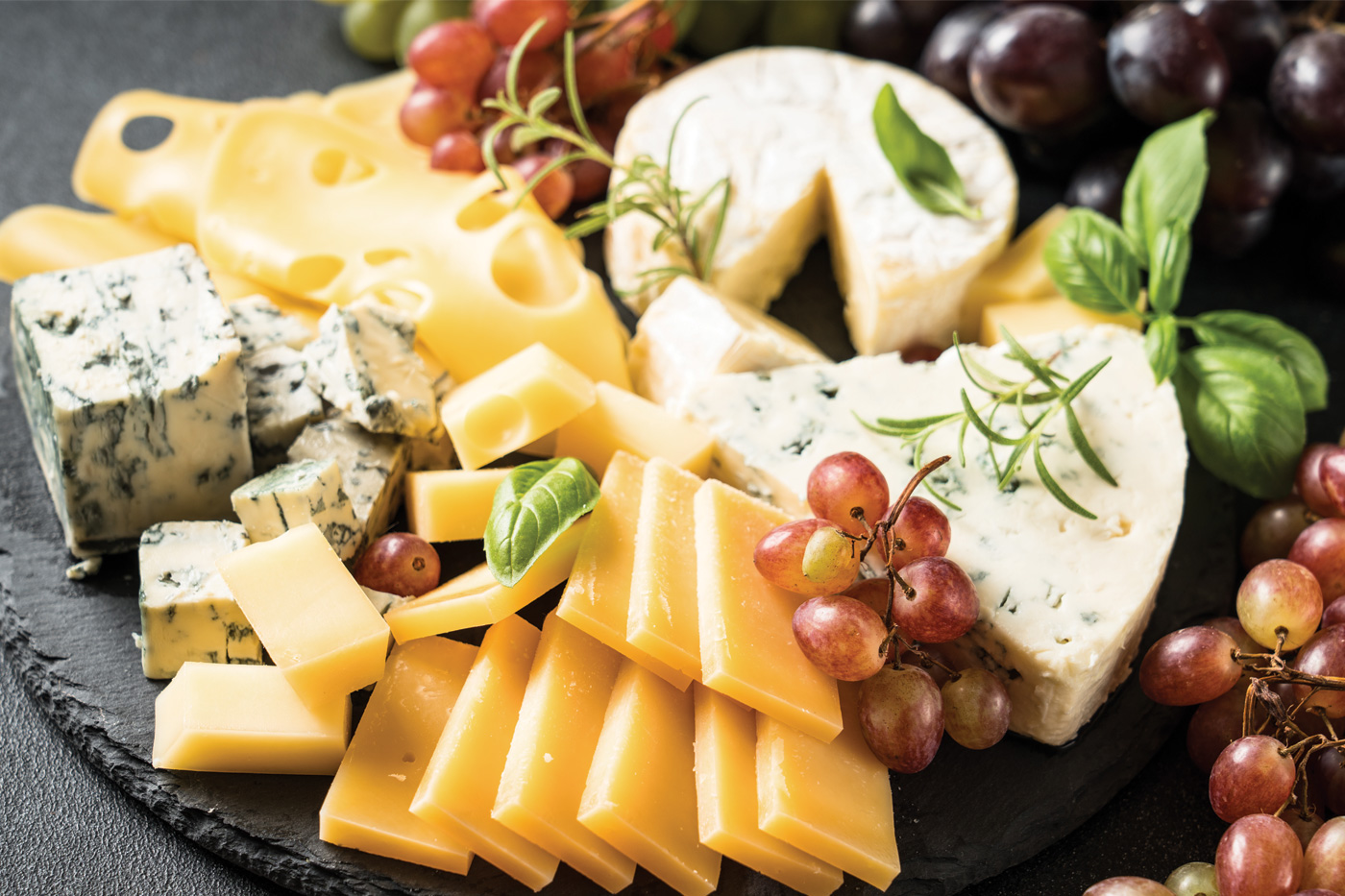
Grass-fed cows produce more flavorful cheese
Researchers from France’s National Research Institute for Agriculture, Food and Environment (INRAE) have found that the proportion of grass in the diet of dairy cows affects the quality of milk and cheese.
The study, published in the May issue of Journal of Dairy Science, reported on a 19-week experiment in which 26 Prim’Holstein and 14 Montbéliarde cows were divided into four balanced groups of 10 cows. During the first eight weeks, two of the groups were fed a diet consisting of 75% grazed grass and 25% hay and concentrates, while the remainder were fed a corn-based diet consisting of 75% mixed ration and 25% grazed grass. During the following 11 weeks, one group in each feeding system (grass-based and corn-based) experienced a change in the diet: a 50% reduction in grazed grass for grass-fed cows and complete removal of grazed grass for corn-fed cows. At the end of the experiment, bulk milk from each cow group underwent physicochemical and microbiological analyses and then processing into cantal-type cheeses.
The researchers determined that cheese softness increased with the proportion of grass in the diet, “and it was positively correlated with primary proteolysis (αS1-casein and β-casein breakdown),” the article stated. “Cheese [samples produced] from cows fed with more grazed grass were the yellowest and had the most pronounced flavors, as well as higher counts of heterofermentative lactobacilli and lactic acid bacteria. Removal of grazed grass from the corn-based diet led to cheese that was less yellow and had less flavor, in line with lower levels of secondary proteolysis.” The study can serve as guidance to French dairy farms (and other dairy farms globally) that have altered or are considering altering dairy cow rations in response to droughts.ft
In Memoriam
IFT notes the passing of the following members: David Busse and Patty L. Howlett.
Hero Image: © diane555/digitialVision Vectors/Getty Images Plus
Authors
-
Carolyn Schierhorn
Categories
-
Food Health Nutrition
-
Food Safety and Defense
-
Flavors
-
Food Ingredients and Additives
-
Diet and Health
-
Omnivore
-
Food Technology Magazine


