
Front-of-Package Claims Research, Keeping Spuds Safe, and More

AGRICULTURE
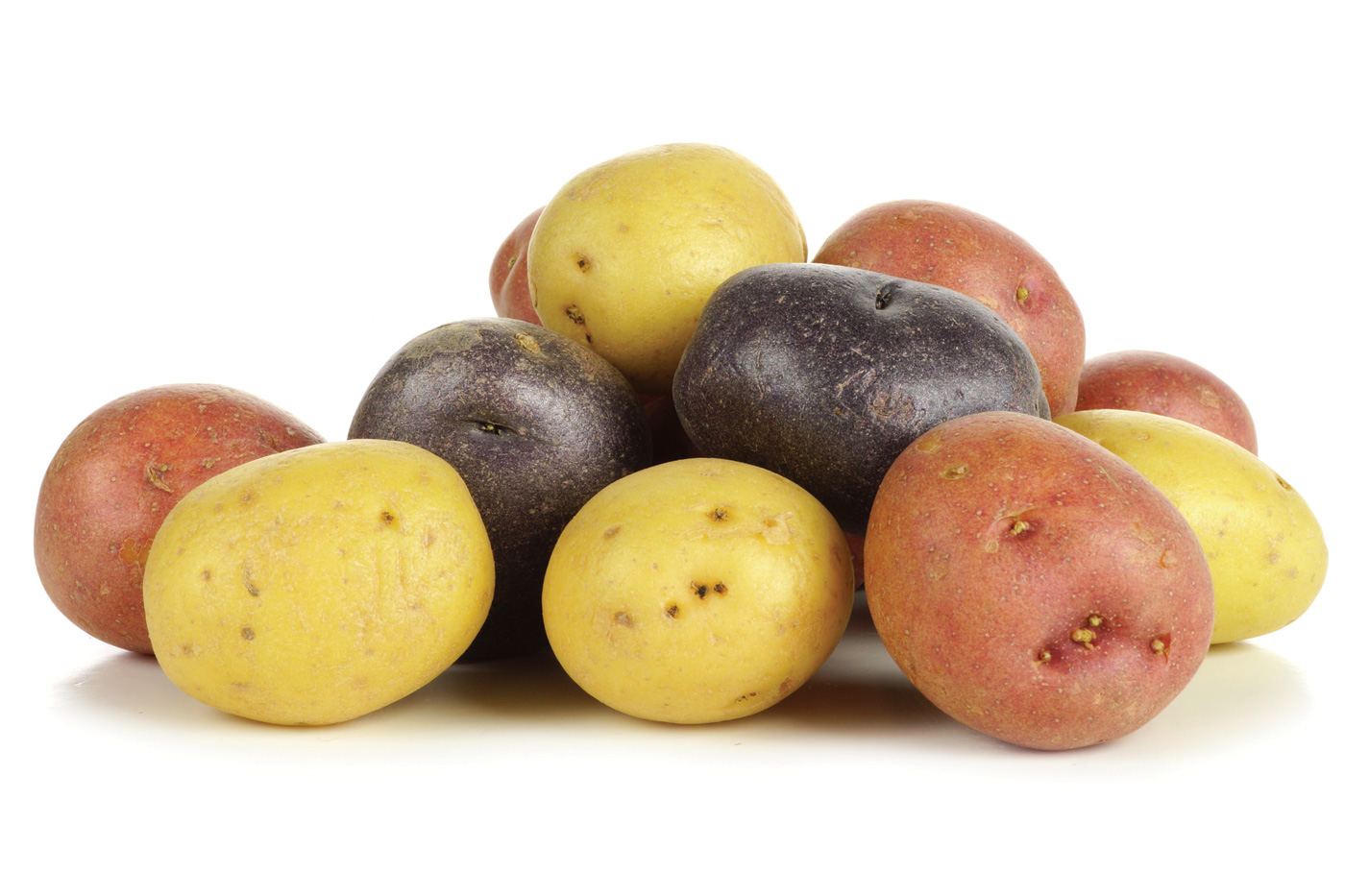
Keeping spuds safe, from farm to space
Potatoes naturally produce steroidal glycoalkaloids (SGAs), chemicals that protect them from insects. Found in large quantities in the green parts of potato peels and the sprouting areas, SGAs continue to be produced after potatoes are harvested when tubers are exposed to sunlight. Because SGAs ultimately render potatoes unsafe for consumption, researchers have been looking for ways to curtail and control SGA production so it doesn’t occur in the edible part of the plant. Scientists at the University of California, Riverside (UCR)—collaborating with the Weizmann Institute of Science in Israel, as well as Kobe University, the University of Osaka, and the RIKEN Center for Sustainable Resource Science in Japan—have identified a key genetic mechanism in SGA production that can be manipulated to reduce toxicity and improve potato resilience during storage and transport.
Published in Science, the study, which builds on prior research, reports on the discovery of the glycoalkaloid metabolism 15 (GAME 15) protein, which plays a key role in SGA biogenesis in the Solanaceae family of crops (which includes potatoes, tomatoes, eggplants, and so on). Silencing GAME15 results in a significant decrease in SGA levels in potatoes and tomatoes, the researchers found.
“Now that we’ve uncovered the biosynthetic pathway, we can potentially create plants that produce these compounds only in the leaves while keeping the edible parts safe,” said Adam Jozwiak, the UCR molecular biochemist who led the study, quoted in a news article on the university’s website.
These findings could have several potential benefits, according to Jozwiak. “You could store the potatoes in your kitchen and not worry about exposure to sun, which makes them produce more SGAs,” he explained. “And then you could eat them whenever you want, reducing food waste.” In addition, further limiting SGA production through the use of the GAME 15 pathway could make potatoes an even hardier and more efficient food source. “For space farming, where every part of a plant may need to be edible, these findings are especially promising,” Jozwiak said.
COMMUNITY

Remembering Dennis Heldman
IFT Past President Dennis “Denny” R. Heldman passed away on April 3, 2025.
A member of IFT since 1968, Heldman’s legacy spans decades of service, scholarship, and leadership. He was a steadfast advocate for food engineering and education, generously sharing his time and expertise to help shape the future of food science.
“Denny’s reach and impact were extensive, influencing the career paths of countless food engineers. He was always kind, approachable, and receptive to lending advice and direction to this community,” said Chistopher Daubert, IFT board president. “He set a high scholarly standard for food engineering faculty and played a central role in raising the visibility and academic rigor of the discipline.”
Heldman served as IFT’s president from 2006 to 2007. He also served on the IFT Board of Directors and lent his leadership to numerous committees and task forces over the years. He was named an IFT Fellow in 1981, received the Distinguished Career Award in 2013, and was honored with the Lifetime Achievement Award in 2018—one of IFT’s highest honors.
“Denny’s foremost concern was always to ensure that IFT was supporting the important role of food science, and in particular, academic food science programs and students,” reflected IFT Chief Executive Officer Christie Tarantino-Dean. “He had an impact on IFT and on so many in the field, and he never stopped caring about the organization that was his professional home.”
A renowned educator and researcher, Heldman most recently served as the Dale A. Seiberling Endowed Professor of Food Engineering at The Ohio State University. He was widely known for advancing the application of engineering principles to food processes and for his passion for mentoring students and professionals alike. His authorship of seminal textbooks and encyclopedias continues to influence food science education and practice around the world.
Learn more about Dennis Heldman’s career.
FLAVORS

Bitter truth
Genes play a role in the perception of coffee’s bitterness, according to researchers at the Leibniz Institute for Food Systems Biology at the Technical University of Munich in Germany. In an article published in the March 30, 2025, issue of Food Chemistry, the authors examine why coffee tastes more bitter to some people than it does to others. The research, which focused on roasted Arabica coffee, also identified and analyzed the substances that contribute to coffee’s bitterness. Although caffeine has long been known to be bitter tasting, decaffeinated coffee is also bitter, which means that other substances in coffee influence the bitter flavor.
“Indeed, previous studies have identified various compound classes that are formed during roasting and contribute to bitterness,” said Coline Bichlmaier, a doctoral student at the Leibniz Institute, in an article on the institute’s website.
Bichlmaier initially looked at the mozambioside contained in Arabica beans. It tastes about 10 times more bitter than caffeine and activates two of the approximately 25 bitter taste receptor types found in the human body: the TAS2R43 and TAS2R46 receptors. However, the concentration of mozambioside decreases substantially during roasting, so that substance has only a small impact on coffee’s bitterness. That said, the breakdown of mozambioside yields seven different degradation products that are also bitter and could have an impact of the coffee’s taste. Those compounds are present in roasted coffee in various concentrations and are released into the beverage during brewing.
In this pilot study, 11 volunteers sampled brewed coffee with varying concentrations of the individual roasting compounds and/or mozambioside. The researchers found that the subjects’ perceptions of bitterness depended to a large extent on their genotype. For example, two of the subjects had defects in both copies of the TAS2R43 receptor, seven had one intact and one defective variant of the receptor, and only two people had both copies of the gene intact. This preliminary study enhances understanding of how the roasting process affects coffee’s flavor and of why individuals have widely different coffee preferences, according to the authors.
RESEARCH

Front-of-package ‘healthy’ claims spur skepticism
In its final rule issued December 27, 2024, the U.S. Food and Drug Administration (FDA) redefined healthy, a claim that can be used voluntarily on front-of-package food labels for products that meet specific nutritional expectations and are low in saturated fat, sodium, and added sugar. Many dietitians and other champions of healthful eating advocate for concise front-of-package nutritional labels as a way to nudge consumers to avoid junk food and choose nutrient-dense products. They believe that the Nutrition Facts label and ingredient decks are too complex to sway average Americans to make better food choices. Accordingly, the FDA is weighing whether front-of-package nutritional labels should be required.
Researchers at the University of Florida Institute of Food and Agricultural Sciences, however, have conducted a study indicating that front-of-package claims may repel consumers by triggering skepticism, rather than nudging them toward more healthful dietary habits. Published in the February 2025 issue of Food Policy, the study analyzed the responses of 308 subjects who were asked to physically examine unbranded but familiarly designed containers of strawberry Greek yogurt, each with a front-of-package claim of “healthy,” “great taste,” “healthy and great taste,” or no claim (the control group). Some of the participants were given the FDA’s criteria for the “healthy” designation. In this laboratory experiment, the subjects were asked to rate what they’d be willing to pay (the retail price) for each of the yogurt containers they were presented.
Compared to the claim-free control group, respondents were willing to spend 18% less for the “healthy” yogurt and 25% less for the yogurt labeled both “healthy” and “great taste.” When presented as the only front-of-package claim on a product, “great taste” labels did not affect respondents’ willingness to pay. However, providing the respondents with the FDA criteria for the “healthy” designation did have mitigating effects, according to the study.
“Simply putting ‘healthy’ on a product may not be enough—it can even backfire if consumers are left wondering what qualifies the food as healthy or if they associate the label with less desirable attributes, such as poor taste,” said the study’s lead author, Jianhui “Jeffrey” Liu, a doctoral candidate in the University of Florida’s Food and Resource Economics Department, in a news article on the university’s website.

Influencing appetite in infancy
Appetite self-regulation (known as ASR) in childhood is influenced by biological, psychological, and social factors that originate in infancy, according to researchers at the University of Illinois at Urbana-Champaign. Published in Social Science & Medicine, their study explores how these complex, interrelated variables, or pathways, help determine whether a child will develop a healthful, finnicky, or unregulated (obesogenic) eating style:
- Biological factors include physiological hunger and satiety signals, sensory experience, and the gut microbiome.
- Psychological factors include cognitive control, emotional self-regulation, reward processing, and stress regulation.
- Social factors include parental behavior and feeding practices, geographic location, culture, and food insecurity.
Parental influence is a key social factor, the research indicates. For example, giving infants and young children food to help regulate their emotions affects whether they will use food to self-soothe as they get older. Forcing children to eat certain foods, however, turns eating into a stressful situation and is counterproductive to nurturing healthful dietary habits. Physiological variables such as abdominal discomfort and psychological variables such as mood, in turn, have an impact on a young child’s behavior, which parents might try to calm or manipulate with food.
TECHNOLOGY

Bionic bees take wing
Researchers at the Massachusetts Institute of Technology (MIT) have developed insect-sized micro-aerial robots, with the expectation that they will someday be used to rapidly and precisely pollinate fruits and vegetables. This technology is intended to make multilevel, or vertical, farming more efficient and sustainable.
Much more robust and agile than their precursors, the latest iteration of the microbots can hover for approximately 1,000 seconds, which is 100 times longer than previous versions could maintain.
“The revamped robot is designed to boost flight precision and agility while minimizing the mechanical stress on its artificial wing flexures, which enables faster maneuvers, increased endurance, and a longer lifespan,” states an article on MIT’s website, which features a video clip of a microbot doing aerial acrobatics. A research article on the new insect robots was recently published in Science Robotics.ft
Hero Image: © Abeie/iStock/Getty Images Plus
Authors
-
Carolyn Schierhorn
Categories
-
Food Business Trends
-
Food Health Nutrition
-
Consumer and Marketplace Trends
-
Sustainability
-
Food Security
-
Diet and Health
-
Omnivore
-
Food Technology Magazine


