

Top 7 Food Packaging Innovations
 Claire Koelsch Sand
Food Technology Magazine
-
Key Takeaway 1
Identify the key food packaging format, design, and material science innovations of the past 50 years.
-
Key Takeaway 2
Understand why these food packaging innovations are relevant.
-
Key Takeaway 3
Learn how these innovations will continue to impact how food packaging prevents food waste and protects food.
In the past 50 years, packaging format, design, and material science innovations have allowed for significant progress in meeting consumer needs, from extending shelf life, preserving food safety and quality, preventing food waste, and providing higher levels of sustainability, all while conveying increased nutrient and tracking information. Seven of these packaging innovations—four associated with format and design achievements and three material science discoveries—have risen to the top in the past half century in terms of positive impact on the food system and consumers worldwide.
Packaging Format and Design
• Polyethylene terephthalate (PET) bottles. When Owens-Illinois (O-I) produced its first 32 oz PET bottle in 1976, consumers praised its lightweight (67 g) and non-breakable design. Since those early days, PET water bottles have provided consumers worldwide with access to potable drinking water. In addition, manufacturing innovations such as blow-fill-cap equipment, which eliminates the need to ship empty bottles to filling facilities, as well as advanced engineering science have significantly reduced both the initial bottle weight and the carbon footprint of the original PET bottle by 50%.
Nevertheless, even though PET bottles are highly recyclable, the United States has struggled to collect enough used PET bottles to make recycling profitable. However, the (still only) 10 U.S. deposit law states and many foreign countries that have implemented bottle deposit legislation have much higher recycling rates than those that depend on consumers to return bottles voluntarily. Former O-I senior scientist and PET packaging pioneer Tom Brady, author of History of the PET Bottle, wrote, “Incentivizing consumers to return bottles for recycling requires a nationwide bottle deposit scheme and, perhaps, to create some fruitful energy for recycling, random cash awards are given to those consumers when they return bottles. These random ‘lottery’ type awards can be readily conveyed to consumers when returning bottles in machines such as the TOMRA Reverse Vending machine” (Brady 2022).
• Aseptic cartons. TetraPak, Lami Packaging, Sig Combibloc, and others supply aseptic paperboard-based multilayer packaging to the food industry. More than 179 billion TetraPak packages are used worldwide each year. Aseptic cartons are shelf stable and are often used to store products like soups and milk for long periods of time without the need for preservatives or refrigeration, thus lowering the environmental impact of food distribution and increasing food access to those without refrigeration. Although paper-based cartons were introduced in 1951, aseptic processing was not used until 1961, and the classic TetraBrik aseptic cartons were not introduced until 1969. The aseptic cartons represent the elegant optimization of each layer, with aluminum providing extended shelf life, the sealant layer ensuring an intact seal, and paperboard providing rigidity.
Cartons are recyclable when they contain 75% paperboard, 25% polyethylene, and 5% aluminum foil, and the layers are separated during the recycling processes by companies such as Sustana (Robertson 2021). In 2022, recyclable paper and polymer replacements for the aluminum foil layers were launched by TetraPak and Lami Packaging, which enables further recycling of the multilayer structure.
• Polypropylene (PP) woven totes. In the 1970s, woven PP replaced conventional fabric and multi-wall paper bags to deliver food aid to refugees and other people in need. Replacing bags prone to rupture and moisture damage generated less food waste. The food industry employs reusable totes to distribute grains, oats, rice, coffee beans, and other low-moisture products from suppliers to food manufacturers. The woven bags increased cube efficiency and integrated encoded counterfeit resistance within the PP weave, resulting in more sustainable distribution and less food diversion. Interestingly, totes are often reused to distribute other food to markets and in areas external to food, such as tarps and floor coverings.
Bags and totes are, as appropriate, coated with anti-infestation substances, antioxidants, and perchlorate to reduce static in filling operations. The release of these compounds and microplastics from woven bags or totes during the agitating filling and distribution process is unknown and a concern. As much as 12,000 parts per million of perchlorate is allowed in dry food packaging by the U.S. Food and Drug Administration (FDA) as an anti-static agent to plastic packaging for dry food with “no-free-fat” or oil. There is evidence that perchlorate is released from polymers due to abrasion. However, there is no standard method to test for the release of compounds from polymers due to abrasion. Because of the reuse of these totes, this is a growing concern.
• Digital printing. Minor ingredients, nutritional, and other information adjustments can be made rapidly through digital printing. Refined printed packaging and smart packaging labels for specific markets can be produced at a low cost for small firms. This allows for tracking of food for enhanced food safety or enabling more accurate post-consumer recycling. For instance, all wine labels must have the bottle deposit noted on the label by July 2025, when the California Redemption Value (CRV) for wine bottles is implemented per the state’s expanded “bottle bill,” SB103.
Digital printing enables the more rapid implementation of this label modification for both large and small wine appellations. “For wine clients, digital print has reduced the lead time by 30% when updating labels to include the California CRV endorsement and other vintage-specific details,” says Kim Connolly, owner of Loupe Graphics. “Using digital print, there are no plate costs to consider, making the cost lower than that of conventional print.”
In addition to its initial application for labels in 1994, digital print is now visible on cans, paperboard, flexible packaging, and glass. The quantities printed are precisely the required amount, thereby minimizing the need for packaging storage and material waste.
The primary function of food packaging is to protect our food supply.
Packaging Material Science Innovations
• Paperboard coatings. Paperboard used for food packaging has always been coated to create a uniform surface for printing, protect food from water vapor, protect the paper from external moisture, and remove grease and oil from the food. Coatings are composed of fossil fuel-derived polymers (e.g., styrene acrylates, synthetic latex, polyethylene, PP, and PET) and bio-derived polymers (e.g., starch, clay, cellulosic, and lignin). Many new paperboard coatings are designed to meet disposal requirements for recyclability, repulpability, and/or compostability/biodegradability, and they are free of compounds that can migrate into the environment.
Increasingly, the amount of non-cellulosic content is regulated. To align with regulations and maintain a non-cellulosic content of less than 5%, Asian Pulp and Paper, Huhtamaki, StoroEnso, and other paperboard manufacturers apply pH-balanced oil-in-water emulsions as dispersion coatings onto paperboard. For instance, nanoscale components with a set aspect ratio are used in Foopak Bio Natura, which is Flustix-certified as plastic free and contains less than 0.75% plastic. This meets the plastic-free criteria, EN13430 recycling, and EN13432 compostability standards.
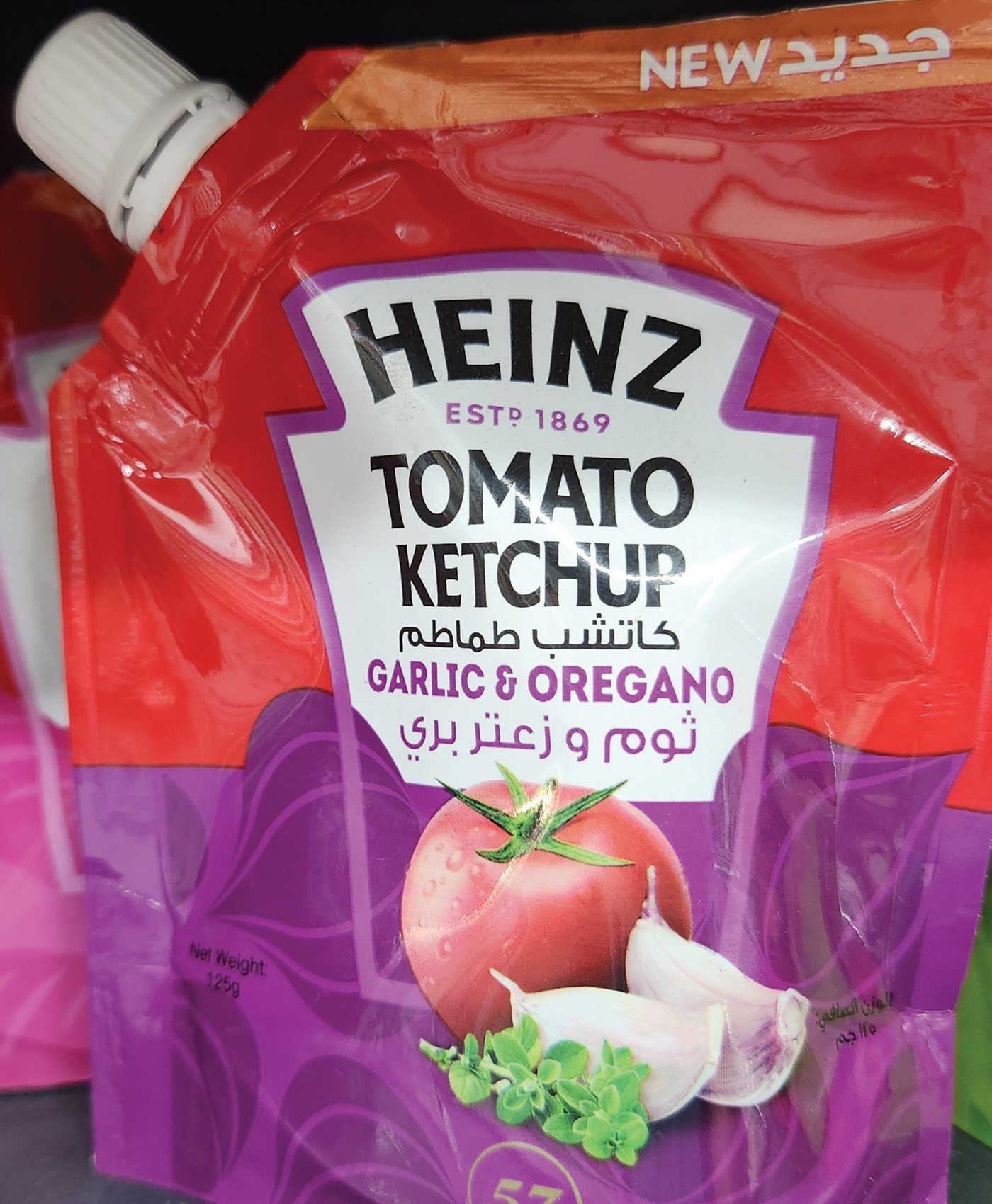
A metalized film pouch extends the shelf life of ketchup and reduces packaging material use. Photo courtesy of Claire Sand
• Metalized film. The use of metalized film for food packaging emerged from developments in the late 1880s; however, packaging applications occurred in the mid–1970s. Now, chemical vapor deposits of aluminum onto packaging material substrates results in only 20 to 30 nm-thin layers of aluminum. This creates a high barrier requiring less plastic to achieve the same barrier properties. For example, switching from PET to metalized PET lowers the oxygen permeability by a factor of 100, allowing for thinner layers of PET and reducing plastic use when delivering the oxygen transmission needed to extend shelf life. For this reason, brands use metalized films for lidding and pouches.
Often, metalized films are required for longer shelf life or in challenging environments. For example, in Egypt, metalized film is used for packaging Twinkies whereas in the United States it is not required to achieve the desired shelf life. Paperboard laminated with metalized film creates a susceptor that absorbs microwaves and concentrates heat at the film interface. This allows heat control to crisp or cook foods such as popcorn, egg roll, and meat using microwaveable packaging. Since susceptors were first used for packaging foods in the early 1980s, consumers have appreciated the convenience of microwaveable food. If the aluminum portion is less than 5% of package weight of a predominantly PE- or PP-based film, it is considered recyclable according to the European initiative Circular Economy for Flexible Packaging in 2020.
Just 40% of approved food-contact chemicals have undergone rigorous food safety assessments.
• Migration testing. The primary function of food packaging is to protect our food supply. Migration testing experienced a surge in innovation in the 1980s and early 1990s as the European Union (EU) standards were developed and refined, and research methodology in understanding the sorption and desorption kinetics and migration from packaging into different food types was elucidated. Today, we are seeing a resurgence in the need for migration testing for several reasons.
First, just 40% of approved food-contact chemicals have undergone rigorous food safety assessments. Thus, since more than 10,000 chemicals of concern are approved for direct food contact, data on more than 6,000 approved chemicals needs to be generated to ensure their safety (Geueke 2024).
Many food manufacturers are embarking upon packaging stewardship to ensure that packaging that may come into direct contact with food does not contain substances of interest, including specific chemicals, allergens, and processing aids. This addresses intentionally and non-intentionally added substances. Package stewardship allows companies to trace chemical use through the packaging supply chain to ensure their supplied packaging is safe for consumers. Likewise, packaging companies are verifying their supply chain.
Global sourcing and export of packaging demands global compliance. Unfortunately, regulations based on known science vary. For example, the FDA and the European Food Safety Authority differ in measuring phthalates. In the European Union, four ortho-phthalates are considered a class with one tolerable daily intake since they are structurally similar and cause the same effects in the human body. However, in the United States, these phthalates are not in one class and thus, daily intakes can be higher. Brands using global packaging or exporting to the European Union will be required to comply with EU limits. Consumers are increasingly concerned about and aware of the migration from packaging. The Human Foods Program, a new FDA initiative, will concentrate on the substances utilized in food packaging (FDA 2024).ft
Hero Image: © AKlion - Andrey Kryukov/iStock/Getty Images Plus
Authors
-
Claire Koelsch Sand Member
Claire Koelsch Sand, PhD, contributing editor to Food Technology and an IFT Fellow, is a global packaging leader with more than 35 years of food science and packaging experience. Sand is the owner and founder of Packaging Technology and Research, LLC, and an adjunct professor at Michigan State University and CalPoly.
Categories
-
Food Waste
-
Sustainability
-
Aseptic Packaging
-
Applied Science
-
Active and Intelligent Packaging
-
Food Technology Magazine
-
Food Processing and Technologies
-
Packaging Equipment


