
Reusable Packaging: Pack, Return, Repeat

-
Learning Objective 1
Understand the role of reusable packaging in relation to “reduce, reuse, and recycle.”
-
Learning Objective 2
Learn how regulations encourage the use of reusable packaging.
-
Learning Objective 3
Define challenges associated with consumer-facing reusable packaging.
After ingredients are transferred to the food manufacturer and people consume food, the packaging remains. Disposal solutions such as recycling, waste-to-energy incineration, and composting are viable solutions to handle packaging waste. However, before deploying these final disposal options, packaging can be reused, and increasingly, that is the case. With much of the environmental impact of packaging associated with the extraction of the Earth’s resources and subsequent processing, reusing packaging presents a critical opportunity to reduce the environmental impact of packaging.
Consumers are increasingly demanding that brands address packaging waste issues, and reuse presents much promise. Regulations are driving reuse for the transport of ingredients and consumer packaging. Careful design, policy alignment, and systems-level thinking are shaping reusable packaging to have a mainstream role in circular strategies. As the industry struggles to keep pace with the demand for more sustainable packaging, reuse is worth reconsidering.
Regulatory Changes
Regulators and policymakers seek solutions that can serve the public interest while maintaining industry buy-in and receptivity. This predicament can be challenging to balance due to regional differences in the United States and the multinational nature of major industry players that create barriers. Currently, several key directives are driving the industry to adopt more circular packaging solutions that increasingly involve reusable and returnable options. This momentum is shifting, not only toward increased sustainability and compliance brought about by reduced waste and raw resource extraction, but also to cost efficiency, job creation, and other supply chain benefits such as enhanced product traceability and improved information flow across value chain partners.
The European Union’s (EU) revised Packaging and Packaging Waste Regulation (PPWR) mandates reusability and refillability levels by 2030. The PPWR mandates ambitious reuse targets to cut packaging waste by 15% by 2040. By 2030, at least 10% of beverage packaging (excluding wine and spirits) and 40% of transport packaging (like crates and pallets) must be reusable, with higher thresholds by 2040 (40% and 90%, respectively) (PPWR 2025). These rules require packaging to be designed for “as many rotations as possible,” supported by return systems, traceability tools, and digital tracking of environmental conditions, geo-location, and eventually product quality to ensure compliance and circularity.
Consumers are increasingly demanding that brands address packaging waste issues, and reuse presents much promise.
In North America, Canada continues to work on designing packaging for multiple reuse cycles with a 55% reuse goal by 2030 as part of the Ocean Plastics Charter. They are also working to meet other ongoing regulations to limit single-use packaging, such as the Single-Use Plastics Prohibition Regulations and several regional Extended Producer Responsibility (EPR) schemes on the way. The EPR scheme has been used in the United States for batteries, tires, and electronic waste, and is being expanded to include packaging.
In the United States, California’s Plastic Pollution Prevention and Packaging Producer Responsibility Act (SB 54) implements state-level circular economy goals, aiming to reduce single-use plastic packaging by 25%, recycle 65% of it by 2032, and ensure that 100% of it is recyclable or compostable. SB 54’s reusables focus is related to efforts to evaluate the status of reusable systems within the broader goal of preventing plastic pollution and minimizing material extraction (CalRecycle 2025). Other states, including Maine, Oregon, Washington, and Minnesota, have ongoing EPR programs and proposals that aim to incentivize producers to design products that are reusable, recyclable, and compostable. Oregon is the first state to provide eco-modulation bonuses and incentives to companies that conduct non-comparative life cycle assessments and demonstrate tangible environmental benefits of their packaging. This opens the opportunity for robust evidence-based discussions around existing packaging, such as reusables.
These evolving regulations are prompting companies to reassess their packaging strategies beyond compliance and explore scalable reuse models that align with state-level circular economy objectives. However, the patchwork of state regulations, differing infrastructure readiness, and lack of national harmonization make it difficult for brands operating across borders to invest confidently in reusable systems. This regulatory complexity underscores the importance of shared standards and interoperable systems enabling widespread adoption.
Ingredient Transport Packaging
Transport packaging, such as crates, pallets, bins, and intermediate bulk containers used to ship ingredients, offers a more immediate and practical entry point for reducing single-use packaging. This is because such systems typically operate in closed-loop logistics environments, often between known business partners, reducing the need for complex collection infrastructure or unpredictable consumer behavior. With fewer variables and higher predictability, the reuse of transport packaging can achieve economies of scale more quickly and with greater traceability.
Reusable transport packaging (RTP) offers operational and environmental benefits, including reduced material use, lower long-term costs, and less packaging waste. Many companies already use reusable plastic containers for distributing fresh produce, where durability, stackability, and cleanliness are critical. Beyond durability, RTP enables better data capture opportunities across logistics. Technologies such as radio frequency identification tags, QR codes, and global positioning system tracking integrated into crates or pallets allow for real-time visibility of product location, environmental conditions (e.g., temperature, humidity), and turnaround rates.
These digital enablers support quality assurance and help address issues such as spoilage, shrinkage, and loss prevention, particularly in perishable food supply chains. For example, integrating temperature sensors into milk crates ensures cold chain compliance throughout distribution, while providing actionable insights to prevent quality degradation. These tracking systems also support compliance with food safety and traceability regulations, such as the U.S. Food and Drug Administration’s Food Traceability Rule, which reinforces transparency from processor to retailer (FDA 2022).
Still, scaling reusable transport packaging systems is not without obstacles. One significant barrier is the longer payback horizon compared to single-use options, which can be challenging to justify in an industry operating on thin margins. In sectors requiring such designs, redesigns are often necessary to accommodate reuse. Furthermore, performance limitations in highly automated distribution centers, such as variability in crate tolerances or damage accumulation over multiple cycles, can disrupt robotics and sorting equipment calibrated for uniform, one-time-use materials. These factors highlight the need for cross-industry coordination and investment in infrastructure to fully realize the benefits of reusable transport packaging.
Despite these hurdles, the momentum behind reusable packaging continues to grow, driven not only by regulatory pressure, technological advancement, and shifting consumer expectations but also by mandates from retailers requiring the use of reusable transport packaging in fresh supply chains. As digital tools improve tracking and industry collaborations enable shared standards and return infrastructure, reusable systems can become not only more feasible but also more competitive. Companies aiming to stay competitive in markets shaped by emerging circularity regulations must proactively adapt by integrating reusable packaging systems into their operations and supply chains. With thoughtful design, policy alignment, and systems thinking, reusable packaging can transition from a niche solution to a mainstream circular strategy.
© Burak Sür/iStock/Getty Images Plus
Consumer-Facing Reusable Packaging
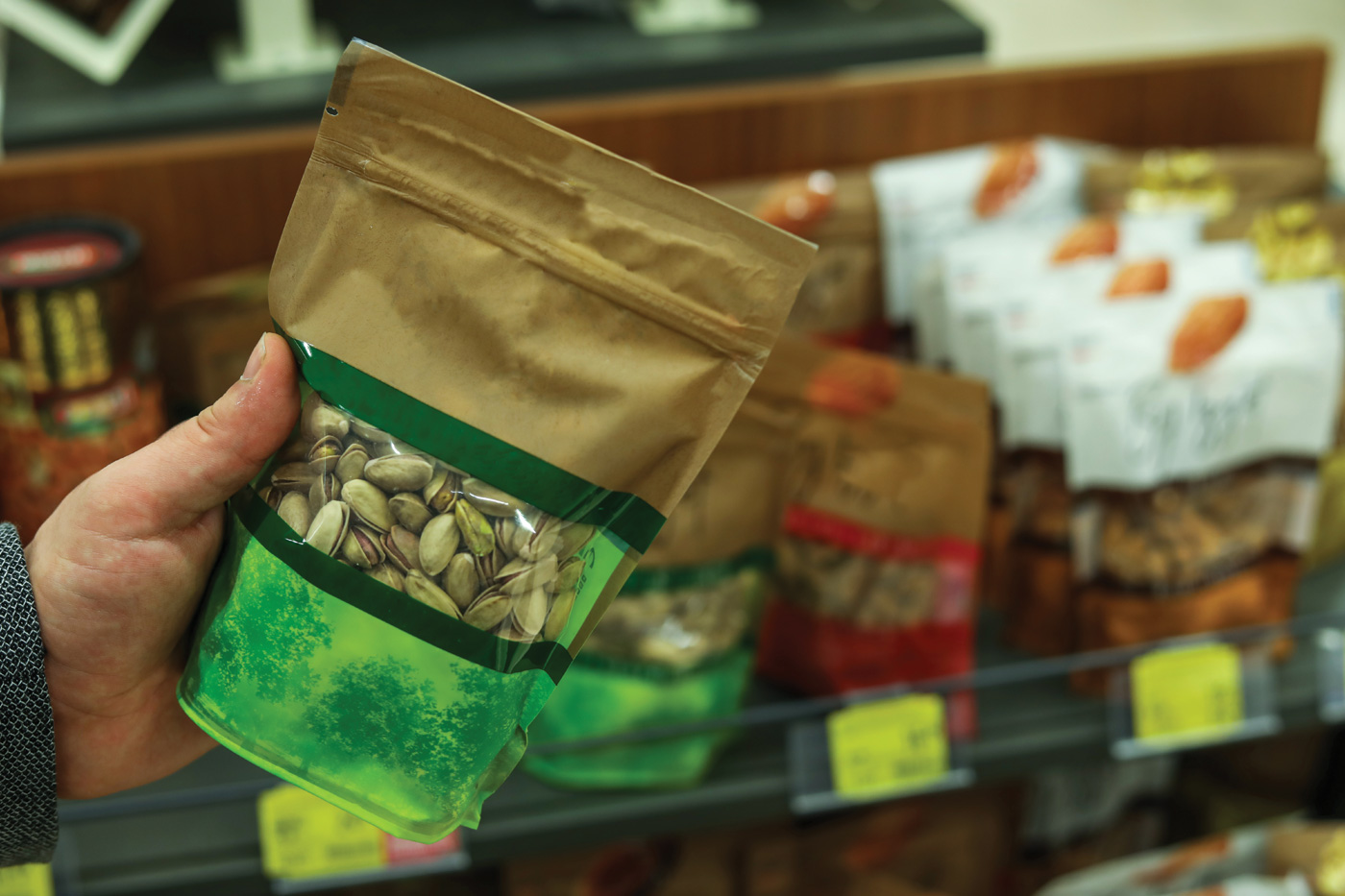
Where infrastructure is available, consumer-facing reusable packaging is increasingly explored across various food categories, including beverages, dairy, sauces, ready-to-eat meals, and dry goods. Solutions range from deposit-return systems and refill-on-the-go stations to return-from-home models such as Loop, where consumers receive food products in durable containers that are later collected, sanitized, and refilled. However, if this cycle of reuse occurs in a large geographic area, the environmental impact can be larger than that of single-use packaging. Reusable packaging is most sustainable when the distance traveled to use, sterilize, and reuse is less than 100 miles (Sand 2020). Several retailers have launched reusable product aisles, and major foodservice chains such as Starbucks and McDonald’s are experimenting with cup return programs, signaling a growing industry shift.
However, these systems rely on packaging materials that are not only durable and safe for repeated use but also efficient in terms of cleaning and logistics. Common materials include those that can withstand sterilization temperatures and arduous collection and sorting processes. These include polypropylene valued for its mechanical resilience and resistance to heat; polyethylene terephthalate (PET), including recycled PET, for its clarity and lightweight nature; stainless steel, particularly for premium reusable containers that require long life cycles; and food-grade silicone, which is gaining attention for flexible and collapsible applications.
Increasing the number of reuse trips is critical to reducing the environmental impact of reusable packaging.
Scaling reusable consumer packaging faces significant challenges. Reusable packaging offers sustainability benefits but is hindered by high costs for production, reverse logistics, and sanitation, especially for smaller enterprises. To withstand actual reuse, packaging often needs to be stronger, and this translates into more material being used per package. This increases package costs and increases the environmental impact of the package. Increasing the number of reuse trips is critical to reducing the environmental impact of reusable packaging.
The absence of standardized formats also makes collection inefficient. To realize environmental benefits, containers need to be reused consistently, often requiring multiple cycles. Without strong consumer involvement, these systems may fall short. A key issue is the lack of infrastructure for collecting, sanitizing, and redistributing containers. Consumer participation can be inconsistent due to concerns about convenience, hygiene, and unclear incentives, which limit adoption. However, proper infrastructure and tools such as QR codes and refill apps can enhance traceability, foster loyalty, and improve environmental performance.ft
Hero Image: © monticelllo/iStock/Getty Images Plus
Authors
-
Ziynet Boz
Ziynet Boz, PhD, is an assistant professor in the Department of Agricultural and Biological Engineering, University of Florida (ziynetboz@ufl.edu).
-

Claire Koelsch Sand Member
Claire Koelsch Sand, PhD, contributing editor to Food Technology and an IFT Fellow, is a global packaging leader with more than 35 years of food science and packaging experience. Sand is the owner and founder of Packaging Technology and Research, LLC, and an adjunct professor at Michigan State University and CalPoly.
Categories
-
Food Policy
-
Food Laws and Regulations
-
Food Technology Magazine
-
Food Processing and Technologies
-
Packaging Equipment
-
Applied Science


