
What Consumers Want in 2026

 Mary Ellen Kuhn
Food Technology Magazine
What will matter most to food and beverage shoppers in 2026? The answer in a word? Value.
That’s not surprising given the current economic climate. But how consumers define value is where it gets interesting.
Food Technology’s 2026 consumer outlook analysis breaks it down based on nearly 350 responses to the IFT Consumer Trends Survey of food system professionals with roles in marketing, consumer insights, and R&D, along with input from a group of longtime food and beverage trend trackers. Here’s what they had to say about the 2026 consumer value proposition, as well as their perspective on four additional trends expected to define the food and beverage marketplace in the year ahead.
1) Value 3.0
More than anything, consumers will continue to worry about the cost of food in 2026, just as they have for the past several years.
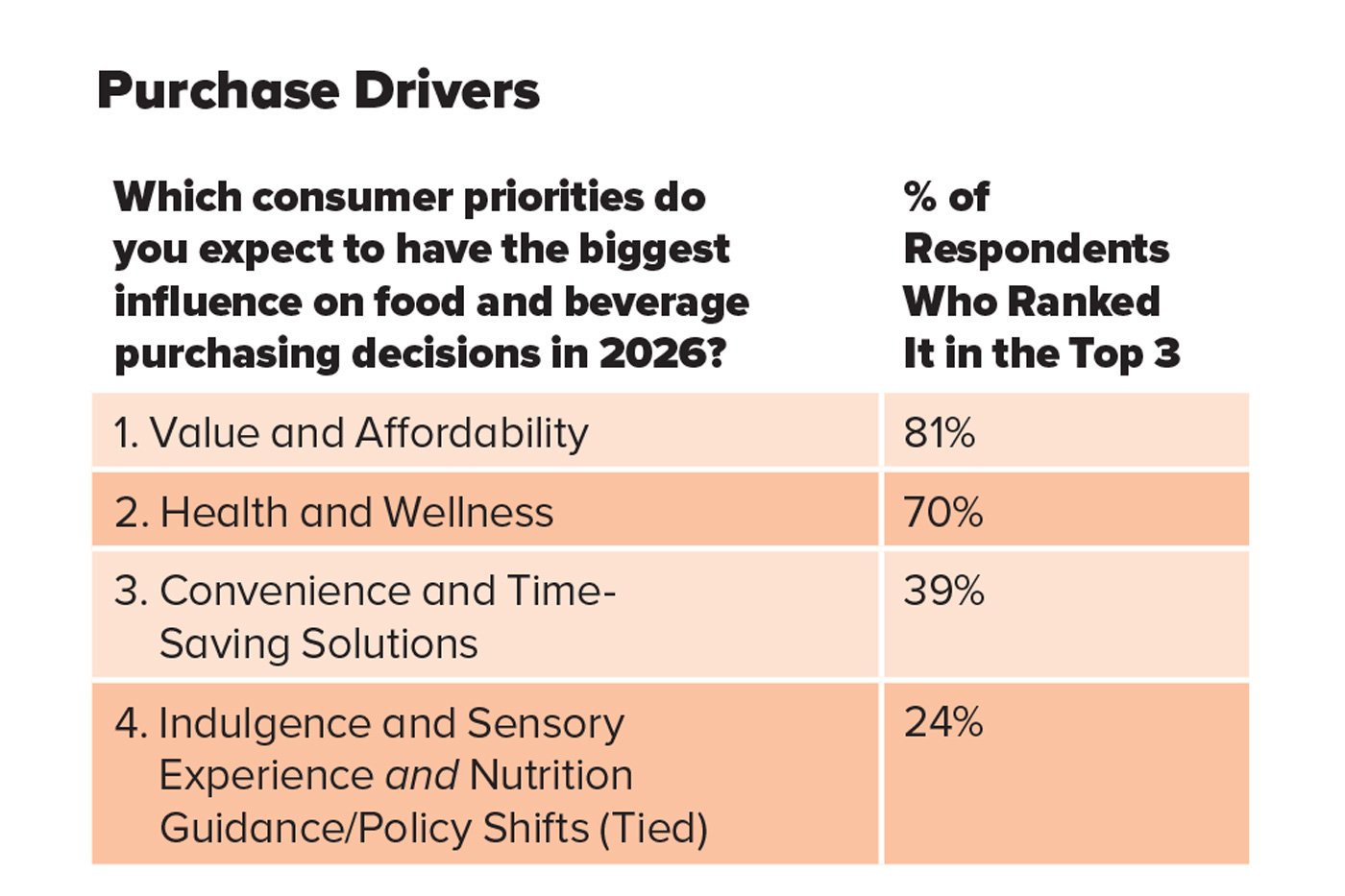
Value/affordability was No. 1 on the list of factors that will influence food and beverage purchasing decisions, cited by 81% of survey respondents, who were asked to predict the top three factors. (See Purchase Drivers table below.)
“Even traditionally higher-spending groups are trading down or eating at home more often as noted in Chipotle’s latest earnings,” says Thomas Bailey, Rabobank executive director – consumer foods and foodservice. “Brands that deliver strong value propositions—through bundled deals, affordable indulgences, and transparent pricing—are consistently outperforming [industry averages],” Bailey notes, pointing to Taco Bell and Chili’s as prime examples in the foodservice sector.
Value isn’t all about price, according to Bailey. “[It] doesn’t mean cheap,” he emphasizes. “It means perceived fairness and ‘more for less’ without sacrificing relevance or experience.”
Jenny Zegler, principal strategist at market intelligence firm Mintel, agrees with Bailey’s take on value. “Value has a complex definition—meaning both the actual price of a product as well as the tangible and intangible benefits that consumers receive in return for the price,” she reflects.
After years of inflation, “consumers’ value calculation will begin with the actual price,” Zegler says, noting that an October 2025 Mintel survey found that 54% of U.S. consumers say they have significantly changed their approaches to food and beverage purchases because of rising prices. Still, however, she says, “added value through enhanced benefits” will also win over shoppers “by helping them feel like they’ve scored a good deal.”
To be willing to spend more, consumers will need to feel confident that they are getting more bang for their buck, observes Sydney Byrne, marketing manager, Sensient Flavors & Extracts. It’s essential to “create purpose and value in everything,” says Byrne.
The best nutrition for the least amount of money is going to be the main focus.

2) Delivering on Health Benefits
The fact that consumers are increasingly price conscious doesn’t mean that they are ignoring the impact that food and beverage decisions have on their health. Just the opposite, in fact. In the IFT survey, health and wellness came in second on the list of factors expected to influence purchase decisions this year, cited by 70% of respondents.
If shoppers are spending hard-earned dollars for a product with a value-added nutritional positioning, they want it to deliver bona fide benefits. “Consumers have been worn down by inflation and are increasingly looking for clear value to come with premium pricing, like clean ingredients and measurable health outcomes,” says Erich Sieber, founding general partner of venture capital firm PeakBridge.
“Consumers expect products that taste exceptional, use recognizable ingredients, and actively improve their lives,” Sieber continues. “Measurable wellness is the new minimum for a truly viable product.”
“Consumers will be more intentional on how they spend their money for food,” says survey respondent Christy Kadharmestan, principal research scientist – global R&D, Amway. “The best nutrition for the least amount of money is going to be the main focus.”
It’s all about “nutrition per dollar,” says Michael Howard, CEO of Nichefire, a firm that taps into digital data to provide market insights. “We’re living in an interesting time where grocery prices are continuing to rise at the same time that we’re seeing strong consideration of health and nutritional goals.”
Nutritional claims related to fiber, protein, gut health, and brain health may be attracting consumers’ attention, but bottom line, Howard says, “the consumer of 2026 is also going to be scrutinizing every dollar.”
© Alina Storozhenko/iStock/Getty Images Plus
3) The GLP-1 Effect
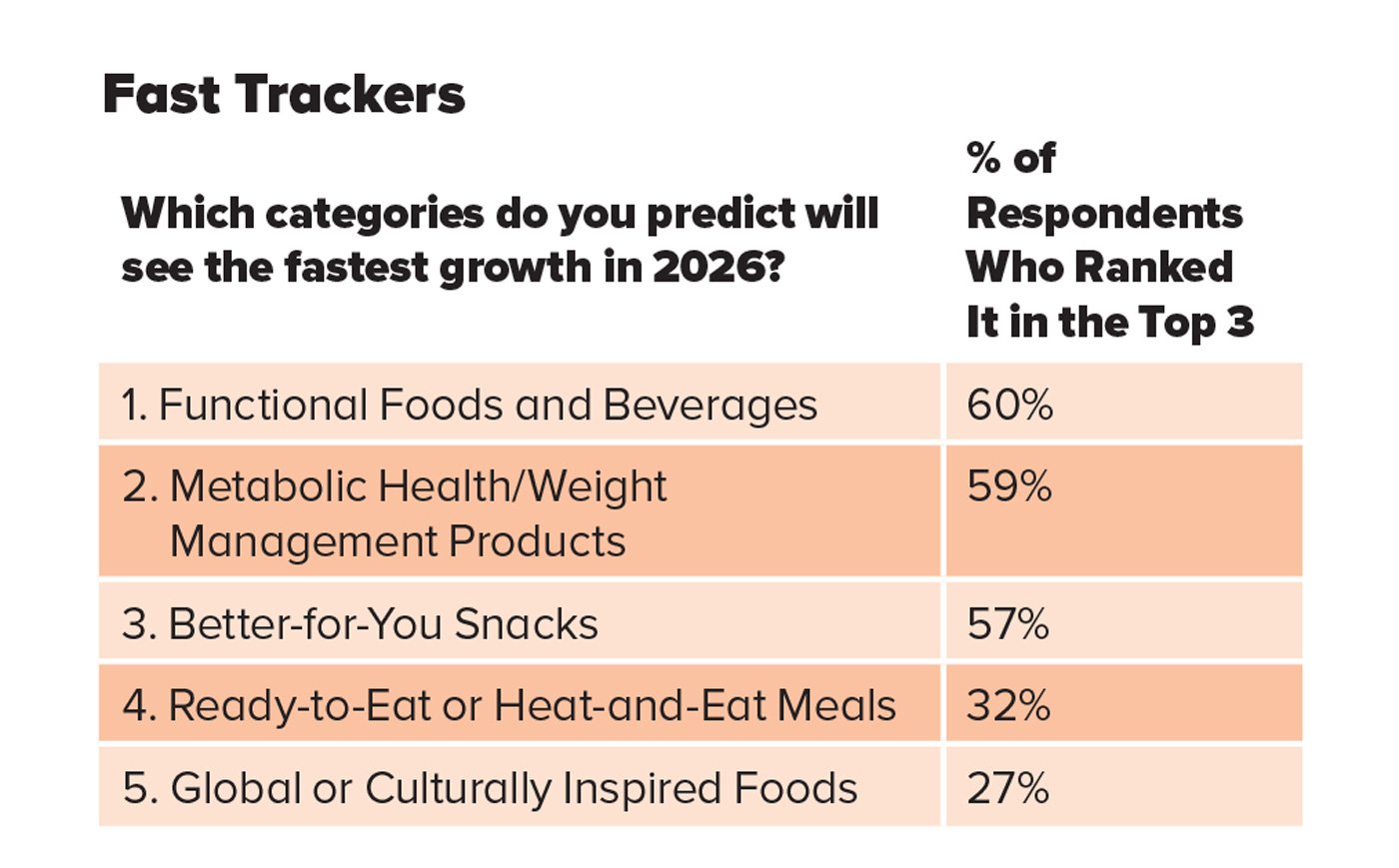
Arguably the biggest news at the intersection of health, wellness, and food in the past year has been the rise of GLP-1 medications to support weight loss. Food Technology trend trackers expect the food and beverage marketplace to reflect the ongoing impact of GLP-1s. Metabolic health/weight management products were a close second to functional foods and beverages in the list of categories IFT survey respondents expect to grow the fastest this year. (See Fast Trackers table below.)
“The GLP-1 revolution is really resetting consumer expectations around functional nutrition,” says Sieber of PeakBridge, emphasizing that “people want scientifically backed benefits they can actually feel.”
Protein has been the ingredient superstar in products formulated to support those using GLP-1s on their health journeys. “Protein beverages used to be limited to shakes, but now consumers can find protein water, protein sodas, and protein coffee and coffee creamers,” says Sensient’s Byrne. “There are even protein options in bakery, like bread, cookies, and crackers.”
Consumers will continue to prioritize protein intake for its satiety benefits and ability to support muscle mass maintenance during weight loss, trend watchers agree. Recent research from ingredient supplier MANE found that 46% of consumers rank “high protein” among the most important on-pack health claims, reports Samantha Forgham, MANE’s vice president of marketing and consumer insights. She adds that 39% of those surveyed say they don’t get enough daily protein.
This year, fiber may steal some of the spotlight from protein, however. It’s overdue, says Arlin Wasserman, founder and managing director of consultancy Changing Tastes. “We don’t think about it [fiber] enough,” Wasserman maintains. “But the constipation and other digestive problems associated with GLP-1s are the main reason most people who try the drugs quit within a few months,” he notes, adding that fiber can help address those issues.
Mintel experts also expect 2026 to be a big year for fiber. “Mintel predicts that consumer interest in fiber fortification will increase as people understand they are more than likely not consuming enough fiber, and, therefore, are missing out on fiber’s many benefits, including digestive health, as well as satiety,” says Zegler. “In addition, fiber is linked with heart health benefits, and 32% of U.S. consumers say heart health is a top benefit that they look for food and drink to provide.”
Fiber-rich diets are returning as a priority, and we expect to see natural, clean label fiber enhancement and fiber claims grow in 2026.

“Fiber-rich diets are returning as a priority, and we expect to see natural, clean label fiber enhancement and fiber claims grow in 2026,” says Terry Stover, senior vice president of special markets at Riviana Foods.
The ways that GLP-1 medications impact the food and beverage market will continue to play out, says Mike Kostyo, vice president with food and beverage consultancy Menu Matters. “I think the key for understanding how to build a pipeline for consumers on GLP-1 drugs is watching out for and planning for upcoming changes in the category. What happens when the prices drop? What happens when oral versions are released? What happens if a major side effect is discovered?”
Kostyo counsels food and beverage companies to avoid reacting to the GLP-1 trend out of fear but urges them instead to “thoughtfully consider how it will evolve.”
4) The Snacking Surge
Research firm Innova Market Insights reports that nearly half of U.S. consumers say they snack two to three times a day. Better-for-you snacks were No. 3 on the list of food and beverage categories that IFT survey respondents predict will see the fastest growth in 2026, just behind functional foods and beverages and metabolic health/weight management products. (See Fast Trackers table above.)
“The old associated stigmas of snacking have mostly fallen away as new products emerge that offer healthier options that include more nutritional value,” says Lu Ann Williams, cofounder and global senior vice president, research, Innova Market Insights. She adds that the interest in portion control that often characterizes GLP-1 medication users “will reinforce the role that snacking plays” in consumer consumption patterns.
“As anti-obesity medications scale, expect ‘snacks as sustenance’ and protein-dense mini meals to proliferate,” says Suzy Badaracco, president of trends foresight firm Culinary Tides. Financial pressures may also drive snacking behaviors, with some consumers replacing meals with snacks, Badaracco says. “But consumers will want them to feel purposeful (protein snacks, functional bites, and refrigerated prepared foods),” she continues. In addition, she predicts that appetizers will be recast as snacks in restaurants, “with menus repositioning shareables and small plates as value-driven meal replacements.”
Consumer belief systems will move away from the idea of good and bad food choices to a more generalized approach to managing their food choices portfolio based on daily habits, feelings, and actions.

Snacking won’t only be about price and portion control, however. Zegler points to Mintel research that shows that 27% of U.S. snackers define a snack as “a nutritional indulgence or splurging on something that ‘isn’t good for me.’”
Forgham says MANE is forecasting increased interest in “indulgent products and treats.” She anticipates that “[even] with the focus on health, wellness, and function, consumers will still reach for these products for reward and indulgent experiences. Consumer belief systems will move away from the idea of good and bad food choices to a more generalized approach to managing their food choices portfolio based on daily habits, feelings, and actions.”
Amy Marks-McGee, founder of Trendincite, a trend-focused marketing firm, observes that while some health-conscious individuals are cutting back on snacking, members of younger demographic groups continue to enjoy snacks. She notes that gamers, for example, seek out convenient, easy-to-eat products that deliver the energy they need to power through long stretches of gaming activity.
People want to eat their way to feeling better.

5) Make It Better!
From the COVID-19 pandemic to grocery price inflation to widespread political polarization, recent times have been stress-inducing. It’s an environment that some describe as a polycrisis—i.e., one crisis piled on top of another. In this climate, consumers are seeking functional foods in a bid to lower their stress levels.
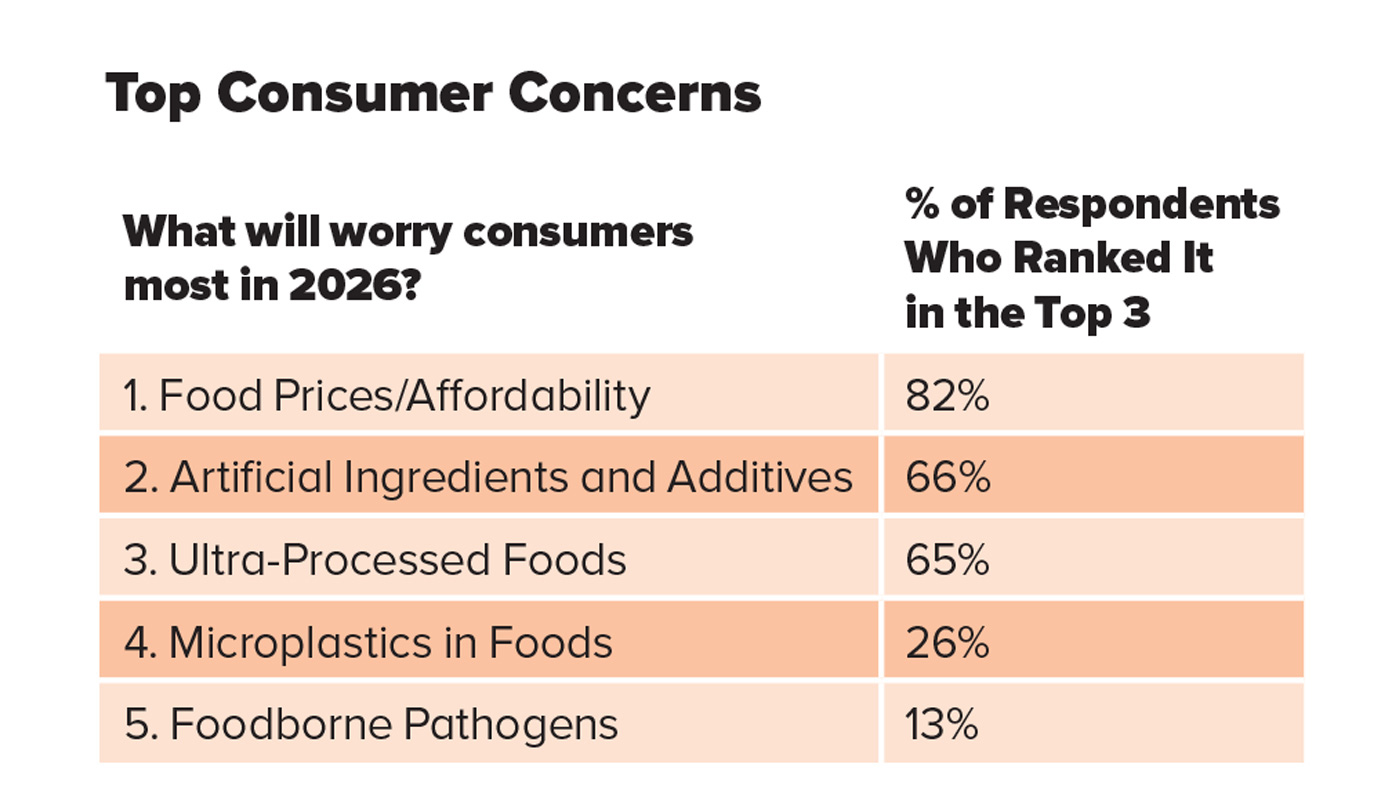
IFT’s survey asked respondents to weigh in on what they expected consumers to worry about in 2026. Food prices/affordability led the list, just as value/affordability did in the query related to purchase drivers as noted in trend No. 1). Artificial ingredients and additives were second on the list of worrisome things, closely followed by ultra-processed foods. (See Top Consumer Concerns table below.)
“People want to eat their way to feeling better,” says Wasserman of Changing Tastes. And that creates functional food and beverage opportunities.
“Products positioned around stress reduction, calm, and focus (adaptogens, functional botanicals, teas, and nonalcoholic elixirs) will gain momentum as financial and political stressors stay high,” Culinary Tides’ Badaracco predicts, describing it as a trend toward “mood and mental health editing.”
“Functionality beyond simple nourishment has become a baseline expectation,” Sensient’s Byrne observes. “People want food and beverages that improve their lives or make them better somehow.”
“Increased energy and increased calm and focus [are] both necessary to cope with the year ahead,” Wasserman reflects. It may seem counterintuitive, says Williams of Innova Market Insights, but energy and relaxation are the two functional benefits that she expects to see consumers prioritize this year. “Consumers need help supporting convenient nutrition—i.e., products that support energy levels, but also options that help them manage their mental load and unwind,” she says.
“Consumers are increasingly seeking out both sides of the mental and emotional spectrum, wanting increased energy and improved focus at one end and desiring relaxation and stress relief at the other end,” Byrne agrees.
As consumers seek to reduce stress, ease anxiety, and improve sleep, Marks-McGee believes they’ll turn to hybrid functional beverages that deliver added benefits via ingredients such as functional mushrooms and nootropics.ft
Consumers May Choose Price Over Planet
Consumers’ focus on price and value will have a trickle-down effect, reducing their willingness to spend more for products that tout sustainability benefits, some respondents to the IFT Consumer Trends Survey predict.
“Sustainability and ethical sourcing will be trends that start to decline due to a preference shift toward value and price,” says Kevin Nolan, director of quality at healthy snack company JUNKLESS Foods. “The cost of food will continue to rise significantly, and consumers will make the trade-off for price.”
Sustainability and ethical sourcing “have been catchy slogans over the past couple of years, but I believe that in 2026 people will become more focused on cost, convenience, and healthy options, causing these areas to fade,” says Scott Marckini, director of arbitrage research with Batory Foods.
Caitlin Thomson, a scientist with Australian food company Sanitarium, is also among the survey respondents who share that perspective. “I think the importance of sustainability has started to fade. With the increased cost of living, people cannot be putting money toward more sustainable choices,” Thomson says.
Hero Image: © Portra/getty images/E+
Authors
-
Mary Ellen Kuhn Executive Editor
Mary Ellen Kuhn, executive editor and assistant director of publications, oversees the editorial content of Food Technology magazine.
Categories
-
Food Health Nutrition
-
Functional Foods
-
Diet and Health
-
Food Technology Magazine
-
Market Trends


