
Fermentation Meets Fat Design

 Abbey Thiel
Food Technology Magazine
When most people imagine a fat-production facility, they think big: giant steel vats, pallet stacks of raw materials, and a maze of pipes moving oils from one processing step to the next. But what if a factory could be so small that millions of them fit on the head of a pin?
That is the promise of precision fermentation. Microbes become microscopic manufacturing plants, capable of producing fats with levels of structural control that conventional sources cannot achieve.
As Thomas Cresswell, chief business officer at Melt&Marble, a Swedish company that is developing designer fats through precision fermentation, explains, “With our technology, we are able to control the composition of the fats in terms of the different types of fatty acids. We can control the chain length, the saturation, and even the positioning of these fatty acids onto the glycerol backbone.” This represents a level of molecular customization that crops and livestock cannot offer.
For food scientists, this reframes fats as engineerable ingredients that can be designed for targeted melting behavior, mouthfeel, or even health profile.
The Basics
Fermentation is one of the oldest food technologies, but precision fermentation applies modern biology to turn microbes into highly specialized lipid-producing machines. At its core, the process works by rewiring metabolic pathways so that microorganisms convert simple feedstocks, usually sugars, into targeted lipids with predictable composition (Hilgendorf et al. 2024).
Although each company uses its own engineering strategies, the basic workflow is similar and follows this pattern:
1) Choose and program the microbe. Scientists select a host organism and insert specific genes so it can make the desired fat.
2) Grow and optimize it in bioreactors. The engineered microbe is fed sugars, oxygen, and other nutrients so it multiplies and shifts more of its carbon toward fat production.
3) Scale up the process. Move from small lab fermenters to large industrial tanks to produce enough fat for commercial use.
After fermentation, the lipids are recovered from the microbial biomass using separation processes such as centrifugation or filtration (Augustin et al. 2023).
Where Precision-Fermented Fats Fit
Designer fats made through precision fermentation are beginning to demonstrate their potential across multiple food categories, from meat and dairy to snacks and ready-made meals.
Among the companies advancing this space is Nourish Ingredients, an Australian firm focused on engineering high-potency lipids for flavor and texture. “Our focus is on revolutionizing the plant-based and hybrid food market with our animal-free fats that provide the same authentic taste, aroma, and mouthfeel as animal-based products, qualities that have been missing from the market,” says James Petrie, CEO of Nourish Ingredients.
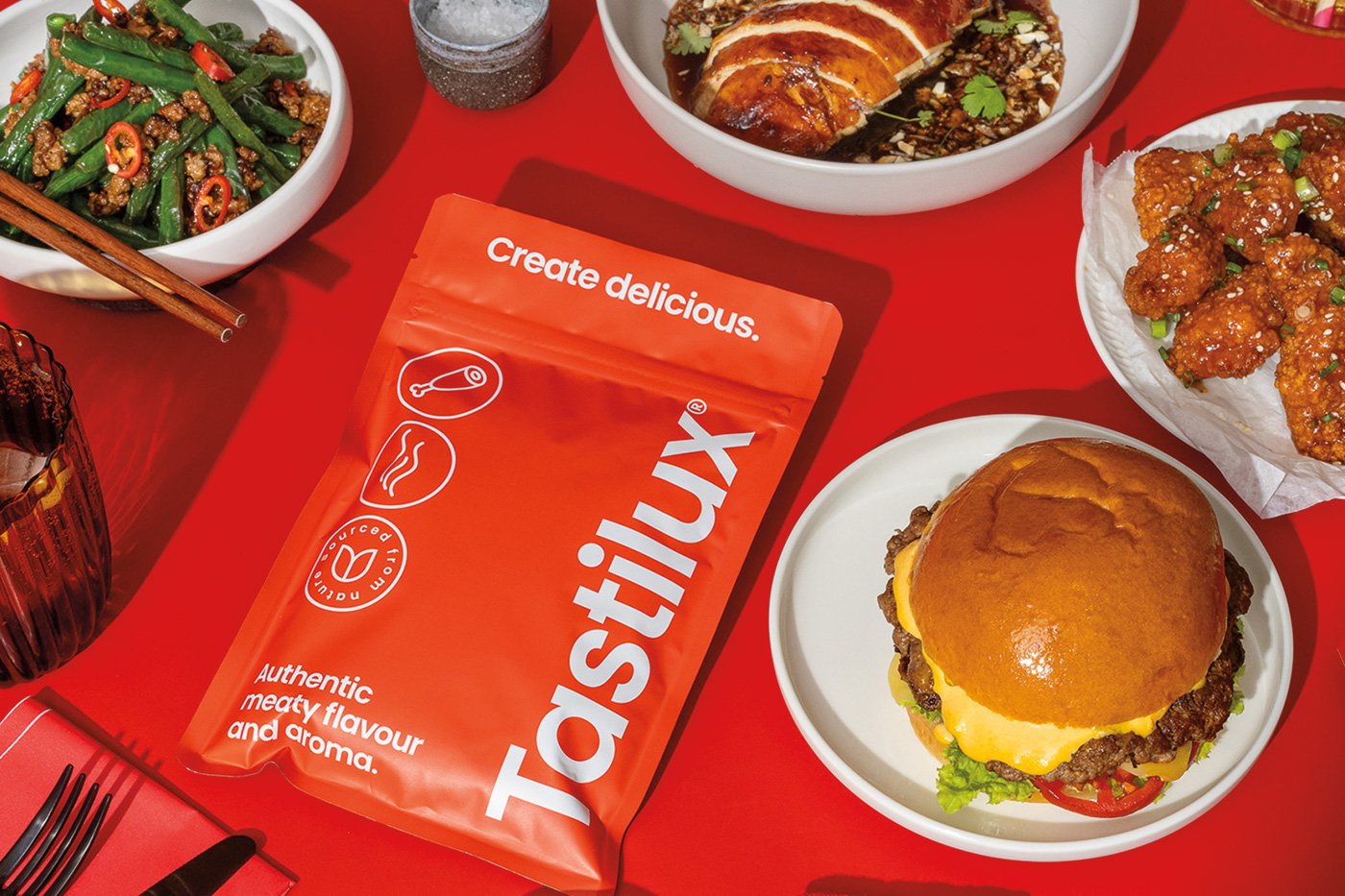
When incorporated into meat alternative products before cooking, Nourish Ingredients’ Tastilux designer fat triggers Maillard reactions. Photo courtesy of Nourish Ingredients
The Nourish fat ingredient Tastilux is engineered to supply the long-chain omega-6 phospholipids that drive browning and aroma development. When incorporated into meat alternatives before cooking, it triggers Maillard reactions that mimic chicken, beef, and pork. In a recent independent study, “73% of the growth market (mainstream customers who do not currently buy plant-based products) preferred a plant-based product when Tastilux was included,” says Petrie.
Nourish’s fats are also highly potent, with Tastilux delivering full impact at inclusion levels as low as 0.5%, allowing manufacturers to simplify formulations while boosting flavor. The company’s dairy-focused Creamilux targets another long-standing gap in plant-based products: mouthfeel. Petrie describes it as a lipid solution that “provides the genuine creamy texture and emulsification properties that replicate the mouth-coating sensation of full cream.”
Melt&Marble is focusing on designing fully structured fats from the ground up. As Cresswell explains, their technology not only mimics the behavior of existing fats but also “lets us create fats with new properties that do not simply seek to replicate existing plant or animal fats but are instead optimized for whatever function is needed.” This includes the ability to engineer fats similar to cocoa butter but with melting profiles better suited for warmer climates, which can present logistical challenges for confectionery distribution.
Melt&Marble’s emphasis on solid-fat engineering positions it to address categories where plant oils perform poorly. Its recent partnership with the Finnish food and dairy company Valio aims to bring these fats into consumer products and marks an early step toward broader commercialization.
Market and Regulatory Hurdles
Both companies are now moving from R&D into early commercial deployment, but their regulatory progress reflects the varied approval timelines across global markets.
Nourish Ingredients recently achieved a major milestone in the United States: FEMA GRAS status for its Tastilux flavor ingredient. “This regulatory clearance means that we can now sell Tastilux directly to U.S. food manufacturers and brands,” says Petrie. “It’s a major step toward full-scale commercialization.”
Melt&Marble expects to follow a similar route. Cresswell says the company expects to achieve GRAS self-affirmation in the near future, “which will pave the way for future launch into the U.S. food market.” But entry into Europe will take significantly longer, as the European Food Safety Authority’s Novel Foods approval process can extend up to two years.
Because of these lengthy timelines, precision-fermented fats are expected to reach U.S. and Singaporean markets well before appearing on shelves in the European Union. Both companies are already preparing multinational submissions, but because there is no global approval system, they must adapt to a different set of regulations in every region.
Building Trust
Despite the scientific gains behind precision-fermented ingredients, consumer acceptance remains one of the most significant hurdles. The industry has seen this pattern before: Genetically modified foods faced resistance not because of technical flaws, but because consumers rejected them.
Mariana Hase Ueta, a researcher at Wageningen University & Research who studies the societal impact of novel food technologies, emphasized that technical performance alone is not enough to ensure adoption. “Many technologies fail because they don’t fit the systems they exist in, don’t respond to contextual problems, and don’t offer benefits to the actors involved,” she says. Her work with precision-fermented milk proteins shows that acceptance improves when farmers, consumers, and other stakeholders are involved early in the development process rather than after decisions have already been made. “We can learn a lot from the GMO experience, where the development of technology excluded civil society, which resulted in fear and opposition when the products finally reached consumers,” she continues.
Fermentation isn’t new; humans have used it for thousands of years.

Companies developing precision-fermented fats are increasingly considering how to introduce these ingredients in ways that build trust and clearly communicate their value. Petrie underscores the value of grounding communication in familiarity: “Fermentation isn’t new; humans have used it for thousands of years.” For him, consumer trust grows when companies highlight tangible benefits such as fewer artificial ingredients and cleaner labels.
Cresswell echoes this benefit-oriented framing. Consumers, he says, “care most about outcomes: better nutrition, improved sustainability, and higher-quality products. When companies explain how precision-fermented ingredients reduce environmental impact; avoid allergens; or improve flavor, health, or performance, trust grows naturally.”
What Comes Next
As precision fermentation matures, fats may become one of the most flexible ingredient classes in the food industry. Instead of being limited to what nature provides, food scientists could increasingly design lipids around function, which might mean driving specific Maillard pathways, tuning melt curves for new climates, or creating entirely novel textures.
As production scales, regulatory approvals broaden, and consumers become more familiar with fermentation-derived ingredients, these fats are positioned to move from promising innovations to foundational building blocks of next-generation foods.ft
Hero Image: Photo courtesy of Melt&Marble
Authors
-
Abbey Thiel Food Scientist
Abbey Thiel, PhD, is a food scientist and food science communicator who created her own YouTube series, Abbey the Food Scientist, to explain complex scientific topics in engaging ways. Her professional life includes working as a research project manager for Wageningen University, as a lecturer for the University of Wisconsin–Madison, and as a consultant, in addition to freelance science writing. She has a PhD and BS degree in food science from the University of Wisconsin–Madison.
Categories
-
Emerging Science and Technologies
-
Food Product Development
-
Food Ingredients and Additives
-
New Product Development
-
Innovation
-
Biotechnology
-
Fats and Oils
-
Novel Technologies
-
Food Technology Magazine


