

Harvesting New Agricultural Technologies
Will advances in gene editing and artificial intelligence push food innovation further upstream?
 Kayt Sukel
Food Technology Magazine
Key Takeaways
-
Gene editing technologies like CRISPR are opening the door to crops that can better withstand pests, disease, and climate stress.
-
Progress toward broader adoption of CRISPR and other gene-editing technologies may be hindered by intellectual property challenges.
-
Widespread implementation of these innovations will depend on its ability to provide benefits to multiple stakeholders, including farmers, formulators, and consumers.
When CRISPR technology first hit the scene in 2012, many saw its promise in tackling stubborn genetic diseases in humans. Yet this gene-editing technique also offers scientists the ability to quickly, precisely, and cost-effectively alter genetic traits in crops, providing the potential to grow hardier stock while increasing yield and improving nutrient density.
“This kind of gene editing allows you to make changes that you’d actually find in nature,” says Tom Adams, chief executive officer at Pairwise, an agricultural biotechnology company that is leveraging CRISPR to develop improved fruit and vegetable varieties. “It’s something that can help us bring value to the food industry, changing the way different traits are deployed to address different problems.”
For the better part of a century, food innovation has largely occurred after crops have been harvested. But increased use of emerging technologies, like CRISPR and artificial intelligence (AI), could push innovation to the very plants themselves. Instead of adding vitamins and minerals through fortification or formulating products to improve taste or texture, today scientists are working on groundbreaking techniques with the power to achieve these goals before a seed is put in the ground. As these technologies continue to evolve, however, it is incumbent on the food industry to answer some critical questions. How will the use of emerging agricultural technologies (agtech) change the way foods are developed? What impact might they have on current supply chains? And how can we best ensure that all food industry stakeholders, from grower to consumer, will benefit from agtech adoption?

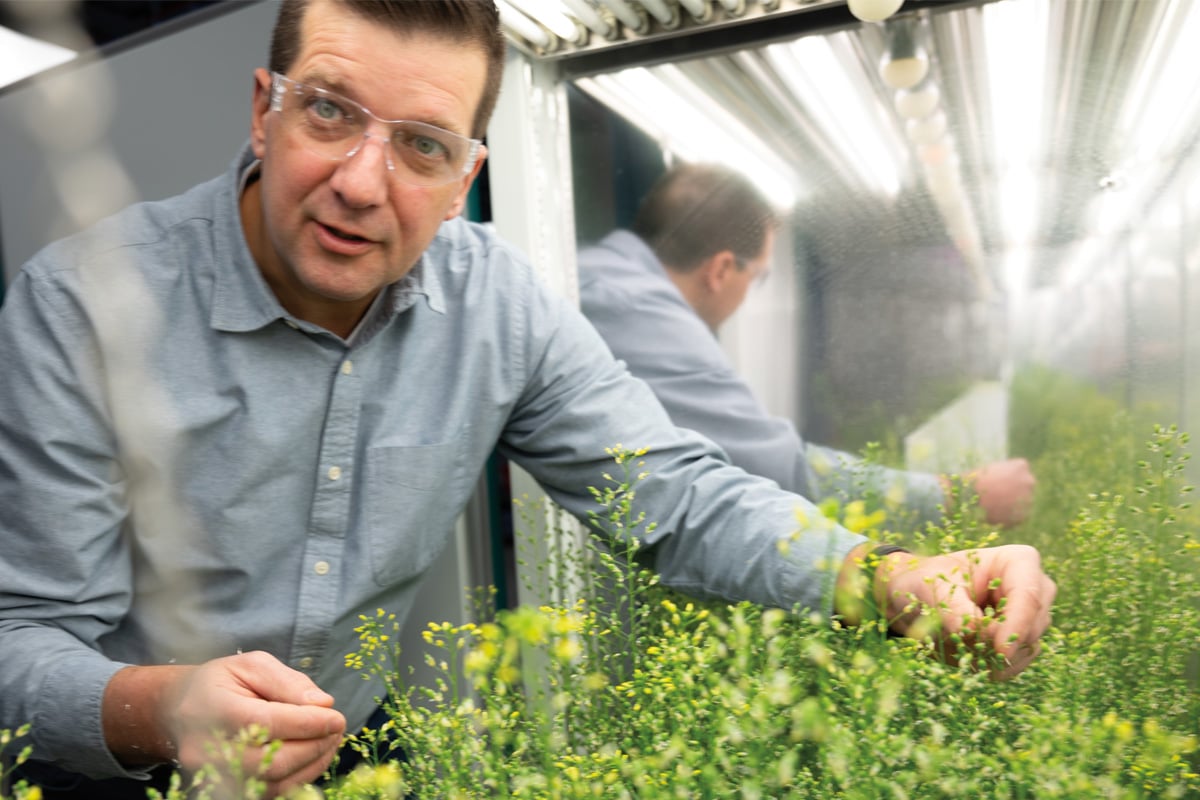
As deputy director of RIPE, Donald Ort leads research focused on uncovering the underlying causes of photosynthetic inefficiency. © GEGC/ SmugMug, CC BY 4.0

Work by Zachary Lippman of Cold Spring Harbor Laboratory has altered the genetics of tomato plants, enabling faster ripening and greater yield. Photo courtesy of Cold Spring Harbor Laboratory

Lab-based plant research at Cargill’s Crop Innovation Center helps drive advances in food and agriculture. Photo courtesy of Cargill
Boosting the Right Traits
Zachary Lippman, Jacob Goldfield professor of genetics at Cold Spring Harbor Laboratory, says there have been remarkable breakthroughs in crop innovation over the past five years. Genome sequencing has provided pangenomes, or “the DNA blueprint not of a single species, but many varieties or genotypes within a species and related species.” Those pangenomes, he says, offer scientists the ability to look at how genomes have adapted over time, identifying the genes, or combination of genes, responsible for beneficial or attractive traits like heat tolerance, crop yield, or improved flavor. Today’s agtech researchers can leverage the pangenomes to target specific genes for editing. However, Lippman cautions, even with this knowledge, it’s difficult to know where “to point [CRISPR] and with what strength you should shoot.
“Gene-editing technology is a big bazooka, if you will, that we use to try solve a problem,” he says. “Do you edit the gene? Do you edit the DNA that regulates the gene? You need to think about any changes you make in the context of networks instead of this gene is responsible for this and that gene is responsible for that so you can get to the trait you want to get to.”
Numerous studies and pilot projects have shown that it is, indeed, possible to deploy such a bazooka in specific applications. But it takes time and precision. Lippman’s own research has improved tomatoes, altering their genetics in ways that help them ripen more quickly as well as have single plants produce more fruit. Pairwise made headlines a few years ago for developing a mustard green without its telltale bitterness, and it has also produced high-yield seedless blackberry plants that can be grown at higher density. And then there’s the Realizing Increased Photosynthetic Efficiency (RIPE) for Sustainable Increases in Crop Yield project, which is leveraging gene editing to “remedy inefficiencies in photosynthesis” to improve crop yields.
This kind of gene editing allows you to make changes that you’d actually find in nature.

Adams says he sees these advances as merely “the tip of the iceberg.” In time, he and other stakeholders could translate the trait alterations achieved in one plant to others—which can accelerate agricultural improvements.
“If you can get more fruit in a year and a half, as opposed to in three to five years, it makes a big difference in what you think about putting in the ground—and where you put those plants in the ground,” he says. “It could open up more local production for different ingredients, increasing our yields and expanding our supply chains.”
There is significant potential to improve and increase different ingredients in the food supply through agtech, agrees Donald Ort, Robert Emerson professor of plant biology and crop sciences at the University of Illinois and deputy director of RIPE. But he says that, to date, much of the work has been done in academic laboratories. And those results do not always translate well to the real world—particularly to commodity agriculture.
“Academia and commodity agriculture often have different goals—and we aren’t always so well versed in each other’s businesses,” he says. “Historically, food companies have been much more interested in product development. For us to really scale these new technologies will require companies to have the ability and will to invest in modeling to understand how these traits work and then the engineering to skillfully edit them.”
Crop-Level Specifications
Today, food manufacturers specify functional and compositional needs for ingredients like protein content, oil stability, starch viscosity, micronutrient levels, and more. Ingredient companies then work to identify specific supply chains that can provide them or, instead, add those traits during processing.
With advances in plant genetics, most can see a future where food companies will ask for those traits to be provided at the crop or seed level. Lyle DePauw, director of crop innovation at Cargill, says food and ingredient companies are already making investments in agricultural technologies. And, unsurprisingly, their customers are starting to query where, when, and how gene editing could help them attain specific requirements.
“Sometimes companies are asking for improved nutrition. Others want improved flavor. People are also interested in greater sustainability. But these things, most of the time, could be achieved through supply chain or crop innovation. There are different approaches we can use to meet those customer needs, and we need to determine the best one,” he explains.
We can leverage these technologies to not only produce a safe, reliable, and healthy crop, but also a profitable crop for farmers.

There is excitement about emerging technologies, says DePauw, but as ingredient companies like Cargill look at new ways to provide customers with specific crop traits, it is important to understand that innovators can still “only move at the speed of biology.” It is imperative that food companies understand that—and be willing to think about longer-term investments when applying new agtech.
“When there’s a set of wants, I get one growing season to learn something, reset, and then do it again,” he says. “So as these new asks are coming in, we take the view of ‘now, near, next.’ What solutions do we have ready to go today? Where are we close—with something in pilot phase? And then what are the farther out projects? That’s where the dreaming comes into play and we start thinking about how to prepare our teams to address [projects] for 2036, not 2026.”
Getting the Market Ready
Today, food companies rely on extensive processing steps, including protein fractionation, oil hydrogenation, micronutrient fortification, and chemical starch modification, to create the ingredients they use in product manufacturing. Crop innovation could potentially reduce the need for such extensive processing—if consumers accept it.
“There is an interesting dynamic today, with the Make America Healthy Again movement, of trying to reduce processing,” says Adams. “There’s definite potential for that with these new technologies—you could modify some of the nutritional content of grain crops that get used in ingredients all over the place and provide simpler labels by creating, from the crop itself, the starch, oil, and protein profile you want without chemical processing.”
While there are examples already out there—high-oleic oilseed crops that reduce the need for hydrogenation and ultra-high-protein soybeans that simplify protein extraction—it will take time to expand those kinds of ingredient portfolios. In addition, says Robert Saik, an agricultural consultant and author of Food 5.0: How We Feed the Future, there is the matter of consumer acceptance to consider. While he says that the European Union has “softened” its stance on gene editing, the ghosts of transgenic technologies and “genetically modified” labels still haunt the industry. It will require education to help consumers understand the advantages of future crop improvement methods.
“The reality is, when you say people are against genetically modified organisms (GMOs), there are only eight crops that fall into that category in the system,” he says. “CRISPR and gene editing is advancing where we may not need transgenic crops anymore … but people are still ignorant of what genetically modified means in food and the only way to combat that ignorance is educating people. They need to understand how CRISPR can help alter output trait technology in a way that helps us feed all the people we need to feed in the future.”
DePauw believes that food companies should “get in front of” misinformation, helping consumers embrace new ingredients before they become more mainstream. “We can go back to the fundamentals to improve nutrition and flavor in many of these plants with our knowledge of genetics, plant breeding, food science, and genetic engineering to reduce downstream processing,” he says. “But people have emotions about some of these tools. And we need to help consumers understand the value in using them to advance crops faster and meet the needs they are asking us to meet.”
The Intellectual Property Question
There is another issue for food companies that may be considering new and evolving agtech: intellectual property (IP) rights. Lippman says that CRISPR and other gene-editing technologies can help better meet consumer demands in the future—perhaps even at reduced costs—but only if those applications are not locked into IP battles.
“CRISPR has become more democratized over the past decade but there’s a continuing fight over licensing for some of these techniques,” he says. “Unfortunately, there are advances that we won’t be able to get out of the research realm, even though they are technically products that can benefit the food industry, because we don’t have the licensing rights to sell and distribute them.”
Pairwise has worked to alleviate some of these concerns with its Fulcrum Platform, which offers customers a Pairwise-developed suite of gene-editing tools and is designed to help save some developments from languishing in the laboratory. “There’s more than one CRISPR protein,” Adams explains. “Because we worked to create a better enzyme, we were able to create a CRISPR tool that is free of intellectual property issues. We also added the bells and whistles to help companies do different types of editing without a lot of restrictions on it, which can help spur new products.”
The Future of Agtech
When asked what the future of agtech might look like, Saik says he foresees greater “convergence” across a variety of promising applications. AI will be a great equalizer, he adds, combining with sensors on the input side of agriculture to shape more efficient, productive farming operations and then CRISPR on the output side to enhance crop traits.
We need to understand that any technology has to benefit the whole system or else, no matter how intriguing, it will not and cannot be effective.

“We can leverage these technologies to not only produce a safe, reliable, and healthy crop, but also a profitable crop for farmers,” he says.
At some point, it is likely, even probable, that food companies will be able to successfully select for traits like pest resistance, heat tolerance, nutrient density, and more—and those selections could occur at the seed level instead of at the processing plant. These technologies have the power to become a significant competitive advantage for food companies, ultimately transforming product formulations and supply chains.
How, exactly, it will do so, however, remains an open question. But it’s one, says Kamesh Ellajosyula, chief innovation and quality officer at Olam Food Ingredients (ofi), that food and ingredient companies can guide by embracing strategic partnerships and investments moving forward. Greater adoption and application of these promising technologies, he adds, depends on it. “Any technology scale-up requires a lot of collective effort, which you can only gain through strong partnerships,” he says.
“You need to make sure the technology you adopt works for the farmer, that it works for the processor, [that] it works for the company formulating and manufacturing the food product, and that it works for the consumer. As we move forward and we see more advances coming, we need to understand that any technology has to benefit the whole system or else, no matter how intriguing, it will not and cannot be effective.”
Learn More
In episode 86 of the Omnivore podcast, Cargill's Lyle DePauw discusses how advances in breeding, genomics, gene editing, and AI are helping food companies develop more resilient, nutritious, and functional ingredients by innovating at the crop level.
Hero Image: © fotokostic/iStock/Getty Images Plus
Author
-
Kayt Sukel Author
Kayt Sukel is a book author, magazine writer, and public speaker who frequently covers scientific topics (ksukel@hotmail.com).
Categories
-
Food Product Development
-
R and D
-
Food Technology Magazine
-
Ingredient Trends
-
Innovation


