
INGREDIENTS
Spice It Up: What’s Hot in Seasoning Ingredients

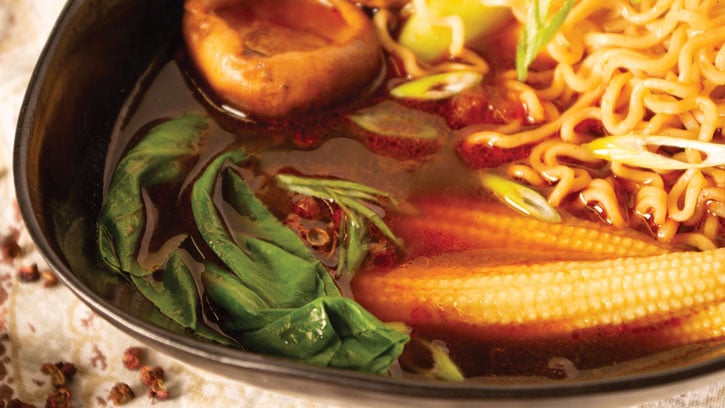
Hot Pots, like this one featuring seasonings from Fuchs North America’s East Asian Creations Collection, have been growing in popularity among consumers. Photo courtesy of Fuchs North America
Global travel may be a shadow of its former self during the COVID-19 pandemic, but consumers are continuing to expand their culinary horizons by seeking out unexplored regional and national cuisines. The quest for spiciness and authenticity is leading to more regionally specific seasonings that add layers of flavor to traditional dishes from other parts of the world. And the desire to navigate new taste territories is inspiring innovative seasoning blends that mix and match lesser-known ingredients.
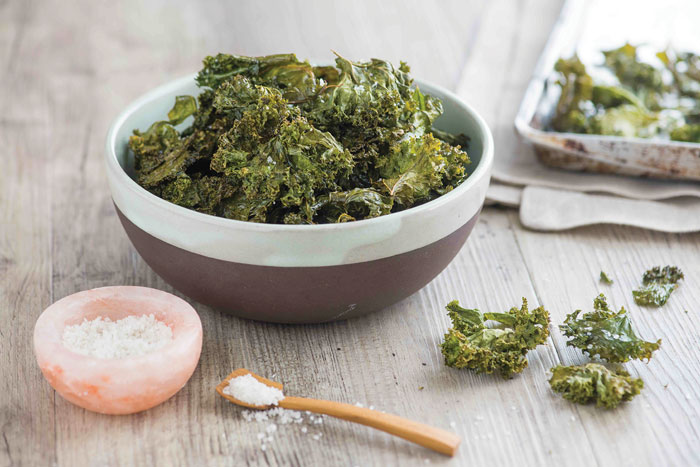
Kale chips can be a healthy snack, and gourmet sea salt elevates the taste experience. Photo courtesy of SaltWorks
“We’re . . . seeing a strong demand for global flavors,” says Mark Zoske, founder and CEO of SaltWorks, which supplies traditional, flavored, and smoked natural salts. “Since many consumers aren’t dining away from home as much anymore, they are craving those big, bold flavors and spices reminiscent of restaurant-quality food.”
“Ethnic cuisines are trending across the board,” agrees Shannon Cushen, director of marketing at Fuchs North America, a supplier of premium custom seasoning blends. “Adventurous consumers—and especially millennials—are constantly seeking out foods and flavors from around the world.”
Eastern Mediterranean, North African, East/Southeast Asian, and Indian cuisines are among the top influencers for trending ingredients in the $16 billion global spices and seasonings market, according to data from research firm Fortune Business Insights. “In the past year or so, we’ve noticed a substantial increase in demand for Middle Eastern and North African cuisines,” says Cushen. “Consumers have been gravitating toward exotic dishes from countries that border the Mediterranean, like Morocco, Israel, and Lebanon. Ethnic spice blends from this region, as well as other parts of Africa and the Middle East, have been featured in an increasing number of menu items and retail brands.”
“Right now, Asenzya sees both Indian and Eastern Mediterranean showing good potential for the seasoning market,” adds Dax Schaefer, corporate executive chef at Asenzya, a maker of custom spice blends and functional ingredients.
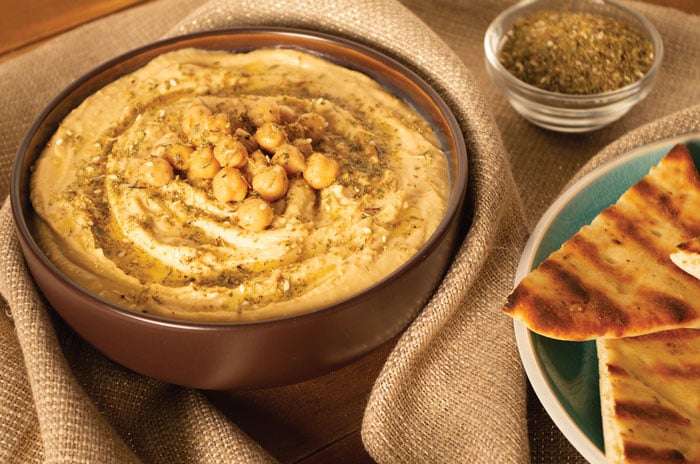
Middle Eastern seasonings add authenticity to classic hummus. Photo courtesy of Fuchs North America
The cuisines of East Asia and Southeast Asia, particularly South Korea, Vietnam, Japan, and Thailand, also continue to gain popularity among consumers, says Cushen. “These cuisines feature trending profiles—like sour, fermented, and spicy flavors—and also are typically perceived as healthy by consumers, who have grown increasingly health conscious. Dishes like kimchi, green curry, gochujang, and pho are being translated into seasoning blends and flavors for snacks, proteins, frozen meals, and more retail products.”
This spring, Trader Joe’s rolled out its new fresh Harissa Flavored Chicken Thighs, which can be roasted or grilled by the consumer. Conagra Brands’ Gardein launched frozen Spicy Gochujang Style Chick’n Wings made with its proprietary pea and wheat protein blend last summer. And DNX Foods’ Free Range Chicken Peri Peri Style Bar has been garnering good press as a protein-packed, keto-friendly pick-me-up that ventures beyond traditional meat snack flavors.
Here’s a look at how global flavor trends are translating into seasoning ingredients that meet consumers’ demands for authenticity, more sophisticated tastes—and heat.
The Heat Is On
Peppers are hot: More than half of global consumers go for spicy dishes when dining out, compared with 43% in 2017, according to data from Kalsec’s 2019 Spicy Perceptions report. But consumers increasingly are looking for more nuanced flavors along with mild, medium, or hot levels of heat. The source of the heat, such as a specific pepper varietal, matters to more than half of global consumers, according to Kalsec data.
Ancho, serrano, and habanero are just the beginning for consumers looking for peppers with authenticity in global cuisines. “The Aleppo pepper from North Africa is much more mainstream now,” says Anna Cheely, senior scientist and manager at Kalsec. “The Baklouti pepper from Tunisia is in a category similar to Aleppo—not too spicy but giving a lot of flavor. Among emerging peppers, we’re seeing [very hot] bird’s eye chile, biquinho—a teardrop pepper from Brazil that’s low in pungency—and Calabrian chile.”
Corporate chef Juliet Greene at Mizkan, which markets vinegars, peppers, and other ingredients, agrees that pepper preferences are branching out globally. “Hispanic and Asian flavors are firmly established in the mainstream, and we’re moving into more hyperlocal and specific regional flavors in the spicy flavor palette . . . crushed chile peri peri sauce from Africa and Portugal [and] the fruity and spicy aji amarillo pepper from South America,” says Greene.
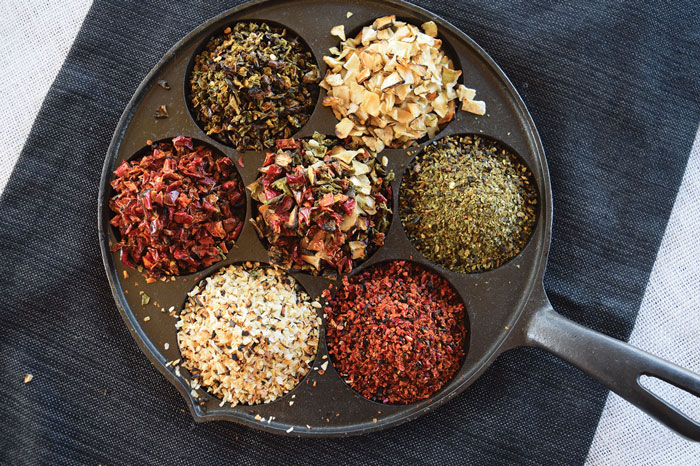
Using ingredients such as Sensient’s Fire Roasted Peppers and Vegetables can add an element of sophistication to even simple menu items. Photo courtesy of Sensient Natural Ingredients
Mexican and Peruvian cuisines offer opportunities to use peppers in products appealing to consumers who want more adventurous spicy, earthy, and pungent flavors, says Mariam Chkhikvadze, sales associate at Sensient Natural Ingredients. “[You can use] varietals such as Hatch, ancho, red and green jalapeño [peppers], in addition to colorful and tasty peppers such as aji rocoto, aji amarillo, aji limo, and aji panca,” she says. Sensient’s new line of Fire Roasted Peppers and Vegetables, for example, includes Fire Roasted Green Jalapeño in granulated and ¼-inch diced formats.
Younger consumers tend to prefer hotter peppers, with 59% of consumers aged 18–34 opting for very spicy foods, according to 2019 data from Technomic. But no matter how many heat units a pepper hits on the Scoville scale, which ranges from 0 for bell peppers to 1.2 million for the Trinidad Moruga scorpion pepper, reliable sourcing is important to maintain a consistent heat level in foods.
Almost any food or beverage product can be fair game for a spicy boost, but most consumers still prefer their heat in familiar savory foods such as entrées, dips and sauces, and snacks, according to 2019 data from Kalsec. New Sichuan Beef Hot Pot Base from Fuchs North America taps into both East Asian and spicy trends, according to a company press release. “Hot pots have been trending in foodservice lately, as consumers love their customizability,” said Howard Cantor, Fuchs’ corporate executive chef, in the press release. “Not only is our hot pot base spicy and savory, but it is incredibly versatile—add just about any protein or meat to it, and you’ve got a mouthwatering meal.”
Regional Asian Ties
As global cuisines that used to be considered exotic become more mainstream, consumers are delving more deeply into the specific seasoning ingredients used in different regional variations of these cuisines.
Chinese food, for example, is no longer seen as one-size-fits-all but as a group of regional cuisines, according to SupHerb Farms’ white paper, “Trending Now: Regional China.” Although only 39% of consumers say they understand the differences between the eight regional cuisine types within China, 58% would like more restaurants to offer fare dedicated to a specific region of China, according to the white paper. Tops among the emerging regional Chinese seasonings, SupHerb Farms projects, will be Sichuan peppercorn, a mildly hot spice with slight lemony overtones, and Cantonese XO sauce, a blend of red chile pepper, ham, and dried scallops and shrimp.
As the use of newer authentic blends grows, expect to see more applications beyond the cuisines in which these blends originated.
Indian cuisine offers perhaps the most promise as a jumping-off site for regional seasonings to hit the mainstream. Mintel’s U.S. Flavor and Ingredient Trends 2019 report sees “significant opportunity for dishes and products that explore the regional specialties of India.” Symrise’s 2020 North American Top Trends Report singles out cuisine from Southern India, particularly the state of Kerala, as ripe for expansion, “with consumers starting to appreciate the many nuances within Indian cuisine rather than looking at it as a monolith.”
“We’ve been hearing [about] Indian cuisine for over a decade, so it may sound funny to hear Indian yet again, but I think Americans are starting to gain an understanding of the key ingredients and flavor profiles that go into Indian cuisine,” says Asenzya’s Schaefer. “This education is happening through newer QSR chains that have Indian cuisine, like Choolaah Indian BBQ in the Northeast or Hot Indian in Minneapolis. We’ve also seen more requests for common spices in Indian cuisine,” he adds.
Garam masala, a hot blend of spices that may include cloves, cinnamon, cumin, and coriander, is a common seasoning in India. In the United States, masala spice mix is increasingly turning up in foodservice fare, with 141% more menu mentions from 2015 to 2018.
In Northern Indian cuisine, yogurt and onions are a common food foundation. Southern Indian cuisine, which typically is spicier and uses a coconut base, is the home of milagai podi, also known as gunpowder spice. McCormick’s 2020 Flavor Forecast has singled out this dry condiment as a seasoning that’s ready to explode, says Kevan Vetter, executive chef and director of culinary development for McCormick.
“Typically, milagai podi is made using a dal, which is a dried lentil that’s then toasted and ground with spices. Some of the flavors you might find in the spice blend include cumin, coriander, cardamom, cinnamon, sesame, crushed red pepper, and mustard seed,” says Vetter. “This technique of dry roasting or frying spices unlocks all the oils to really pull out the rich flavor that Indian cuisine is known to have. If you’re looking to add an Indian flavor profile or rich spice note, you can just sprinkle a little on top of any dish.”
Indian street food, spread across all regions of the country, is another culinary segment drawing increased interest from consumers. New Delhi, Mumbai, and Kolkata offer a lively variety of street foods, especially the savory snacks known as chaat that are flavored with dry spice mixtures, according to Ryan Kukuruzovic, corporate chef at Wixon.
“While exploring the myriad flavor combinations, we found their [chaat] craveability was due not only to the spice combinations, but also to their sensory appeal,” he says. “The crunchiness together with the distinctive flavors is what truly makes them so craveable. Interestingly, while most Indian street foods are savory, we used the taste combinations to develop unique sweet snack applications as well.”
Authentic Blends
The spice blends of North Africa and the Eastern Mediterranean are generating more interest throughout the world these days, with their complex layerings of flavor. “Recently there has been a lot of activity for blends containing Middle Eastern or Eastern Mediterranean spices, such as turmeric, coriander, and warm brown spices,” says Asenzya’s Schaefer. “If I had to pick a few blends that I could see becoming standouts . . . it would be za’atar and zhug, both from the Eastern Mediterranean region. These two seasonings contain a great flavorful profile and are very approachable on many levels.”
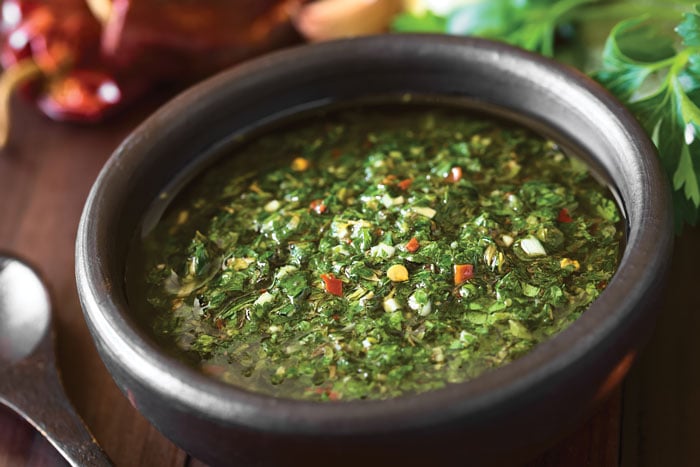
Zhug, a spicy green sauce used throughout the Middle East, is gaining in popularity. Photo courtesy of Mizkan
Mizkan’s Greene also highlights zhug, along with shatta, as promising seasoning blends for creating flavor that packs a punch. “Zhug and shatta are two sauces from the Middle East that are starting to gain ground,” she says. “Zhug is similar to chimichurri sauce but is thicker and made from spicy chiles, onion, garlic, cilantro, and parsley. Shatta also uses parsley and cilantro, but it incorporates red jalapeño puree and tomatoes for a slightly sweeter profile.”
Greater mainstream acceptance of seasonings like North Africa’s harissa and Ethiopia’s berbere has helped pave the way for the emerging suya spice blend, which is highlighted in McCormick’s 2020 Flavor Forecast. “The suya spice blend is native to West Africa, particularly Nigeria,” says Vetter. “It’s a mix of crushed ground peanuts and spices—like ginger, cayenne, garlic—and a little onion. Most often, you’ll see it used to flavor different beef and chicken skewers.”
As the use of newer authentic blends grows, expect to see more applications beyond the cuisines in which these blends originated. Many consumers are likelier to try and enjoy more adventurous seasonings when these flavors are combined with more familiar fare, such as adding Asian seasonings to traditional Southern U.S. barbecue flavoring.
Soy and ginger elements from Asian seasonings can be brought in to complement American barbecue flavors, says Wixon’s Kukuruzovic. “These kinds of nuances provide a comfort in terms of the flavor profile with just enough difference to say, ‘That’s something different and unique.’ You have familiarity up front and center, and you catch them on the back end with a pop of flavor, such as cilantro and ginger.”
Next month’s Ingredients section will provide perspectives gleaned from exhibitors at the SHIFT20 virtual expo.
Elizabeth Brewster is a freelance writer based in Evanston, Ill. (lib500@comcast.net).
Adventures in Dining
From Mintel/Asenzya 2018
(Responses from 1,967 internet users aged 18-plus who purchased food from a restaurant in the prior month)
I am open to trying new flavors 82%
The more descriptive a menu is, the more likely I am to try it 78%
I would like to experience more new flavors when dining at restaurants 73%
I try to seek out unique variations on sauces at restaurants 58%
I try to experiment with ethnic flavors at home 57%
What’s Hot in Foodservice
From Nestlé Professional, Food & Beverage Industry Trends 2020
Top Trending Foodservice Seasonings
1. Gochujang – South Korean savory, spicy-sweet fermented condiment
2. Calabrian Chile – Italian moderately hot red pepper
3. Shishito – Japanese mild pepper
4. Harissa – North African garlicky chile paste
5. Romesco – Spanish red pepper sauce
6. Chimichurri – Argentinian green condiment
Trending Foodservice Spice Mixes
Achiote – South American/Mexican ground annatto seed paste or oil
Berbere – Ethiopian blend of chile powder and warm spices
Chermoula – North African paste of cilantro and other spices
Dukkah – Egyptian blend of toasted ground nuts and spices
Garam Masala – Indian blend of ground spices
Gremolata – Italian garnish of chopped parsley, garlic, and lemon peel
Ras el Hanout – Moroccan mix of up to 30 spices
Togarashi – Japanese seven-spice chile pepper blend
Za’atar – Middle Eastern dried spice blend made with ground red sumac berries
Zhug – Yemenese blend of chile peppers, cilantro, and spices
Curry Power
Golden curry powder has long been the definition of Indian curry flavor for many Western consumers. Although curry, a blend of spices or herbs usually served as a sauce, did get its start in India, the flavorful seasoning has spread throughout Asia, with each cuisine adding its own touches.
The broad array of different curries from India and other countries is starting to gain some traction among curious diners. “People don’t just think curries are [only] from India anymore,” says Anna Cheely, senior scientist and manager at Kalsec. “There are Japanese, Thai, Indian curries. That opens up a huge, expansive picture.”
For example, Japanese fast-food company Go! Go! Curry! has a handful of outlets in the United States but is actively seeking to expand further into U.S. and other international markets beyond Japan, according to the company website.
Thai curries, or gaeng, are based on coconut milk or water and come in three main varieties: green (usually the hottest), red (many variations), and yellow (usually the mildest). In Korea, turmeric gives curry a bright yellow color, while Japanese curry is less spicy and seasoned than other Indian and Southeast Asian curries.
“A wide variety of curries from India and Korea are coming into consumer consciousness similar to the way that sriracha sauce did,” says Juliet Greene, corporate chef at Mizkan.
Shaking Up Salt
Salt has been the most basic seasoning of all for thousands of years. Today it’s a base to build upon for more sophisticated flavors. “Our fondness for sodium chloride in all of its variances, such as sea salt, has exploded on the scene in the last 10 years from a foodservice standpoint,” says Ryan Kukuruzovic, corporate chef at Wixon.
“With the growing trend around clean label ingredients and artisanal foods, gourmet sea salts have become increasingly popular among consumers,” says Mark Zoske, founder and CEO of SaltWorks. “Using a naturally smoked or flavored salt in place of regular salt is a simple and highly effective way to upgrade the culinary experience. The challenge will be how these ingredients are produced, as consumers expect clean, all-natural formulations.”
SaltWorks recently developed a new process for creating its all-natural smoked sea salts using all-natural wood and proprietary ultra-clean cold smoking techniques. The company has relaunched its entire line of smoked salts, including alderwood, applewood, hickory, mesquite, and chardonnay oak flavors.
Mediterranean Umami, a mixture of plant extracts rich in natural umami flavor compounds and sea salt, can reduce sodium by up to 45% while enhancing flavor for uniquely “craveable” products, says David Hart, business unit director for sea salt supplier Salt of the Earth.
“Especially in the QSR and snack categories, brands are looking for a way to make their products uniquely tasty,” says Hart.
Symrise’s 2020 North American Top Trends report predicts that new variations of salty-sweet combinations will become more popular in 2020, “such as with smoked salt adding depth to desserts. Mediterranean, North African, and Asian-Pacific flavors will also make their way to North America via the salted citrus trend,” according to the report.
Triple-Threat Turmeric
With its standout deep yellow color and perceived health benefits, turmeric has been turning up on trendy food and beverage lists for a number of years. And the growing consumer interest in authentic international cuisines means turmeric isn’t likely to be dropped from those trend rosters anytime soon. In fact, turmeric has grown 195% on menus in the past four years, according to Datassential, and the spice is projected to grow another 51% in the next four years.
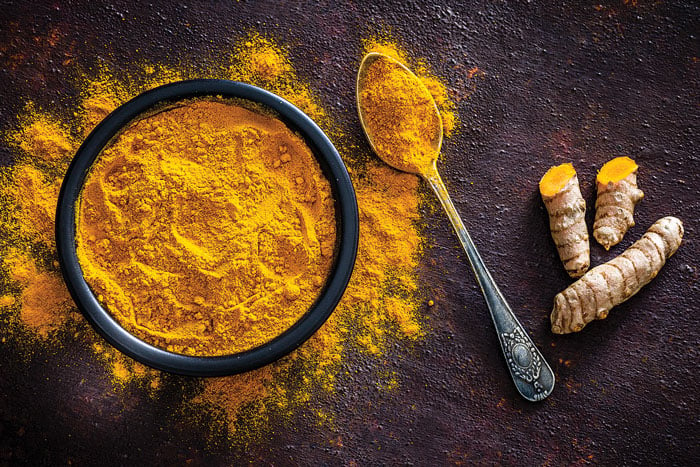
Turmeric is trending as an ingredient in both restaurant fare and packaged goods. ©fcafotodigital/E/+/Getty Images
“Spices like turmeric, which are often staples in popular ethnic cuisines, have been popping up in retail and foodservice,” says Shannon Cushen, director of marketing at Fuchs North America. “The demand for these spices has been driven, in part, by consumers taking more time to research ingredients and their potential health benefits.”
Turmeric is a member of the ginger family and plays a prominent role in many Southeast Asian and Middle Eastern cuisines, especially in curries. Its curcumin content gives the spice its distinctive yellow color. Curcumin is an antioxidant and may provide anti-inflammatory effects, although it is unstable and has low bioavailability, according to the National Center for Complementary and Integrative Health (NCCIH) at the National Institutes of Health. No clear conclusions have been reached about whether turmeric and its components have benefits for health conditions, reports NCCIH.
Filipino Sour Sensations
The diverse culinary culture of the Philippines puts tangy flavors center stage, with vinegars a natural seasoning for this sour/sweet cuisine on the rise.
“[There is] an unmet demand for Filipino flavors in the market,” said Becca Henrickson, marketing manager for Wixon, in a company press release. “Our Innovation Team sees unlimited opportunities to incorporate Filipino flavors into products across the health and wellness spectrum, as well as into savory snacks and meal solutions.”
Trendy Filipino dishes are incorporating various vinegars in braised dishes, marinades and dipping sauces, and Filipino versions of ceviche and vinegar-based chicken adobo, according to Fuchs North America’s Tastes & Trends blog. At Musang restaurant in Seattle, Filipina-American chef Melissa Miranda uses spiced vinegar, pickled spicy vinegar, and cane vinegar in a variety of savory Filipino dishes.
Authors
-
Elizabeth Brewster Writer
Elizabeth Brewster is a freelance writer based in Evanston, Ill. (lib500@comcast.net).
Categories
-
Culinary and Ingredient Trends
-
Food Product Development
-
Food Ingredients and Additives
-
Food Technology Magazine
-
Seasonings
-
Spices


