
NEWS
Robot chef prepares tasty omelet; Transforming the food chain

Higher-protein rice flours are suitable for large-scale use in gluten-free baked goods that aim to naturally increase nutritional value. © Oksana_S/iStock/Getty Images Plus
High-protein gluten-free muffins
Gluten-free products often use hypoallergenic rice flour in their formulations. A recent study in the Journal of Food Science explored the feasibility of using rice varieties with greater protein content in the making of gluten-free muffins.
Physicochemical and sensory properties of white and brown high-protein rice flours and muffins were compared with commercial rice flours. Although the sensory color of white high-protein rice muffins was favored, other attributes did not show a statistical difference between samples. High-protein rice flour muffins also exhibited greater frequencies of “just about right” levels for crumbliness, moistness, and softness than the commercial control.
Purchase intent was greater for both white and brown high-protein rice flour muffins than commercial brown rice muffins. Purchase intent increased further by 9% to 12% after it was disclosed that the products were gluten-free and made with naturally higher-protein rice flour, information that could be used to market gluten-free food products.
Robot chef prepares tasty omelet
Researchers from the University of Cambridge used machine learning to teach a robot to prepare an omelet—from cracking the eggs to plating the finished dish and refining its skills to deliver a consistent finished product that tastes good.
Working in collaboration with domestic appliance company Beko, the research team also schooled the robot in subjective matters of taste. “An omelet is one of those dishes that is easy to make, but difficult to make well,” said lead researcher Fumiya Iida in a press release. “We thought it would be an ideal test to improve the abilities of a robot chef, and optimize for taste, texture, smell, and appearance.”
The machine learning technique developed by Iida’s team employs Bayesian Inference, a statistical tool designed to maximize the amount of information derived from a limited number of data samples. Other issues the team faced included robot manipulation, computer vision, sensing and human-robot interaction, and consistency of end product. And since taste requires subjective evaluation, the team needed to tweak the machine learning algorithm to allow humans to impart information based on comparative rather than sequential evaluations.
The results demonstrate the value of machine learning to obtain quantifiable improvements in food optimization, an approach that could be duplicated in robotic chefs. With further study, the viability of other techniques to optimize food can also be explored.
Transforming the food chain
Meeting the global challenge to feed a growing population in ways that protect the environment and are resistant to climate change will require transformations in the way food is produced, according to researchers from the University of Copenhagen who have developed solutions that encompass a variety of new technologies.
The research, published in Nature Food, identifies 75 technologies that have the potential to transform the food chain, from production and processing to consumption and waste management. These include artificial intelligence, robotics, genetic engineering, microalgae production, and vertical farming. Others include nitrogen-fixating cereals that do not require artificial fertilizers, biodegradable polymers, and insect breeding for animal feed and foodstuffs.
Although each technology can help to reduce environmental impact, there are tradeoffs that public authorities and decision makers must take a stand on, such as the use of GMOs and the different levels of access each country will have to new technologies.
“There is no doubt that this will require the support of, and large investments from, politicians, so that technologies and know-how are available in as many countries as possible,” said Svend Christensen, professor and head of the Department of Plant and Environmental Sciences at the University of Copenhagen, in a press release. “At the same time, there is a need to test and adapt these technologies in order for them to be used across the food chain, from farm to fork. This requires considerable investment and an acceptance of some of the technologies that need to be developed and adapted over many years. But this is the way forward if we are to solve this enormous challenge.”
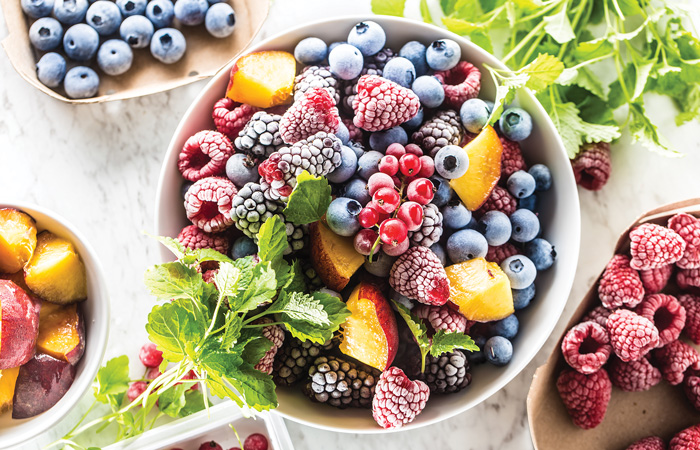
The market for frozen fruits is expected to expand at a compound annual growth rate of 6.7% over the next seven years. © MarianVejcik/iStock/Getty Images Plus
Frozen fruits market to reach $5.6 billion
A study conducted by Grand View Research predicts the global frozen fruits market will expand at a compound annual growth rate (CAGR) of 6.7% over the next seven years, reaching nearly $5.6 billion by 2027. The growing popularity of packaged fruits and vegetables as a result of COVID-19 is expected to expand the market scope. The effect of the pandemic on international trade is also a factor, with consumers expected to increase spending on packaged foods.
Based on product, tropical fruits accounted for more than 40% of global frozen fruits revenue in 2019, with the popularity of papaya, banana, and pineapple helping to fuel growth of the segment. Banana is the most popular fruit, with 114 million tons produced globally in 2017, according to the Food and Agricultural Organization of the United Nations. The large production of frozen bananas ensures availability for the preparation of soft serve, milk shakes, chocolate-dipped frozen bananas, smoothies, and ice creams, as well as for brownies, waffles, and muffins.
Berries are expected to register a CAGR of 7.5% during the forecast period, owing to the increased adoption of the products in beverages in developing countries such as China and India. In addition, the popularity of fruit-fortified beverages among health-conscious U.S. consumers is expected to continue to drive growth, with North America dominating the market with more than 30% share of global revenue in 2019.
How coffee drinking affects body fat
A study published in The Journal of Nutrition used data from the Centers for Disease Control’s National Health and Nutrition Examination Survey to study the relationship between coffee consumption and body fat. The researchers concluded that women who consumed two or three cups of coffee daily exhibited lower total body and abdominal fat than those who drank fewer cups of coffee.
Women aged 20–44 who drank two or three cups of coffee per day exhibited the lowest levels of adiposity, 3.4% lower than those who did not drink coffee. Among women 45–69, those who drank four or more cups exhibited adiposity levels that were 4.1% lower. Women of all ages who drank two or three cups of coffee daily had an average total body fat percentage that was 2.8% lower than their non-coffee-drinking counterparts. Results were consistent for caffeinated and decaffeinated coffee drinkers, smokers and nonsmokers, and those with chronic diseases or in good health.
“Our research suggests that there may be bioactive compounds in coffee other than caffeine that regulate weight and which could potentially be used as anti-obesity compounds,” said Lee Smith, reader in public health at Anglia Ruskin University and senior author of the study, in a press release. “It could be that coffee, or its effective ingredients, could be integrated into a healthy diet strategy to reduce the burden of chronic conditions related to the obesity epidemic.”
Smith added that the study findings should be viewed in light of the fact that it was conducted at a specific point in time, which does not necessarily indicate a trend. “However,” he notes,” we don’t believe that someone’s weight is likely to influence their coffee
consumption.”
News Bites
Functional ingredient supplier AIDP announced that it will distribute Verdant Oasis European hemp products.
• Barry Callebaut has signed an agreement to acquire GKC Foods (Australia), a producer of chocolate, coatings, and fillings.
• Bluebird Grain Farms won a 2020 Natural Products Expo West NEXTY Award for Best New Organic Food for its Bluebird Grain Farms Organic Whole Grain Einka, Emmer Farro, and Einka & French Lentil Blend.
• The Brenntag Food & Nutrition business unit in North America, part of the Brenntag Group, has announced a new collaboration with Axiom Foods for the distribution of Axiom’s plant proteins in the United States and Canada.
• Cargill has signed a multi-year platform agreement with Eagle Genomics to enable the digital transformation of microbiome and life sciences R&D across its global locations.
• Coca-Cola Consolidated announced that Southeastern Container, a PET preform and bottle manufacturing co-operative funded and managed by a group of Coca-Cola bottlers, is producing test tubes for use in COVID-19 kits, with more than 7 million tubes already produced.
• Ferrero USA, part of the global confectionery company Ferrero Group, has announced it will open a new distribution center in McDonough, Ga., in early September.
• FMC has received the American Chemistry Council’s Responsible Care Company of the Year Award in recognition of excellence and leadership in environmental, health, safety, and sustainability performance.
• Fresh Del Monte Produce has announced that its subsidiary Fresh Del Monte Japan has begun operations in its newly completed plant in Yokohama, Japan.
• Givaudan has entered into an agreement to divest its processed and grated cheese business to St. Paul Group, a cheese specialist with premises in Belgium and the Netherlands.
• Ingredion announced the signing of a strategic distribution agreement with Batory Foods, which will become the authorized licensed distributor of the company’s ingredient solutions in Southern California.
• JUST announced that Michael Foods, a subsidiary of Post Holdings, will be the exclusive manufacturer, supplier, and distributor of JUST Egg to foodservice and food ingredient customers.
• Tate & Lyle announced a set of new environmental targets and commitments that include reducing greenhouse gas emissions, eliminating coal from its operations, beneficially using all company wastes, and maintaining support for sustainable agriculture.
• Marine ingredient startup Yemoja has opened a new plant in Israel dedicated to the production of high-value microalgae.
Authors
-
Margaret Malochleb
Categories
-
Food Business Trends
-
Food Health Nutrition
-
Mergers and Acquisitions
-
Global Markets and Trade
-
Food Technology Magazine


