
OMNIVORE
Cutting Carbon Footprint of Coffee Roasting Pretreatment Extends Cashew Storage Time

 Emily Little
Food Technology Magazine
Sustainability

Cutting the carbon footprint of coffee roasting
A coffee company in California is experimenting with new electric technology with the potential to reduce greenhouse gas emissions in the coffee roasting industry.
Bellwether Coffee, a manufacturer of electric roasting systems, received a grant from the California Energy Commission to invest in the electrification of coffee roasting. The company will partner with Red Bay Coffee Roasters and Heirloom Coffee to transition their roasting processes from gas-powered to electric.
Gas-powered coffee roasting produces carbon monoxide and carbon dioxide as byproducts, and these byproducts can contribute to greenhouse gas emissions. Since the United States manufactures over eight billion pounds of coffee per year, the Bellwether team believes it is important to electrify the roasting process to mitigate environmental effects.
“The coffee industry faces serious threats from climate change, with predictions suggesting that if the current rates of greenhouse emissions persist, highly suitable coffee growing regions could decline by 50% by 2050,” said Ricardo Lopez, CEO of Bellwether Coffee in an interview with Food Technology. “Replacing gas-powered roasters with electric ones can reduce the carbon footprint of coffee roasting by almost 90%.”
Lopez explained that the transition to an electric roaster is straightforward because it does not require a natural gas connection. He said that installing his company’s roasters can save time, money, and construction work. Additionally, the roaster is fully automated and has the capacity to do three roasts per hour.
The $1.88 million grant will be used to install 24 Bellwether Roasters at Red Bay Coffee Roasters and Heirloom Coffee retail locations. Bellwether expects that the transition will lower its partners’ carbon dioxide emissions by two million pounds annually while maintaining the same quality of coffee.
“This grant contributes significantly to a cleaner future for the coffee industry and, most importantly, the environment,” Lopez said.
© olovedog/iStock/Getty Images Plus
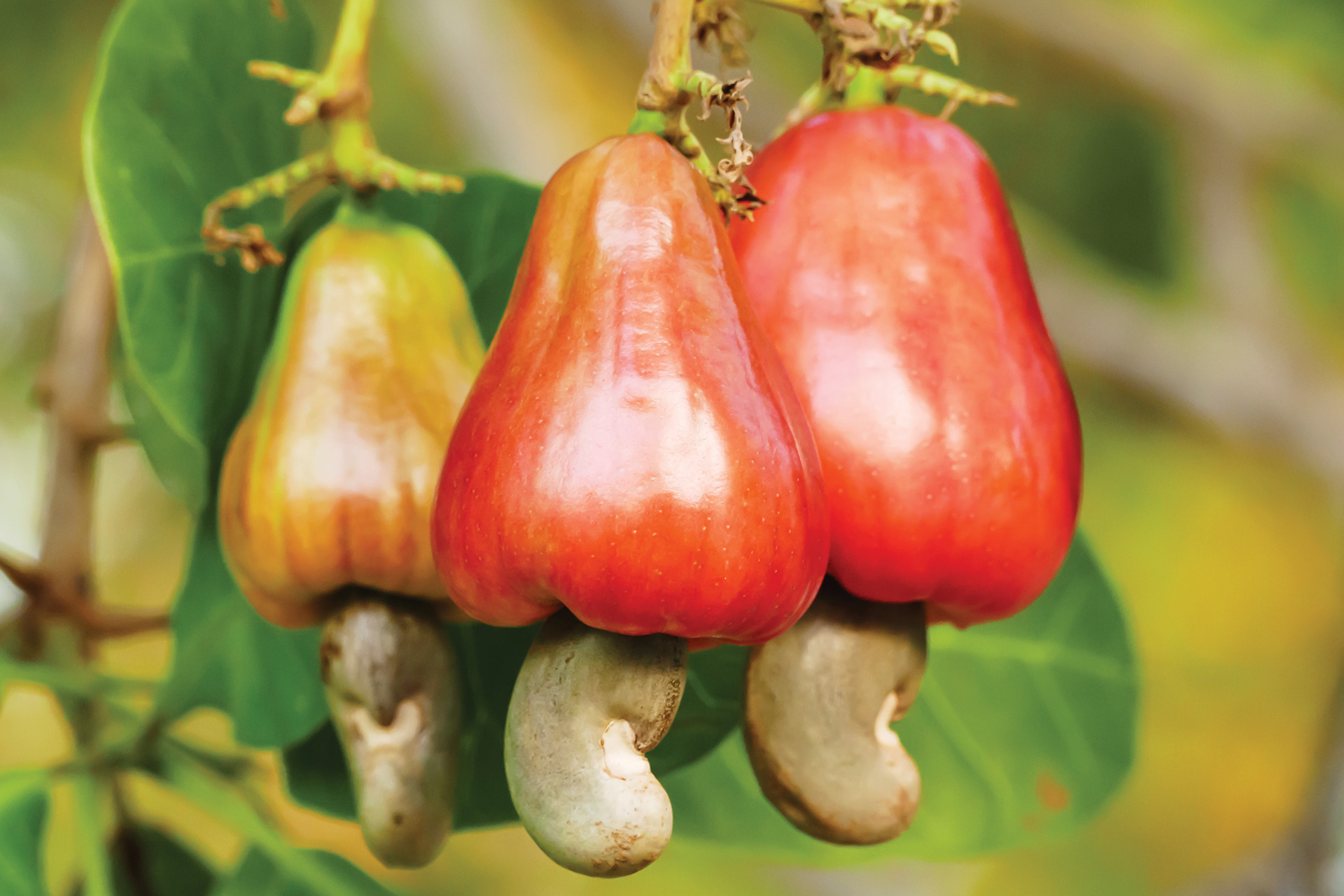
Pretreatment extends cashew apple storage time
The use of chemical pretreatment with sodium chloride or calcium chloride can help extend the time for which cashew apples can be stored before they can be processed, according to a new study from the Institute of Chemical Technology in Mumbai, India.
Cashew apples are a tropical “pseudo fruit” that carry the cashew nut on the tree. It is often a byproduct of commercial cashew nut production due to its high perishability. However, cashew apples contain vitamin C, antioxidants, thiamine, riboflavin, and several minerals. The researchers argued that with chemical pretreatment to hinder spoilage, cashew apples can be further processed for increased profit and introduction of a nutritional product to the market, such as a juice or beverage.
In the experiment, researchers varied the concentrations of sodium chloride and calcium chloride for chemical treatment (1 mmol/L to 10 mmol/L), as well as the duration of the treatment (60 minutes to 180 minutes). After treatment, the cashew apples were tested for changes in total phenolic content, color, and texture, and tannin, antioxidant, and vitamin C content.
The study found that the optimum treatment with sodium chloride was at a concentration of 9.45 mmol/L for 160 minutes, and the optimum treatment with calcium chloride was at a concentration of 7.8 mmol/L for 160 minutes. Using the maximum concentrations of the chemicals, the total phenolic content of the cashew apples was reduced by about 33% with sodium chloride and about 16% with calcium chloride. Additionally, the use of chemical pretreatment reduced the antioxidant content of the fruit by less than 6%, and 90% of the vitamin C content was retained in all treatments.
Further, the researchers concluded that pretreatment with sodium chloride is best for polyphenol oxidase and peroxidase inhibition, while pretreatment with calcium chloride is best for amylase and cellulase inhibition.
The researchers believe that this study can be used to show the efficacy of treatment of cashew apples and the viability of the fruit as a revenue stream. They suggest that these methods be employed by commercial cashew producers to reduce agricultural waste while increasing profit.
Market Trends
Solving the problems of plant-based meat
Manufacturers of plant-based meats in Europe are facing severe headwinds and need to reframe their business models, according to a new report and recommendations from Rabobank.
The report outlines the market challenges in Europe, describing a scenario that the researchers call the “trough of disillusionment.” Products currently on the market are not meeting consumers’ expectations in terms of taste, price, and healthiness, which has stalled growth.
According to the report, sales volume in plant-based meats has decreased in important markets such as the United Kingdom, Germany, and the Netherlands in 2023, and revenue growth has slowed since 2022. The researchers hypothesize that the “initial hype” of plant-based meats has worn off, and consumers are feeling the effects of inflation and unclear nutritional claims.
To help reverse the sales downturn, the Rabobank analysts recommend that manufacturers return to the drawing board. “In principal, the ‘task’ for plant-based meat alternatives producers hasn’t changed: offering consumers tasty products, made from ‘clean’ ingredients that are convenient, flexible to use in different recipes, reasonably priced, and have the additional benefit of being good for the planet and animals,” the report states. “This will require investments in innovation, new products, ingredients, and manufacturing processes.”
JP Frossard, consumer foods analyst at Rabobank, offered five recommendations for manufacturers of plant-based meats: limit ultra-processing; focus on the nutritional benefits of plant-based products; encourage better taste, price, healthfulness, and versatility of products in addition to sustainability claims; reduce price by analyzing the supply chain and making adjustments; and analyze the entire chain—seed selection, farming, crushing, ingredient processing, food manufacturing, and distribution—to see where improvements can be made.

© Daisy-Daisy/iStock/Getty Images Plus
Students value school breakfast programs
Students across the world enjoy school breakfast programs and find they build a sense of community and safety, according to new research commissioned by Kellogg.
Students in both public and private schools participated in the study. Ethnographers observed and interviewed the students while they participated in their school breakfast programs in order to collect data and draw conclusions. Students from the United Kingdom, the United States, Brazil, India, and South Africa were included in the research initiative.
The study identified three key positive outcomes that students experience when participating in school breakfast programs: increased sense of community, improved friendships, and behavioral benefits. By offering a place to eat and commune, these programs allow students to connect and boost their social interactions. Students view school breakfast programs as a “home away from home,” according to the study.
“I would never [have] had the chance to meet and make friends with the diverse group of children if it wasn’t for the Breakfast Club,” said one nine-year-old student.
The study authors shared recommendations for creating and maintaining successful school breakfast programs. These recommendations include creating safe spaces, maintaining consistency in routines, and implementing study groups.
CommunityMeet the Leader: Gina Piscopo

Gina Piscopo is a senior food scientist at Medifast. She earned her bachelor of science degree in nutrition science from Morgan State University in Baltimore, and is a Certified Food Scientist. She currently serves as the treasurer for the Maryland Section of IFT.
Which IFT core value resonates the most with you?
Community! I love networking with other like-minded professionals. It feels great to be part of a larger community outside of my current workplace. I also love seeing the younger generations just starting in food science careers.
What is your favorite thing about being an IFT member?
There are so many networking events to attend, many learning resources, and a lot of other professionals who are willing to connect and collaborate.
If you had to eat one food for the rest of your life, what would it be?
Pizza! So many varieties!ft
In Memoriam
IFT notes the passing of George J. Flick Jr. and Rauno Lampi.Authors
-
Emily Little Associate Editor
Emily Little is associate editor, Food Technology (elittle@ift.org).
Categories
-
Food Business Trends
-
Consumer and Marketplace Trends
-
Food Technology Magazine

