
That’s the (Zero-Proof) Spirit

Dry January. Sober October. No matter what catchy name it goes by, the worldwide movement to reduce alcohol consumption is inspiring a creative and technological revolution in zero-proof spirits and mocktails with an expanding array of ingredients, from whiskey and gin alternatives to tropical fruits and botanicals.
“More consumers view reducing or cutting alcohol as a positive step toward overall wellness ... and consumers increasingly expect alcohol-free options to offer the same sophistication as traditional spirits,” says Lu Ann Williams, global insights director at Innova Market Insights.
The global zero-proof spirits market hit $1.38 billion in 2024, according to Growth Market Reports, which projects an 8.7% compound annual growth rate from 2025 to 2033. But all zero-proof categories are not created equal, with growth in no-alcohol ready-to-drink (RTD) products such as premixed cocktails and “hard” seltzers expected to be concentrated mostly in North America, says Susie Goldspink, head of no/low alcohol for IWSR, a global drinks data and insight provider.
“The nonalcoholic cocktail space is rapidly evolving, with exciting opportunities emerging in both new cocktail recipes and innovative ingredients,” says David Crooch, general manager of nonalcoholic beverages at Diageo North America.
Zero-proof spirits are benefiting from their popularity with younger consumers looking for premium artisanal beverages as they moderate their alcohol consumption. Gen Z and millennials are driving no-alcohol beverage visibility and growth on social media, according to Innova Market Insights, with young millennials accounting for approximately one-third of social media mentions of zero-proof cocktails.
Look for even more adventurous zero-proof flavor combos as the category moves beyond classic spirits and cocktails to more botanical-based mixers and nontraditional flavors such as tea. “In the next few years, we will see nonalcoholic tea-based cocktails evolve with mixology-led techniques like fat-washed tea leaves, adding smoothness to zero-proof drinks, [and more] bold varieties like chocolatey hojicha. Chamomile [also] is breaking out of its wellness halo in cocktail formats,” says Katherine Schub, food and drink trend strategist for WGSN, a consumer trend forecasting firm.
Zero-Proof Beverages Glossary
Alcohol by Volume (ABV)—volume of ethanol in a liquid divided by the volume of the solution when both are at 68°F, expressed as a percentage
Distillation—selective boiling of a liquid mixture of two or more chemically discrete substances followed by condensation of the vapors in a still to separate the component substances
Infusion—extraction of chemical compounds or flavors from plants in a solvent by suspending the plant material in the solvent over time; also steeping
Low-alcohol—mixed drink, spirit, beer, or wine that normally includes ethanol as an ingredient, made with the ethanol significantly reduced
Maceration—the softening, breaking down into pieces, or extraction of flavors of food without using heat, usually employing a liquid
Mocktail—mixed drink or cocktail-style beverage made without alcohol; also virgin cocktail, temperance drink, zero-proof drink
Nonalcoholic—mixed drink, spirit, beer, or wine that normally includes ethanol as an ingredient, made with the ethanol removed or significantly reduced and generally less than 0.5% ABV
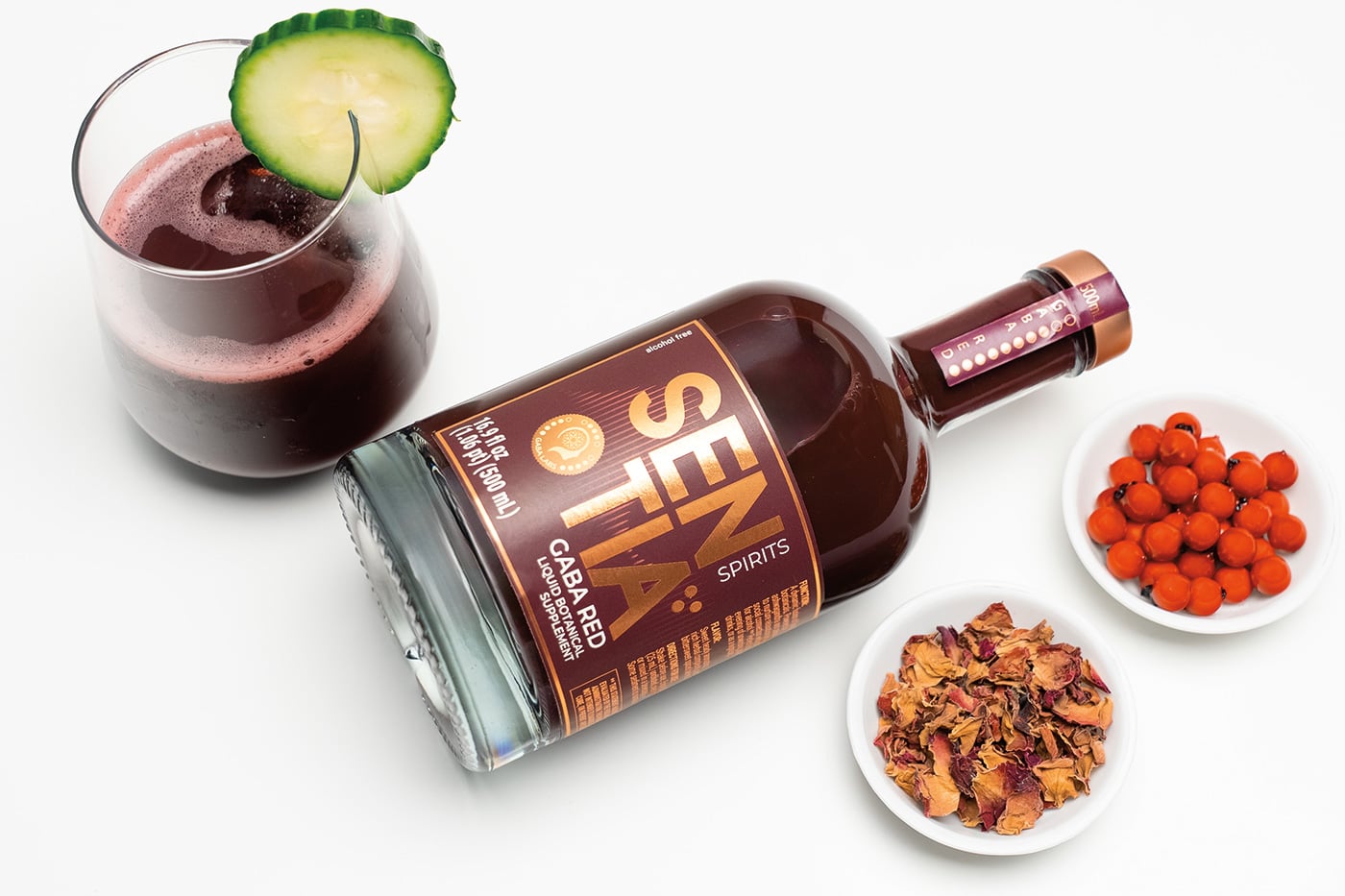
GABA Labs’ Sentia Red, Black, and Gold spirits contain botanical ingredients including magnolia bark, hops, ashwagandha, and chamomile. Photo courtesy of GABA Labs
Functional Spirit Alternatives
- With a projected compound annual growth rate of 16.8% for 2025–2033, the global market for functional alcohol-free spirits should reach $2.13 billion by 2033, according to Growth Market Reports.
- Blue Pacific Flavors and Tastewise report that the herb damiana is the top trending ingredient for functional mocktails, followed by kratom, lion’s mane mushroom, chamomile, GABA (gamma-aminobutyric acid), L-theanine, and protein powder.
- Functional no-alcohol innovators are working with botanical and synthetic compounds to replicate the effects of alcohol minus the hangover, reports IWSR, such as Free AF’s zero-proof canned drinks featuring Afterglow, a natural botanical extract from a New Zealand fruit, and GABA Labs’ Sentia Red, Black, and Gold spirits with botanical ingredients including magnolia bark, hops, ashwagandha, and chamomile.
No-Buzz Beer and Wine
© Dariia Chernenko/iStock/Getty Images Plus
The global markets for no-alcohol beer and wine continue to tap into a taste for healthier beverages:
- Volume in the $20 billion market for no-alcohol beer climbed 9% worldwide in 2024 compared with a 1% drop in total beer volume, reports IWSR. Innova Market Insights says the category has moved well beyond basic lagers into flavorful, craft-inspired variants with tropical, botanical, and spiced profiles.
- The $2.26 billion nonalcoholic wine market, dominated by sparkling products, will see a 7.9% compound annual growth rate from 2024–2030, projects Grand View Research, and Innova Market Insights cites emerging opportunities in pregnancy-friendly wine alternatives.ft
To Learn More
To view the full article with infographics , please download the pdf or view in the January / February 2026 Food Technology Digital Edition.
Hero Image: © urbazon/E+/getty images Plus
Authors
-
Elizabeth Brewster Writer
Elizabeth Brewster is a freelance writer based in Evanston, Ill. (lib500@comcast.net).
Categories
-
Food Business Trends
-
Consumer and Marketplace Trends
-
Food Categories
-
Culinary and Ingredient Trends
-
Food Product Development
-
Flavors
-
Food Ingredients and Additives
-
Beverages
-
Spices and Seasonings
-
Applied Science
-
Food Technology Magazine


