
Moving Beyond Industry 4.0

-
Learning Objective 1
Understand how Industry 4.0 technologies—such as IoT, AI, and cyber-physical systems—transform food safety by enabling real-time monitoring, predictive maintenance, and proactive quality control across complex global supply chains.
-
Learning Objective 2
Learn how Quality 4.0 integrates digital tools into traditional quality management systems, enhancing traceability, reducing defects, and ensuring regulatory compliance through automation and data-driven decision-making.
-
Learning Objective 3
Explore how Food Quality 4.0 applies these principles to the food sector, including AI-enabled risk assessment, blockchain-based traceability, and the evolution toward Industry 5.0’s human-centric, sustainable food safety innovations.
The Fourth Industrial Revolution, known as Industry 4.0, marks a transformative shift in global industries driven by rapid technological advancements. At its core, Industry 4.0 integrates digital and physical systems through technologies such as the Internet of Things (IoT), data analytics, artificial intelligence (AI), cyber-physical systems, and cloud computing (UNIDO 2020). These technologies have enabled interconnected systems that collect, analyze, and act on data in real time. This transformation enables decision-making at the proper levels in real time, moving industries from reactive to predictive and creating environments that are adaptable, efficient, and resilient (Spink 2025).
One of the most significant applications of Industry 4.0 is its impact on quality management systems, encapsulated by the concept of Quality 4.0. This approach integrates digital tools to enhance traditional quality management practices, including predictive analytics, real-time monitoring, and AI-driven decision-making (Juran 2020). By leveraging these technologies, Quality 4.0 makes it possible to identify issues earlier, address root causes with precision, enable early detection and early correction, and ensure superior product standards.
The food industry, characterized by complex global supply chains and stringent safety requirements, is particularly suited for these advancements. “Food Quality 4.0” applies the principles of Quality 4.0 to improve food safety, traceability, regulatory compliance, and efficiency across the supply chain. This article explores the definitions, histories, applications, and future potential of Industry 4.0, Quality 4.0, and Food Quality 4.0, emphasizing their role in modernizing food safety management.
What Is Industry 4.0?
Definition. Industry 4.0 represents the fourth significant era in industrialization, building on the mechanization of Industry 1.0, the electrification of Industry 2.0, and the automation of Industry 3.0. Its defining feature is the integration of physical and digital systems to create “smart factories” capable of self-monitoring, optimization, and decision-making (UNIDO 2020). IoT devices, cloud computing, data analytics, and advanced computing power are the key enablers of Industry 4.0, providing the infrastructure and intelligence needed for these advanced systems.
The interconnectedness of Industry 4.0 systems allows machines and processes to communicate seamlessly, exchanging vast amounts of data to optimize operations (Vaidya et al. 2018). This real-time capability ensures higher efficiency, better quality control, and reduced operational costs.
History. The concept of Industry 4.0 originated in Germany in 2011 during the Hannover Fair as part of a national strategy to enhance manufacturing competitiveness (UNIDO 2020). The initiative focused on integrating cyber-physical systems into production, creating a blueprint for smart factories. Over the past decade, Industry 4.0 has gained traction worldwide, transforming industries such as health care, agriculture, and logistics.
Building on advancements made during Industry 3.0, Industry 4.0 introduced connectivity and computation into automated systems. This evolution laid the foundation for advanced manufacturing environments where machines and systems collaborate autonomously.
Current Applications. Industry 4.0 technologies are applied across various industries to improve efficiency, sustainability, and resilience. Predictive maintenance is a prominent application that uses IoT sensors to monitor machinery health in real time. These systems predict probable failures before they occur, reducing downtime and extending equipment lifespan (UNIDO 2020).
In the food industry, Industry 4.0 enables real-time monitoring of perishable goods. IoT sensors track temperature, humidity, and other conditions during transportation and storage, ensuring compliance with safety standards. For example, cold chain logistics for pharmaceuticals and seafood rely on IoT-enabled systems to maintain quality and safety. Precision agriculture is another critical application. Farmers use IoT devices and drones to collect data on soil conditions, crop health, and weather patterns. This information allows for optimized irrigation, fertilization, and pest control, resulting in higher yields and reduced environmental impact.
The evolution of Quality 4.0 reflects the growing importance of digital transformation in addressing modern quality management challenges.
What Is Quality 4.0?
Definition. Quality 4.0 extends Industry 4.0 principles to the domain of quality management. It integrates digital technologies such as AI, IoT, and cloud computing into traditional quality frameworks, creating systems that are proactive, data-driven, and highly adaptive (ASQ 2017). Unlike conventional methods, which often rely on periodic inspections and reactive responses, Quality 4.0 emphasizes continuous monitoring and predictive analytics.
The core goals of Quality 4.0 remain aligned with traditional quality management principles: improving product quality, reducing defects, and enhancing customer satisfaction. However, the use of advanced technologies ensures these goals are achieved with greater precision and efficiency.
History. The evolution of Quality 4.0 reflects the growing importance of digital transformation in addressing modern quality management challenges. Total Quality Management and Six Sigma laid the groundwork by emphasizing data-driven decision-making and process improvement. Quality 4.0 builds on these principles by incorporating digital tools that enable real-time insights and automation (Juran 2020).
The adoption of Industry 4.0 technologies accelerated the development of Quality 4.0. As industries began integrating IoT and information communication technology into their operations, it became clear that these tools could significantly enhance quality management systems (Hoffman 2020).
Current Applications. Quality 4.0 technologies are widely applied across industries. Machine vision systems, for example, use technology to inspect products for defects during manufacturing. These systems are usually faster and more accurate than manual inspections, ensuring that only high-quality products reach consumers (ASQ 2017).
In the food industry, information communication technology enhances traceability and compliance. Enhanced traceability creates a secure, transparent record of every step in the production and distribution process, making it easier to identify and remove contaminated products during recalls. For instance, Walmart has used enhanced traceability (a blockchain-enabled process) in a pilot to trace mangoes from farm to shelf in seconds, demonstrating its potential to improve food safety.
Predictive analytics is another critical component of Quality 4.0. By analyzing historical data, these tools can forecast potential quality issues and recommend preventive measures. This capability reduces waste, improves efficiency, and ensures compliance with regulatory standards.
What Is Food Quality 4.0?
Definition. Food Quality 4.0 applies the principles of Quality 4.0 to food safety and quality management, leveraging digital technologies to enhance transparency, traceability, and efficiency (FB Tech Review 2020). IoT devices, information communication technology, and enhanced traceability are the foundational tools of Food Quality 4.0, enabling organizations to monitor operations continuously and respond to issues proactively.
History. The development of Food Quality 4.0 builds on established food safety practices, such as Hazard Analysis and Critical Control Points (HACCP). While HACCP focuses on identifying and controlling hazards, Food Quality 4.0 incorporates digital tools to improve accuracy, speed, and effectiveness (Boz 2021). The increasing complexity of global supply chains and the growing demand for transparency have further driven the adoption of these technologies.
Current Applications. Food Quality 4.0 technologies are transforming the food industry by enabling real-time monitoring and enhanced traceability. IoT sensors in cold storage facilities monitor critical parameters such as temperature and humidity, ensuring that perishable products remain safe. For example, dairy producers use IoT devices to track milk quality from collection to processing, reducing spoilage and ensuring compliance with safety standards.
Enhanced traceability technology provides an immutable record of every transaction in the supply chain, improving traceability and accountability. Seafood companies have reportedly used blockchain-enabled systems to verify the origin of fish, ensuring that products meet sustainability and safety requirements.
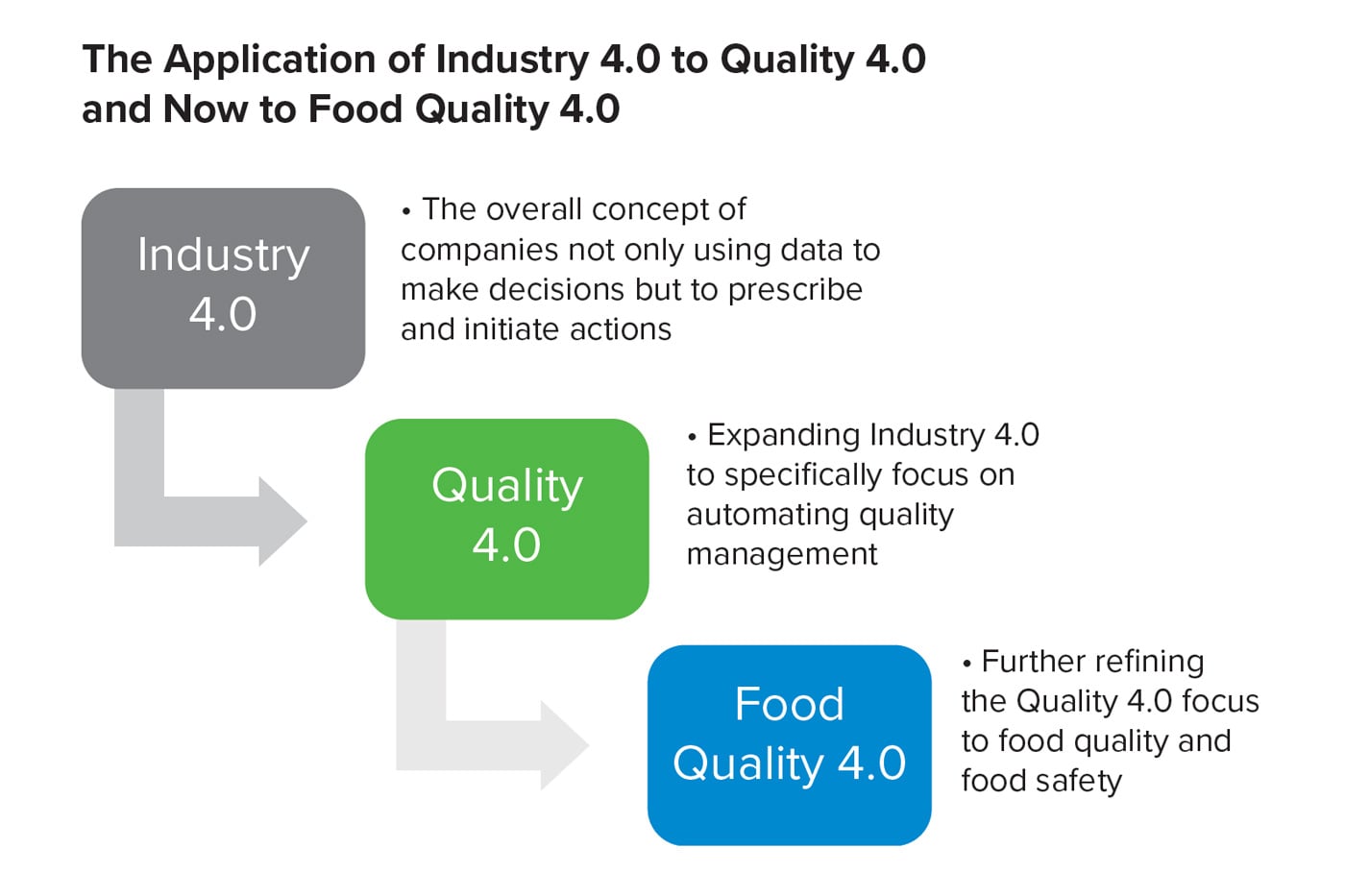
AI-driven predictive analytics is another essential component of Food Quality 4.0. By analyzing data from multiple sources, these tools identify potential supply disruption and contamination risks and optimize production schedules. This approach reduces waste, improves efficiency, and enhances overall food safety (See figure below.)
Future-Forward Research
As Industry 4.0 continues to evolve, discussions about Industry 5.0 have emerged, emphasizing human-centric approaches to industrial operations. Industry 5.0 focuses on collaboration between humans and machines, leveraging advanced technologies to enhance productivity while maintaining the human touch (UNIDO 2020).
In the context of food safety, Industry 5.0 offers opportunities to integrate AI, renewable energy, and sustainability principles into Food Quality 4.0 systems. Future research should explore how these technologies can improve food safety management while addressing challenges such as data privacy, cybersecurity, and environmental impact.
AI as a Game Changer
AI is rapidly emerging as a transformative force in food safety and quality management, redefining how risks are detected, processes are controlled, and data-driven decisions are made. AI systems can integrate and analyze massive volumes of data from sensors, suppliers, and production lines to forecast contamination risks, detect anomalies, and enable real-time corrections. Unlike static, rule-based systems, AI learns and adapts—continuously improving performance over time.
This intelligence is core to the shift toward Industry 5.0, where the synergy between humans and machines enhances productivity while preserving human oversight, ethics, and creativity. In food systems, AI-enabled tools support traceability, predictive maintenance, and hyper-personalized quality assurance, aligning safety goals with sustainability and resilience.
Looking ahead, Industry 6.0 could fuse quantum computing, bioinformatics, and fully autonomous networks—enabling food systems to anticipate global disruptions, optimize nutrition at the individual level, and achieve previously unimaginable levels of food security and efficiency. AI isn’t just a tool; it’s the gateway to a radically reimagined future of food safety and quality—one where potential continues to expand beyond what we can yet envision.
As we enter the era of Industry 5.0 and we inch closer to Industry 6.0, food safety and quality management will be redefined on a global scale.
Conclusion
Quality 4.0 and its application in Food Quality 4.0 represents a paradigm shift in how food safety and quality management are approached. By integrating digital technologies such as IoT, AI, and enhanced traceability, these concepts enhance transparency, traceability, and efficiency across the food supply chain. As industries continue to adopt these advancements, food safety managers play a critical role in implementing and optimizing Food Quality 4.0 systems.
By reducing risks, improving compliance, and increasing operational efficiency, Food Quality 4.0 has the potential to transform the food industry. Looking ahead, the integration of Industry 5.0 principles could further enhance these systems, emphasizing sustainability, ethics, and collaboration between humans and machines.
As we enter the era of Industry 5.0 and we inch closer to Industry 6.0—where artificial intelligence merges with quantum computing, autonomous systems, and bioinformatics—food safety and quality management will be redefined on a global scale. Now is the time for food safety professionals and organizations to begin experimenting with AI on simple, practical tasks—such as trend detection in quality data or automation of routine checks—to begin unlocking its transformative potential and preparing for the future.ft
The writing of this article was supported by ChatGPT 4o.
Hero Image: © stellalevi/ DigitalVision Vectors/Getty Images
Authors
-
John Spink Director, Food Fraud Prevention Academy
John W. Spink, PhD, is director, Food Fraud Prevention Academy and assistant professor, Department of Supply Chain Management, Business College, Michigan State University (spinkj@msu.edu). -
Archana Patil Food safety and Quality Manager
Archana Patil, MS, is global food safety and quality manager, The Hershey Company (arcchana42@gmail.com).
Categories
-
Artificial Intelligence
-
Food Safety and Defense
-
Novel Technologies
-
Food Quality
-
Applied Science
-
Food Technology Magazine
-
Food Processing and Technologies


