
Spread the Safety: Making Nut Butters

-
Processing Science
Understand the science behind nut butter manufacturing.
-
Food Safety Risks
Gain insight into the food safety risks and pathogen control measures necessary when making nut butters.
-
Processing Steps
Learn about the fundamental processing steps used in nut butter production.
To many people, the term “nut butter” means peanut butter, but really, it’s a moniker that involves many different spreads. Look at the nut butter products currently on your supermarket shelves. Of course, there is peanut butter, which is actually a legume, not a nut, but there are also nut butters made from almonds, cashews, walnuts, and hazelnuts and those made from seeds such as sunflower. There is definitely a greater choice than there was in the past.
Nut butters are deemed healthy foods thanks to the high protein levels, high fiber, vitamin E, minerals such as magnesium and folate, and healthy fat profiles. And what is one of the classic school lunch sandwiches? Peanut butter and jelly. Kids love it and mothers should also love it since both products are low moisture and are not prone to spoilage.
Nut butters are manufactured from low moisture nuts, seeds, and legumes, so the butter itself is low moisture with water activities in the 0.60–0.70 range—well below levels that will support the growth of food pathogens and spoilage organisms. In fact, these foods are also one of the rare instances of products that are not labeled, “Refrigerate After Opening.” Although nut butters have low moisture levels and will not support the growth of food pathogens, the low water activity and high fat levels tend to protect microbial contaminants. So, what are the best practices behind making these nutrient-rich spreads with food safety in mind?
Food Safety Fails
The food industry has had far too many high-profile food poisoning outbreaks linked to peanut butter and nuts. In 1996, Kraft Foods of Australia had to initiate a recall of peanut butter due to Salmonella that sickened more than 50 people. The cause of the outbreak was determined to be contamination of the supplier’s roasted peanuts used to make the product. The root cause of how the nuts were contaminated was never confirmed but possible causes of the incident were supplier-level raw materials contaminated by rodent droppings; supplier cross-contamination of roasted nuts by bulk raw nut packaging (i.e., reused flexible intermediate bulk containers, also known as super sacks); and/or improper storage of the roasted peanuts that led to post-process environmental contamination.
In 2007, Conagra Brands had a similar problem with its peanut butter. The resulting foodborne illness outbreak associated with Salmonella contamination cost the company millions of dollars. The problem was such that the company suspended production for months to upgrade its processing facility and operations to ensure the future production of safe foods. The upgrades included programs to minimize the potential for post-process contamination and facility upgrades to the physical plant itself.
Two years later, perhaps one of the most infamous Salmonella outbreaks in U.S. history was traced to the Peanut Corporation of America (PCA). This outbreak sickened more than 700 people (and probably more) and resulted in nine deaths. What made this incident even worse was that PCA was a major supplier of peanut products to 300-plus further processors, which meant that these operators also had to initiate recalls involving over 3,900 different products, making it the most extensive food recall in U.S. history at the time. Inspections of the facility following the outbreak revealed a number of issues, including leaking roofs, storage of raw and roasted products in close proximity, and improper roasting procedures, along with other subpar practices. This incident put PCA out of business and resulted in the company’s CEO being jailed for distributing adulterated products.
In 2012, Sunland, a major supplier of nuts and nut butters, initiated a recall of its products for Salmonella contamination. Officials from the U.S. Food and Drug Administration(FDA) found Salmonella bacteria throughout the plant. They also observed improper handling of the products, unclean equipment, and uncovered trailers of peanuts outside the facility. This incident also resulted in the company’s buyers having to initiate recalls like what occurred during the PCA recall.
Processors must develop, document, implement, and maintain programs to minimize the potential for cross-contamination of raw materials.
Processing Basics
There are two basic strategies that nut butter manufacturers need to have in place to ensure the safety of the final product for their further processing customers in the supply chain and for consumers: process validation and prerequisite programs.
Validated Processes. First, establish processes for nuts, seeds, and legumes (oil roast, dry roast, etc.) that are validated by a knowledgeable process authority to achieve an appropriate log-reduction based on risk analysis. The Almond Board of California and the U.S. Department of Agriculture (USDA) have determined that a minimum of a 4-log reduction of Salmonella bacteria is appropriate. The products may be processed in-house or purchased from a supplier that has established such programs. Two outbreaks of Salmonella attributed to raw almonds in 2001 and 2004 led to the addition of a pasteurization rule to the existing USDA Marketing Order that mandates almonds consumed in North America be processed as described—that is, the development of validated processes using approved process authorities and approved processing methods.
Prerequisite Programs. Processors must develop, document, implement, and maintain programs to minimize the potential for cross-contamination of raw materials and in-process products by pathogens, especially Salmonella. These programs should include but are not limited to:
- Physical plant condition and maintenance
- Vendor quality program
- Segregation of raw and processed raw materials (e.g., nuts, seeds, peanuts)
- Validated cleaning and sanitizing programs
- Proper management of wet cleaning, if employed (but not recommended)
- Positive pressure in the plant maintained by minimum efficiency reporting value filtered air
- Personal hygiene programs for the workforce
- Worker education focused on food safety
- Environmental monitoring programs
- Positive release programs
- Internal audits
- Pre-operational startup inspections
- Pest management program
- Proper storage of bulk nuts or seeds
Before proceeding, allow me to emphasize the importance of cleaning and how it should be done. Nut butter processors should not adopt wet cleaning. The processor runs the risk of increasing moisture in the processing environment, which could allow Salmonella to establish niches in the environment and the equipment. This means that companies should use dry cleaning practices and sanitize food-contact surfaces with alcohol.
© maria17/iStock/Getty Images Plus
In Process
So, let’s assume that a nut butter processor is either using a supplier with a validated process to prepare their raw materials or is processing in-house using a validated process and has implemented and is maintaining the prerequisite programs highlighted above. How are nut butters produced?
In this example, the processor is purchasing bulk processed almonds contained in super sacks. The expectation is that each lot will be purchased from an approved supplier. A certificate of analysis (COA) will accompany each lot that includes a negative test for Salmonella and other pathogens. The processor also purchases sugar, salt, and oils to blend with the nuts when producing almond butter. Some nut butters have a tendency for the oil to separate, so using oil as an ingredient helps prevent this from occurring. The ingredients are also purchased from approved suppliers, and the company requires that a COA accompany each lot that is delivered.
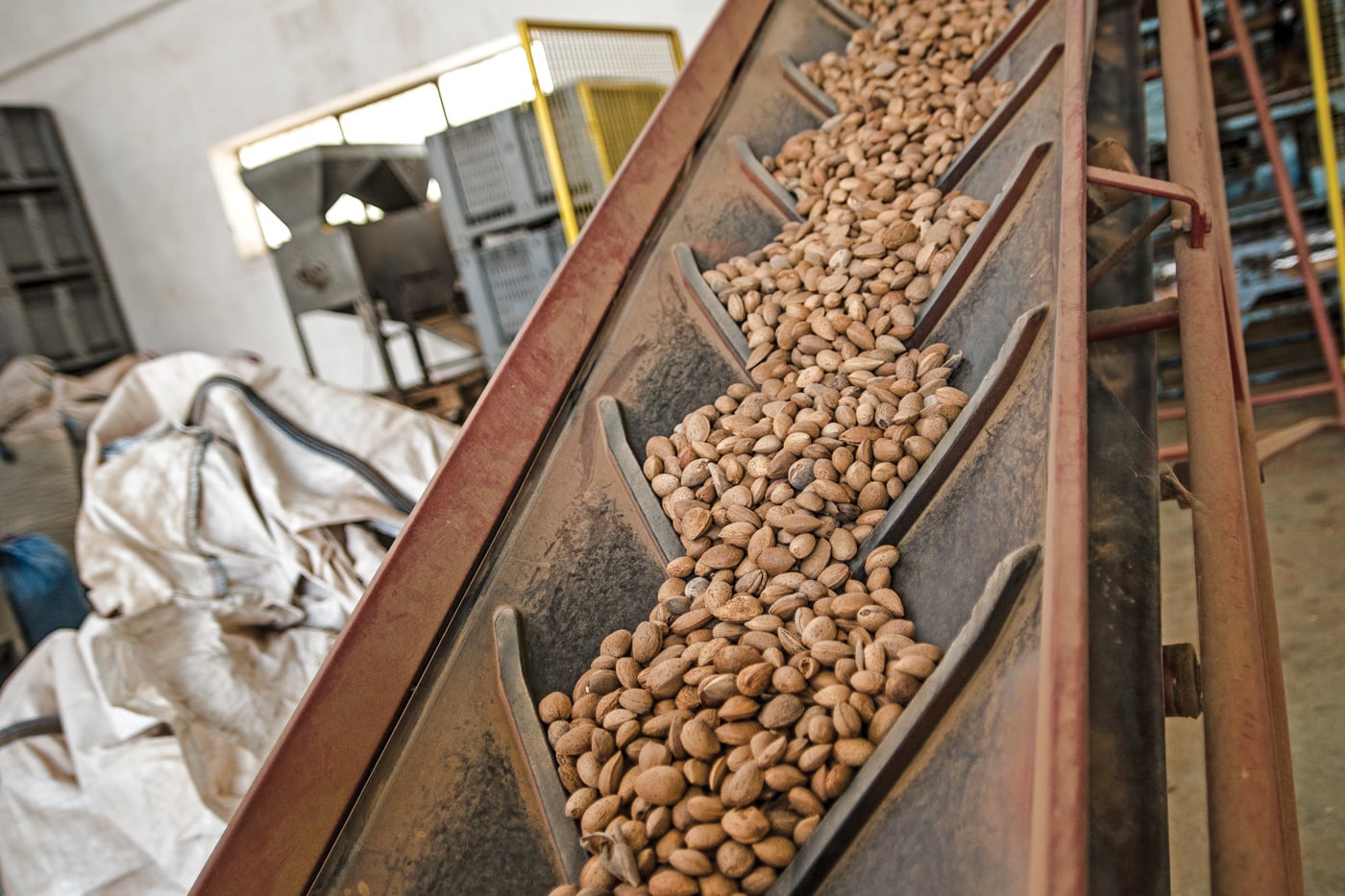
The ingredients are logged and labeled and then stored in the warehouse. An integrated pest management program is in place, which includes traps for rodents and flying insects. The ingredients and almonds are staged, weighed, and dumped. They are passed through rare earth magnets and are conveyed to a pair of mills that grind the almonds and blend them with the sugar, salt, and oil. The two mills ensure that the nut butter is properly ground and homogenized. The first mill coarsely grinds the nuts and the second mill serves to homogenize the nut butter.
The blended nut butter is then conveyed to a slurry tank, a deaerator, and a hold tank. Crunch-style almond butter may be produced by adding ground nuts at the hold tank. There is a votator, also known as a scraped surface heat exchanger, in the line immediately downstream of the hold tank that is used to cool the peanut butter. Grinding is an exothermic process and, therefore, warms the nut butter. From here, the almond butter can be diverted back to the hold tank or proceed to the filler via a metal detector. The metal detector is set to sense the following: 1.0 mm ferrous metal, 1.5 mm nonferrous metal, and 2.0 mm stainless steel. The almond butter is packed into 8 oz and 16 oz plastic jars, which are induction sealed, labeled, and coded. Finished product is cased, palletized, stretch wrapped, and stored in the warehouse to await shipment.
Distribution and Use
As noted earlier, local supermarkets stock all kinds of nut butters. They are usually sold in glass or plastic jars but may also be found in single-serve foil pouches in the market. These pouches are also found on the breakfast buffet tables in many locations. Nut butters are also industrial ingredients. They are packed in 5 gal pails or 55 gal drums. The walk through the supermarket will also show how many products use peanut butter and other nut butters as an ingredient, including bakery items, cookies, crackers, candies, and ice creams. These items must be labeled because they contain peanuts, which are one of the Big Nine allergens in the United States.
Of course, the same commitment to quality and safety must also apply to nut butters used as industrial ingredients. As the PCA recall reminds us, ensuring the safety of nut butters is a function of properly processing the nuts or seeds and developing and implementing the necessary prerequisite programs to ensure there is little potential for contamination with Salmonella or other pathogens.ft
Processing and Food Safety at IFT FIRST
A variety of processing and food safety topics will be explored at IFT FIRST, July 13–16, at McCormick Place in Chicago. Here are three of the highlights.
NextGen Food Safety: Bridging Farm to Table With Smart Tech Solutions
8 a.m. – 4:30 p.m.
Saturday and Sunday, July 12 and July 13
This timely food safety workshop is designed for agri-food industry professionals seeking enhanced training, focused on Hazard Analysis and Critical Control Points (HACCP), Good Agricultural Practices (GAP), the Food Safety Modernization Act (FSMA), and more. This workshop prior to IFT FIRST requires separate registration.
Attracting Students and Graduates to F&B Processing
2:20 p.m. – 2:40 p.m.
Monday, July 14
This presentation aims to inspire students and graduates to explore rewarding careers in this industry through storytelling, including blogs and podcasts.
Powering Your Digital Transformation
2:50 p.m. – 3:10 p.m.
Tuesday, July 15
Digital tools will bring significant disruption to how we will work in the future. This talk, presented by Mohamed Badaoui Najjar, global R&D senior director – digital transformation, PepsiCo, will be anchored on use cases to discuss the value of these digital tools to users and to the enterprise.
Hero Image: © t_kimura/iStock/Getty Images Plus
Authors
-
Richard Stier Food Scientist
Richard F. Stier is a consulting food scientist with international experience in food safety (HACCP), food plant sanitation, quality systems, process optimization, GMP compliance, and food microbiology (rickstier4@aol.com).
Categories
-
Food Safety and Defense
-
Food Ingredients and Additives
-
Processing Equipment
-
Nuts and Seeds
-
Applied Science
-
Food Technology Magazine
-
Food Processing and Technologies


