
The Sunny Side of Food Drying

-
Learning Objective 1
Understand the historical role of sun drying, its global significance in dried fruit production, and why it remains one of the most sustainable food preservation methods.
-
Learning Objective 2
Gain insight into the complete step-by-step process of sun drying tomatoes, along with the pros and cons of each stage.
-
Learning Objective 3
Learn how to evaluate the safety, quality, and market applications of sun-dried products.
Drying is among humanity’s earliest methods of preserving food, a practice that dates back thousands of years. As Chapter 5 of Desrosier’s 1970 classic The Technology of Food Preservation succinctly notes: “Drying is one of man’s oldest methods of food preservation.” While technologies have advanced, the fundamentals remain unchanged. The objective is clear: remove enough water from food to prevent spoilage and inhibit microbial growth. Today, drying still underpins global food supply chains, from grains and legumes to meats, fish, and fruit. Within this broad spectrum, sun drying stands out as a timeless, sustainable approach.
Global Role of Sun Drying
Worldwide dried fruit production in 2023–2024 was estimated at 3.36 million metric tons, according to Statista. Raisins and dates dominate this market, with major contributions from Turkey, Iran, the United States, Saudi Arabia, and Pakistan. While precise figures for fruit processed exclusively by sun drying are elusive—owing largely to the informal nature of smallholder production and limited recordkeeping—industry experts agree that hundreds of thousands of metric tons, and possibly well over a million, are preserved each year by direct exposure to the sun.
In countries with hot, arid climates, sun drying remains the preferred method. Turkey’s dried apricots and figs, Iran’s dates and raisins, California’s prunes and grapes, and Saudi Arabia’s and Pakistan’s dates illustrate the method’s enduring importance. Sun drying is especially common in regions where modern mechanical dehydrators are prohibitively expensive or unnecessary thanks to favorable weather conditions.
Worldwide dried fruit production in 2023–2024 was estimated at 3.36 million metric tons.
Pros and Cons
Despite its advantages, sun drying is highly dependent on climate. It requires long stretches of dry, sunny weather—conditions found in California’s Central Valley, the deserts of the Middle East, the Mediterranean, and parts of South America. Rain-prone regions simply cannot rely on this method consistently.
Infrastructure is another factor. A rule of thumb suggests one acre of drying yard is needed for every 10 acres of harvested fruit, though this ratio varies depending on the fruit type and its water content. Farmers must also guard against contamination, pests, and uneven drying, challenges that modern solar or mechanical dryers help mitigate.
In an era increasingly focused on sustainable food systems, sun drying holds a unique appeal. Unlike mechanical drying, it consumes no fossil fuels or electricity. The only required inputs are sunshine and space, making it one of the most environmentally friendly preservation methods available. For smallholder farmers in developing countries, it represents an accessible, low-cost means of adding value to harvests while extending shelf life for both local consumption and export.
Balancing Tradition and Technology
Still, reliance on natural elements poses risks. A cloudy harvest season or unexpected rainfall can lead to losses. Many commercial operations now use hybrid approaches, starting with sun drying and finishing with controlled mechanical drying to standardize moisture levels and ensure safety. This balance preserves the authenticity and sustainability of sun drying while meeting modern quality and safety standards.
So, what products are sun-dried and why sun drying as opposed to other methods? Fruits such as cherries, apricots, peaches, pears, tomatoes, plums, nectarines, grapes, figs, dates, and strawberries may be sun-dried. Sun-dried products are very flavorful with a very pleasing texture, due to the slower, longer drying process. How each of these products are handled varies slightly, but the process itself is very similar for each, so let’s focus on a single product that continues to increase in popularity today: sun-dried tomatoes.
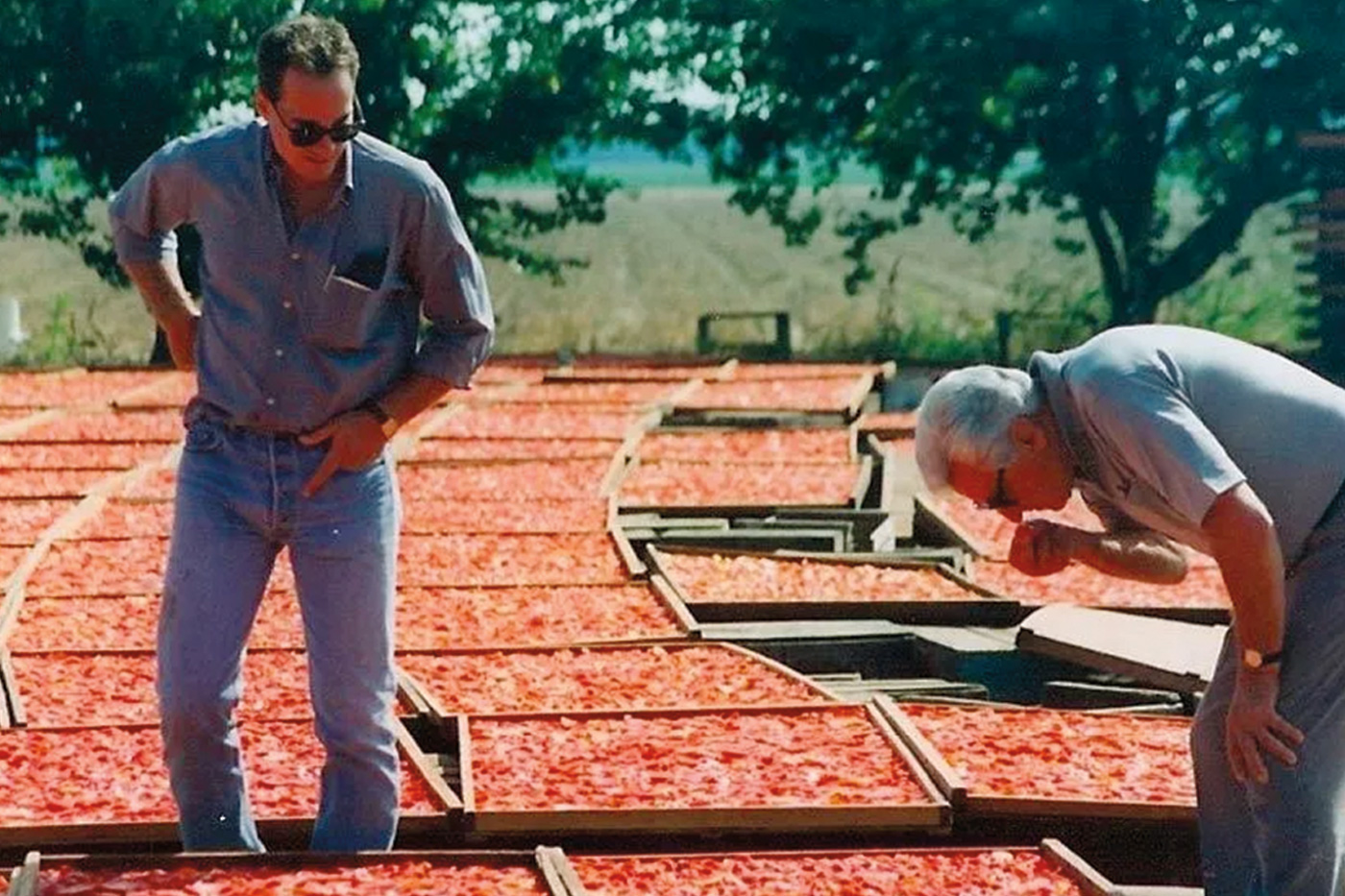
Courtesy of Traina Home Grown, San Joaquin Valley, California
Sun Drying Tomatoes: Step-by-Step
The first step is receiving. Tomatoes arrive in gondola trucks bearing about 27,000 lb of fruit. Products are then washed and sorted. Tomatoes are sliced in half with stainless steel blades, while pits are removed from stone fruits such as plums and apricots. After slicing and a secondary inspection, the fruit is placed on wooden trays made from Douglas fir or plywood. Each tray is three feet by six feet with a two-inch edge.
Some may question the use of wooden trays since many food facilities restrict wood. The industry has tested metal, but it is not feasible due to cost and performance. Wood has advantages: it retains heat overnight, aiding drying; it is lighter than metal; and it prevents fruit from sliding during handling. Drying on wood helps guarantee the distinctive quality associated with sun-dried fruit.
Reducing Waste and Enhancing Security. Sun drying also enhances food security by reducing waste. Fresh fruit rejected by packing houses—cherries, plums, nectarines, apricots, and peaches—can be “upcycled” into high-quality dried fruit. Since dried fruit is microbiologically stable, it can be held at ambient temperatures, reducing energy demands for refrigeration.
Sulfured or Unsulfured. Once loaded, trays are either moved directly to the dry yard or into the sulfur house, where fruit is treated with 1,500–1,800 ppm sulfur dioxide (SO₂) gas or with SO₂ generated by burning elemental sulfur. The dose depends on the fruit, house size, and operator experience. Non-sulfured fruit sales are growing due to consumer preference for clean labels, but both sulfured and unsulfured products achieve high quality.
Industry estimates suggest a 50:50 split between sulfured and unsulfured fruit. Sulfuring fixes color, slows browning, and inactivates enzymes. SO₂ also suppresses microbes. “I do not recall seeing any pathogen-positive samples of sulfured dried fruits,” Thomas Jones of the Safe Food Alliance of Kingsburg, Calif., told the author. “Sulfites do an excellent job at controlling these organisms.” Fruits such as cherries, plums, and blueberries are typically unsulfured, while many light-colored fruits may or may not be sulfured. Interestingly, elemental sulfur itself is an organically approved pesticide in vineyards, used to control powdery mildew.
Dry Yard Operations. Trays are conveyed to paved dry yards coated with dust retardant. They are stacked so that rails overlap in a way that allows air flow beneath each tray. Drying time ranges from five to seven days for tomatoes and similar fruits. Sun drying raises concerns because products are exposed to the open environment. However, insects and animal pests are less problematic than expected. The SO₂ released during drying discourages pests, and careful yard monitoring reduces contamination. Fruits are dried to a final moisture content of about 10%–20%, ensuring stability.
Handling After Drying. Once drying is complete, trays return to the plant. Fruit is emptied into 1,000 lb totes lined with double plastic bags. From here, products may be stored under refrigeration or further processed—sliced, diced, or washed. The wash step cleans the fruit, restores some moisture, and may serve as a kill step if hot water or culinary steam is used.
Some sliced or diced products undergo secondary sulfuring and additional drying, though at lower SO₂ concentrations than the initial treatment. These lots are also stored in 1,000 lb totes until needed.
Packaging and Safety Controls. Before packaging, bins are emptied and the fruit passes through a series of safety checks. Products move across rare earth magnets, metal detectors, and X-ray machines to identify foreign matter. Detectors are typically calibrated at 1.0 mm for ferrous metals, 1.5 mm for non-ferrous, and 2.0 mm for stainless steel. X-ray units, set with metal and glass standards, may also catch stray pits. Finally, fruit passes over a second bar magnet and through a visual sort to remove fine particles such as rust.
Final Products. Finished dried fruit is packed for industrial, foodservice, or retail markets. Industrial and foodservice customers typically receive 5, 20, or 25 lb boxes with liner bags, or 1,000 lb totes. Retail packs are sealed in foil-laminate pouches designed for upright display or inclusion in consumer packaged goods. All carry “Best By” dates. Storage instructions generally recommend cool, dry conditions (40°–70°F) for transit and refrigeration at under 45°F for long-term storage. After opening, products should be kept in tightly sealed containers. Until shipment, all lots are held under refrigeration to ensure the highest quality.
Sun drying endures because it is simple, effective, and sustainable.
Safety of Sun-Dried Products
We already touched on how sun-dried fruits are processed for safety. The products are dried to moisture levels that will not support the growth of food pathogens, but there are still concerns about contamination of the fruits pre- or post-process. Sulfuring kills and inhibits microbial growth and processors have the option of making the washing step a kill step by using steam. Ideally, this process should be properly validated by a third party. And processors must establish the necessary prerequisite programs to ensure that products are not contaminated prior to packaging. Chemical hazards from pesticides and such should be controlled at receipt. Sulfured fruit must be labeled as it is an additive and deemed a sensitizing agent in the United States.
Working with growers that have established Good Agricultural Practices helps ensure review of any pesticide application records prior to harvest and delivery to maintain legal and safety requirements. Removing physical hazards is also a necessity, and magnets, metal detectors, and X-ray technology are all employed to protect consumers.
New Products From Dried Fruits
So, how does one take advantage of the high quality and flavors of sun-dried fruits? There are many applications for sun-dried fruit in myriad industries, including baking, cereal, protein, trail mix, prepared salads and meals, sauces, and even beverages. In a health-conscious world that recognizes sustainability and appreciates flavor, who knows what will be next?
Sun drying endures because it is simple, effective, and sustainable. While exact figures are difficult to pin down, the scale of its use remains significant, particularly in fruit-producing regions with the right climates. As Desrosier noted more than half a century ago, “Sun drying remains the greatest food preservation action.” That statement continues to ring true today, reminding us that sometimes the oldest methods are also the most resilient.ft
Hero Image: © ValentynVolkov/ iStock / Getty Images Plus
Authors
-
Richard Stier Food Scientist
Richard F. Stier is a consulting food scientist with international experience in food safety (HACCP), food plant sanitation, quality systems, process optimization, GMP compliance, and food microbiology (rickstier4@aol.com).
Categories
-
Food Waste
-
Food Categories
-
Food Safety and Defense
-
Food Security
-
Applied Science
-
Food Technology Magazine
-
Fruits
-
Vegetables
-
Food Processing and Technologies
-
Instrumentation
-
Process Control


