

Pushing R&D Upstream
PepsiCo Chief Science Officer Tara Glasgow is reworking the food and beverage innovation model by integrating science earlier to shape strategy, test assumptions, and inform where the company places its next bets.
 Bill McDowell
Food Technology Magazine
Key Takeaways
-
PepsiCo is moving R&D upstream, embedding scientific expertise at the earliest stages of strategy development to help identify opportunities and accelerate innovation at scale.
-
By focusing first on the highest-risk questions and validating core assumptions early, PepsiCo aims to build more transformational innovations while reducing wasted time and resources.
-
Modern food and beverage innovation requires scientists to pair deep technical expertise with strategic business acumen, cross-functional collaboration, and a clear understanding of long-term value creation.
Food and beverage R&D has typically organized around a clear division of labor: Strategy defines the opportunity, brands define the constraints, and R&D works downstream to deliver against both. It’s a model built for scale and discipline—assuming the problem is already understood by the time science is asked to solve it.
That assumption is becoming harder to sustain. Consumer expectations around health, functionality, and relevance are shifting quickly and unevenly. Scientific understanding of nutrition, metabolism, and human performance is expanding in ways that don’t map neatly onto existing products. And the realities of scale—supply chains, pricing, manufacturing constraints—leave little room for late-stage surprises. Ultimately, the challenge is less about solving defined problems than about deciding, earlier and with more confidence, which problems are worth solving in the first place.
At PepsiCo, that tension has pushed R&D significantly upstream. Rather than functioning mainly as a downstream executor, Tara Glasgow, PepsiCo’s chief science officer and executive vice president of R&D, describes a model where science comes in at the front end—alongside consumer insight and other market signals—to help shape vision and strategy from the outset, not just to execute, but to help identify and shape the opportunity itself.
The shift is not technological; it’s structural. Work that once advanced in sequence now moves more in parallel, forcing earlier alignment on assumptions, trade-offs, and feasibility.
Tara Glasgow brings a uniquely cross-sector perspective to that work. Before joining PepsiCo in July 2022 to lead Global Beverages R&D, she held senior R&D roles at Johnson & Johnson, Alberto Culver, and RB/Reckitt across consumer products, including personal care, health care, and medical devices. In September 2025, she became PepsiCo’s chief science officer and executive vice president of R&D, succeeding René Lammers.
Glasgow’s background informs how she frames innovation: starting from first principles, asking what must be true for an idea to succeed, and testing those assumptions before the organization commits to scale.
The conversation that follows is less about specific technologies or product pipelines than about how decisions get made: how science, insight, and strategy are brought together, what changes when they are, and what it takes to rethink a well-established model without losing the discipline that made it work.
You’ve brought a different perspective to PepsiCo. You’ve led R&D in medical devices, consumer health, and personal care products before coming into food and beverage. What parts of your prior experience transferred seamlessly, and where did you hit the steepest learning curve specific to food?
When I think about some of the basics, they’re quite transferable. Science is transferable. The foundational capabilities that go across disciplines—cross-functional leadership, how we drive innovation—very transferable. I think what’s really interesting is how food and beverage are intersecting with health and wellness. That makes it even more valuable coming in with all the experience working on functional benefits.
From a learning curve perspective, I think the thing that was so interesting to me, and humbling, is how deeply personal and culturally nuanced food is. To deliver something that’s so local and personal at the scale of PepsiCo was amazing—to figure out how to manage that complexity, and how to really drive things at that global scale. So, trying to do all of that at once, that probably was the most eye-opening and exciting part of the role.
What were some surprises?
The pace of change in terms of how fast the consumer is changing and seeking more functional benefits. I saw it in other industries as well. It happened maybe in cosmetics first, people seeking more and more function in their products, but I think the pace of change and the scale together, that’s the most surprising.
What we’re doing is making sure that we’re wiring in R&D from the very beginning.
Has that informed the way you’re approaching R&D at PepsiCo compared with the way you approached it in prior roles?
What we’re doing is making sure that we’re wiring in R&D from the very beginning. So, changing our operating model so that from the get-go we have consumer insights, human insights, and macro forces that are happening in the marketplace come together to co-create vision and strategy. In other places, it could happen in sequence, over a longer time. Here, working in parallel is the only way to move at the pace we need to move. Typically, you could either get to big ideas and go slowly, or you could get to small ideas and go fast. To be able to do it fast and big required us to really rethink our operating model.
What does that look like in practice? What are a few specific things that you do differently today than when you arrived?
We’re definitely collaborating differently, and it started with making sure we’re doing that at the top of each of the functional areas. We’re starting to wire our operating model together in a way that we show up in governance meetings [differently than] before. Here’s our science strategy, here’s our insight strategy—those things coming together and brainstorming the pipeline against a category vision in a way that we wouldn’t have done before. In creating these new forums, we start talking to new people that maybe we haven’t talked to at this stage of innovation before.
So, those conversations are new, then what comes from it is new. And then we start down on the supply chain side, brand-new collaborations and think, “If we’re going to transform this, that’s a massive transformation to a supply chain. How would we go through something like that?” So, supply chain is more involved in innovation.
You’re describing cross-functional skill sets different from those that might have been a priority for a frontline food scientist five or 10 years ago. How has that changed the way that you look at the composition of the R&D team, and what you want your people to bring to the table?
We’re now becoming co-architects of strategy. We’re bringing a lot more R into our R&D. We’ve always had great science, but sometimes the research would come to the rescue when something’s not working out, or we’re trying to scale up and it’s not working.
We start with the fundamentals of physics, the funda-mentals of biology, the fundamentals of chemistry.
Now, that perspective is coming in at the very front. So, we start with the fundamentals of physics, the fundamentals of biology, the fundamentals of chemistry. When we do that, it starts to shape our ambition differently.
We see how the body fundamentally works—how can we deliver that benefit with precision? Then we know how to design it. It’s causing us to get back to our roots as scientists, which is really wonderful, because we all go into those fields of science and engineering loving the fundamentals, and it’s easy to lose sight of it because you’re applying them in the development of R&D.
We often hear about the challenge for someone well-trained as a food scientist being able to bridge the gap when talking to the consumer insights people, the marketing people, when they’re looking at it from a P&L or operating perspective. Are you seeing a shift in the core business acumen that needs to overlay with the scientific fundamentals?
I think there was always incredible collaboration with insights and marketing, but it was down on a project level. So, the change is how to do that up at a platform level, at a strategy level. That is a skill—elevating to strategy and not jumping to solutions too early so that we can grow it together and be more transformational. The other thing you’re bringing up about business skills is a really good question because we’re also building a lot more acumen, not just in terms of the P&L, but building an understanding of shareholder value, and how when we build a pipeline that helps to shape the future, our job in R&D is to drive that long-term growth, and shape the future of the company to be secure.
What are some things that you stopped doing that turned out to be as important as things that you added?
Instead of jumping in and just doing the first thing that’s thought of, when we slow down, we don’t get distracted with all the small things. And having an aligned strategy across the whole company where R&D is a co-architect of that strategy is one of the biggest things that enables us to focus and stop doing the other stuff.
One of your stated priorities is pushing your teams to disrupt themselves rather than having external forces disrupt them and getting them comfortable with discomfort. In such a large organization, how do you execute that? How do you make discomfort productive instead of paralyzing?
When we look at the other side of the coin, it is exciting; it just depends on the mindset you bring to it. The more that folks can see how they are impacting things, how their ideas are shaping the very strategy of our organization, and they can see their fingerprints on it, it moves from, “I’m a little scared” to, “I’m actually pretty excited.”
It doesn’t mean that there aren’t going to be times that we all get a little bit afraid, but when we feel that we’re doing it together, we feel the collective impact we have.
I’ve had more one-on-ones than ever in my career. One week I did 70, just meeting and asking people, “What do we need to do? What are we not seeing in the strategy that you’re seeing?” Every one of them offered something unique. And it doesn’t mean that there aren’t going to be times that we all get a little bit afraid, but when we feel that we’re doing it together, we feel the collective impact.
What does a healthy, hard conversation look like in a project?
The conversation starts with, “Did we ask the hardest question first, the question that would kill the project?” We’ll start with our aligned strategy and our scientific platforms that underpin it, and then we ask, “Is that the hardest question?” We narrow it down to two or three questions—not every question is a killer question. The old way of working is to show progress and to answer questions in a certain order, but not all projects are created equal about where the risk is. So, we try to ask the hardest question first, the killer question, and we spend a lot of time debating that and driving that in our front end of innovation.
Then, we go after those questions with the experiments that prove the first principles if we’re going to succeed or not, and then, we kill it very early so that people feel they got the learning, but they didn’t invest so much of themselves that they’re attached to it.
We try to ask the hardest question first, the killer question, and we spend a lot of time debating that and driving that in our front end of innovation.
What are some of the hardest questions?
Sometimes it’s about taking a technical function and breaking out all the parts and saying, “What’s really the mode of action, and what’s the issue that could go wrong here? We’ll figure this one out one way or the other because that’s in the realm of our existing expertise. This other question is way outside of our expertise; we need to bring in some external expertise.”
Another example: “Can we keep it stable at the pH we need, or can we have it deliver in the body, and achieve the benefit we want?” It turns into very tangible experiments, which are easy to do once we think of the very hard question. It could be a business model question, or packaging challenge. Can we get it to a point where it will be affordable enough for consumers to pay for that benefit?
PepsiCo’s made some ambitious public commitments around things like sodium and sugar reduction, and nutrition overall. You’re working with huge, iconic brands. When you’re innovating a core product, what usually becomes the first binding constraint? Is it sensory acceptance, ingredient flexibility, manufacturing performance, cost issues? Where does innovation tend to get hung up?
First, when we think about brands that are iconic, the product isn’t necessarily the brand. Iconic brands have more expansion room than we think. If we really understand what the brand means, trying to understand what’s underneath, when we resolve consumer tensions at the same time that we’re driving things like improving nutrient density and reducing sodium, we end up making a superior experience.
When we divorce ourselves with the brands, we can end up in a place where we get stuck in the technology. So, the more we open our aperture about that, and match where the consumer is, we actually open up our ability to deliver against those goals.
Are there constraints that a frontline R&D scientist tends to underestimate at the start of a project, relative to, say, their peers and other functional areas within the organization? Where are the blind spots?
One thing that gets underestimated sometimes is how to talk about it. And in R&D, we’re scientists, and we talk science to each other, and it’s a nice easy conversation with each other. Then when you need to translate for consumers, marketing, or insights, you might think people are understanding what you’re saying—for example, you’re talking about prebiotics and you think everyone knows what you’re talking about, but they might not understand.
Are there distinct signals that you look for to identify whether something is scalable as a platform versus being a one-off innovation?
We start with platform. We start with sizing big spaces—spaces where we have consumer demand and we can see the size of that demand. So, unmet needs, as well as seeing that there is science in that space that we could deliver against in a way that we could make a change. That’s when we know an innovation can be scaled.
What are the big opportunities you think that the food industry still underserves today? And what do you think that PepsiCo uniquely brings to helping solve those problems?
We’re still underserving functionality being mainstream. People might feel like they need to make compromises between the function that they want in their food and beverage and the taste, and they don’t want to compromise.
So, this idea of what we’re doing in PepsiCo—working across these deep science platforms for things like muscle maintenance, satiety, and gut health—and then combining that with all of the know-how that we have in terms of how to make great-tasting products, that is a huge opportunity for us and something quite special for PepsiCo.
Vital Statistics

Experience: Chief Science Officer and EVP, R&D, PepsiCo; SVP, Global Beverages R&D, PepsiCo; SVP, Health Care & Nutrition R&D, Reckitt; VP, Wound Closure R&D (Ethicon), Johnson & Johnson; VP, Baby Care R&D and Oral Care R&D, Johnson & Johnson; Senior Director, Platform R&D and External Alliances, Alberto Culver; earlier roles in consumer R&D, patent strategy, and advanced technology, Johnson & Johnson
Education: MS, Materials Engineering, Drexel University; BS, Textile Engineering, Philadelphia University
Current Scope: Global R&D leadership across beverages and foods; 2,500+ scientists across 19 R&D centers
Expertise: Consumer health and nutrition; medical devices; food and beverage; product development and reformulation; platform innovation; external partnerships and open innovation
Career Highlights: Leadership roles spanning consumer brands (Johnson’s, Listerine), medical devices (Ethicon), and global consumer health portfolios (Reckitt); joined PepsiCo in 2022 to lead Global Beverages R&D and expand science-led innovation across categories
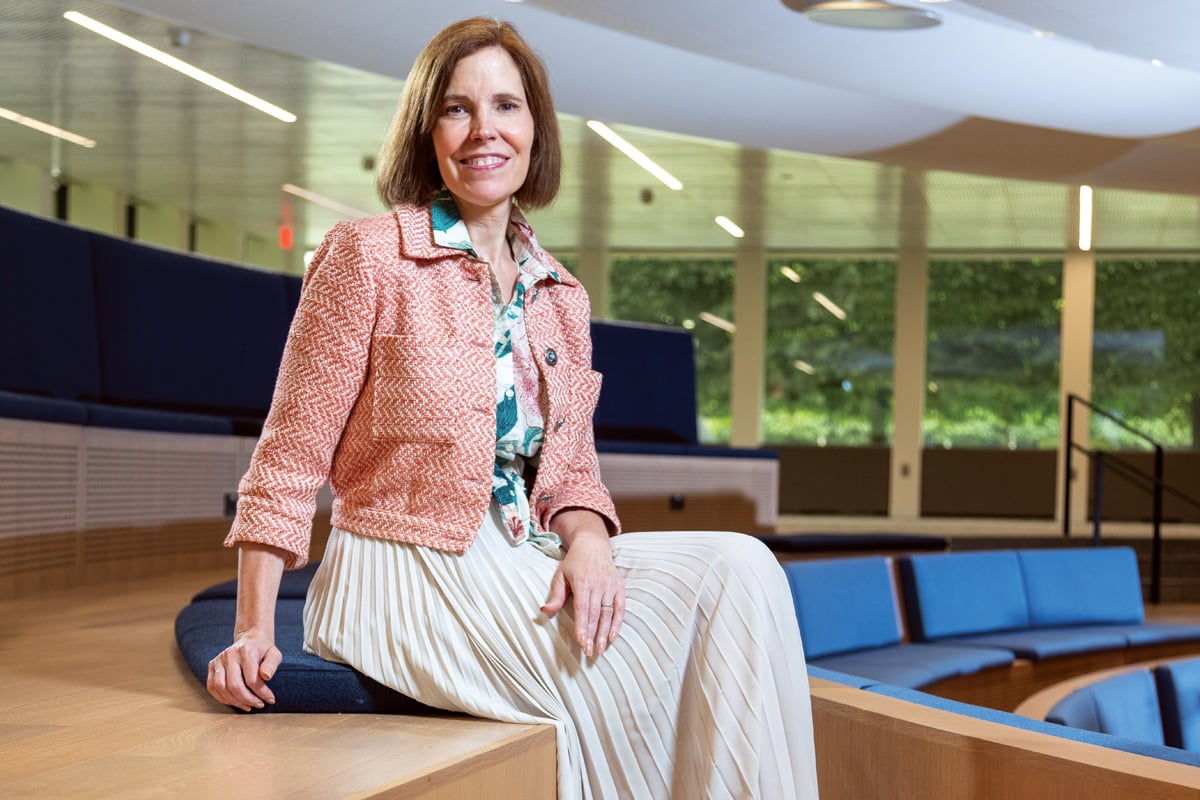
Hero Image: Photography by Christopher Beauchamp
Author
-
Bill McDowell Editor-in-Chief and Vice President
Bill McDowell is editor-in-chief of Food Technology magazine and vice president of content and channel strategy at the Institute of Food Technologists (bmcdowell@ift.org).
Categories
-
Food Sciences
-
Food Product Development
-
Formulation
-
Beverages
-
Food Chemistry
-
Food Technology Magazine
-
Issues and Insights


