

Rewriting the Rules of Work
A generational shift is transforming expectations around time, trust, and career paths.
 Mary Ellen Kuhn
Food Technology Magazine
Key Takeaways
-
Overtime culture is losing ground, with younger professionals less likely to work overtime regularly.
-
Early career professionals still aspire to leadership, but many prefer steady, sustainable progress over rapid advancement.
-
Management styles are evolving as leaders place greater emphasis on empathy, flexibility, and communication along with less rigid hierarchies.
Gen Zs have arrived in the workforce. And they—along with their millennial colleagues—are changing the way that work gets done. The values and expectations of early career professionals differ from those of the generations that preceded them, and the employment landscape has begun to evolve as a result.
Together, Gen Zs and millennials accounted for 61% of respondents in the 2026 IFT Compensation and Career Path Survey, fielded in January, so the impact of their priorities and perspectives should not be underestimated. Think balance, boundaries, and flexibility.
Gen Z respondents prioritized work/life balance more than other demographic segments, scoring it 4.53 on a five-point scale. Millennials were in close alignment with a 4.50 score. Gen X (4.32) and baby boomers (4.16) placed less emphasis on work/life balance.
Figure 1. Demographic Definitions: There’s some variation in the age ranges used for categorizing demographic groups. Here’s how the researcher for the 2026 IFT Compensation and Career Path Survey defined it for survey participants.
Younger food science professionals reported spending fewer hours at work than older professionals, with 71% of Gen Z and 65% of millennial survey participants saying that they seldom or never worked overtime compared with 36% of Gen X and 38% of baby boomers who shared that response.
Notably, work/life balance moved into first place on a list of professional priorities in this year’s survey findings, up from its No. 3 spot in 2024 IFT research.
For many, finding balance means creating a clear divide between work and the rest of life. One survey participant put it like this: “Work/life balance means work when you’re at work—and everything else is life. Don’t multitask life at work and vice versa.”
Boundaries between work and personal life … [are] key to helping me maintain performance at work.

Michael Diehl, a millennial who is an associate product development scientist for P.L. Marketing, says he’s comfortable with work/life boundary setting. “I feel like I have the ability to turn things on or off,” Diehl says. “If somebody messages me late at night, I don’t feel like I have to get up and answer it then.”
“I’m a firm believer in boundaries between work and personal life,” says Ning Yip, an R&D scientist with a leading food company. “It’s key to helping me maintain performance at work.” She uses the time she spends commuting home from the office to disconnect from the job and leave workplace stress behind.
Rethinking the Pace of Progress
Worries about workload, burnout, and stress make many Gen Zs and millennials wary of moving into leadership roles, according to the 2026 Gen Z and Millennial Survey conducted by consulting firm Deloitte. In that survey of more than 22,000 Gen Zs and millennials, concern about maintaining work/life balance was cited as a barrier by 41% of Gen Zs and 46% of millennials who said that a leadership position wasn’t a current priority.
That doesn’t mean that younger employees don’t have leadership aspirations. Early career professionals do want to lead, but they want to do it in a way that feels personally sustainable. In Deloitte’s study, three-quarters (76%) of Gen Zs and two-thirds (67%) of millennials said they are interested in pursuing senior or executive leadership roles at some point in their career.
“I think work/life balance is very important for younger professionals, but I do not think it means avoiding hard work,” says Rabiul Alam Roni, a graduate research and teaching assistant at San Diego State University, where he is pursuing a master’s degree in food science. “Many early career professionals are very motivated and willing to work hard, especially when they feel the work is meaningful,” continues Roni, who belongs to Gen Z.
Figure 2. Who's Putting in Extra Hours?
Source: 2026 IFT Compensation and Career Path Survey
Note: Not all totals equal 100% due to rounding.
In Roni’s view, early career professionals’ priorities aren’t so different from those of their older colleagues. “Across generations, people care about stability, respect, meaningful work, and growth,” he says.
Deloitte’s research found that many Gen Zs and millennials may be taking a long view of their careers. In the survey, 44% of Gen Zs and 46% of millennials said they prefer steady progress over rapid career advancement. Some (21% of Gen Zs and 20% of millennials) even said they were willing to take a step back or make a lateral move to find the role that’s right for them in the long term.
At 23, and in her first year as a quality assurance supervisor at Reser’s Fine Foods, Bindu Naraharasetti says she prefers a gradual career progression. “Obviously, promotions are very important, but I think meaningful growth comes from building strong technical skills and learning from different projects,” Naraharasetti says. “It may take some time to build it, but it will give you a strong foundation in food technology that will help you in the future. So, I prefer steady progress rather than rapid promotions.”
I think meaningful growth comes from building strong technical skills and learning from different projects.

Early career professionals’ emphasis on work/life balance may be linked in part to the fact that they don’t feel defined by their jobs. In a 2025 survey of Gen Zs conducted by The Center for Generational Kinetics, 45% said that they don’t see their job or career as part of their identity.
That resonates with Yifat Rogers, a PhD food scientist who started her own business, Yaniv Consulting, after more than 12 years working in roles of progressive responsibility at General Mills. Rogers, whose birth date puts her on the border between millennial and Gen X, points to something she’s noticed in the way that professionals are describing themselves on LinkedIn. These days, Rogers observes, people are focusing on the unique attributes that make them who they are rather than “this is where I work, this is what I do, this is how many years experience I have.
“People are no longer defining themselves by the work they do but by what they are bringing to the professional community,” she reflects.
New Values, New Approaches
Changing values are translating into the need for changes in management styles. In the IFT survey, 49% of all respondents with supervisory responsibility said they have changed their management style over time based on generational differences in the workforce, with Gen X most likely to do so at 58%, followed by baby boomers at 52%.
Acceptance, empathy, and flexibility are among the traits IFT survey respondents highlighted when asked to describe how they’ve changed in response to generational differences.
“I listen more and speak less,” one manager summarized. Many also reported being flexible in terms of hybrid work schedules when feasible.
“Different generations require different levels of support,” another survey respondent said. “Older generations need less emotional support and more technical support. Younger generations need more emotional support and less technical support.”
Survey participants also emphasized the importance of being open to new ideas and approaches, fostering inclusiveness, and avoiding hierarchical work structures. That kind of openness matters to Diehl. “Knowing that the meeting was happening, but you’re not being invited to it was very frustrating until I got promoted and then was able to be invited to those meetings,” he says, describing his experience at a previous job.
Trust is fundamental for early career employees, according to data from The Center for Generational Kinetics. In the center’s 2025 study, almost half (45%) of Gen Z respondents said they would take a 10% pay cut to work for a boss they completely trusted.
Figure 3. Survey Participation by Generation
Source: 2026 IFT Compensation and Career Path Survey
Note: Total does not equal 100% due to rounding.
Establishing an atmosphere of trust promotes the candid exchange of ideas, and that, in turn, contributes to progress, Yip points out. “If I feel psychologically safe with someone at work, I would be able to bring up a disagreement in opinion without the fear of being judged,” she says.
Yip, a millennial, also believes that communication can go a long way toward overcoming generational differences. Over the course of her career, she’s worked in small teams that included baby boomers, Gen Xers, and Gen Z employees. While the older members of the group tend to prefer in-person work, the younger team members favor hybrid schedules, so figuring out a meeting schedule that balances both options and allows them to come together when needed ensures that the team works effectively together, Yip says.
Recognizing that communication styles have changed is a must, says Marie Kozlowski, founder and principal of Wise Words LLC, a career and leadership coaching firm. “Nobody calls you on the phone anymore unless it’s an emergency,” she says. “It used to be emails. Now we’re texting.”

2026 IFT Compensation and Career Path Report
For more insights into food science professionals’ career perspectives, download the 2026 IFT Compensation and Career Path Report.
The pace of communication has accelerated, Kozlowski continues, so it’s important to be concise and get to the point quickly. “Your messaging has to be faster and shorter,” she says.
Many members of Gen Z became conversant with digital communication platforms during the COVID-19 pandemic when their college classes transitioned to remote-learning platforms, points out Mirjana Pantic, a Pace University associate professor who has conducted research on Gen Z and is developing intergenerational communication training materials for employers.
In her experience, Gen Zs value face-to-face communication, especially for receiving feedback. But they prefer to keep meetings brief and to have complex projects mapped out in a bullet point communication, making all the steps clear. Pantic has incorporated Gen Z’s preferences into her course planning; she’s converted one of her three-hour lecture formats into a hybrid version that combines a 90-minute in-person session with exercises that can be completed online.
Career Path Evolution
As new generations move into leadership roles within food and beverage companies, an evolution in workplace priorities and value systems is inevitable.
“I think the companies that are going to do well are companies that are going to embrace the management style of the incoming generation because they do care about different things,” Rogers reflects. “Honestly, they will have to,” she adds, emphasizing the need for companies to create paths to career progression that aren’t linear and allow for flexibility.
For both millennials and Generation Z, leadership involves a lot of interactivity.

“Certain schedules and values that worked 30 or 40 years ago simply don’t work anymore,” says Pantic, who also points to the increasing importance of building flexibility into work schedules. As artificial intelligence helps streamline workplace tasks, four-day workweeks and hybrid schedules may become more viable options. And that, she notes, aligns with younger generations’ emphasis on eco-friendly lifestyles and work/life balance. After all, why use time and energy commuting into the workplace if a task can be done more quickly and efficiently online?
Pantic adds that Gen Zs and millennials prefer an approach to leadership that is focused on relationship building. “For both millennials and Generation Z, leadership involves a lot of interactivity,” she says. “So their leadership is about the extent you’re able to inspire your followers to share ideas, to contribute to the creativity and productivity at work. So leaders of millennial and Gen Z generations are inspiring in a different way … in a way that really engages others in their leadership.”
As the demographic composition of the workforce continues to shift and more millennials and Gen Zs move into leadership roles, it seems reasonable to envision workplaces built around flexibility, growth, balance, and collaboration, defining characteristics that will resonate across generations.
Career Path Considerations: Optimism, With Caveats
How do those working in the food sciences feel about opportunities in their chosen profession?
About half of those who responded to the 2026 IFT Compensation and Career Path Survey characterized themselves as extremely or very optimistic about professional opportunities. On a five-point scale, respondents rated their level of optimism at 3.52. Baby boomers and Gen Xers were slightly more optimistic than Gen Zs and millennials.
Vivek Savant, global head – product development at Nestlé Health Science, is among those who describe themselves as very optimistic.
“From the holistic approach of regenerative crops—both from soil health and flavor concentration to the creative food trucks and pop-up kitchens—my optimism is driven by the passion of the people dedicated to marrying the science and culinary together,” Savant says. “Food will always have a human connection to it—more so in the AI (artificial intelligence) world.”
Peter Oguda, who is based in Kenya and is currently seeking a new position after recently concluding a contract role in quality control, says he is extremely optimistic about career opportunities despite a competitive employment environment.
Food science continues to play a critical role in addressing global challenges related to nutrition, food security, sustainability, and product innovation.

“Food science continues to play a critical role in addressing global challenges related to nutrition, food security, sustainability, and product innovation,” he reflects. “The increasing global focus on nutrition, food safety, sustainability, and health-promoting foods continues to create exciting possibilities for professionals in the field.”
For some, however, the grass looks greener elsewhere: More than a third (37%) of survey participants said they had considered leaving the profession, often with the goal of earning a higher salary. Other frequently cited considerations include work/life balance, stress, and burnout. A few respondents voiced concerns about the healthfulness of the products their companies produce, and others expressed a desire to make a greater impact with their life’s work.
Frequent shifts in business priorities, coupled with increasing regulatory demands, emerged as recurring sources of frustration among some respondents.
“It has been hard navigating product development when the marketing team constantly changes their minds on what they want and gives unrealistic deadlines,” one observed. “You tack on the additional new food regulations, and it just takes the fun out of what should be the dream career.”
“Product development in the food industry can be like product development in the fashion industry—low probabilities of success, short product life cycles, and tight timelines can make the profession feel like a treadmill,” another noted.
Millennials (41%) were most likely to say they had considered changing professions, and baby boomers (27%) were the least likely. U.S. survey respondents (40%) were more likely than international respondents (32%) to have pondered an exit from the profession.
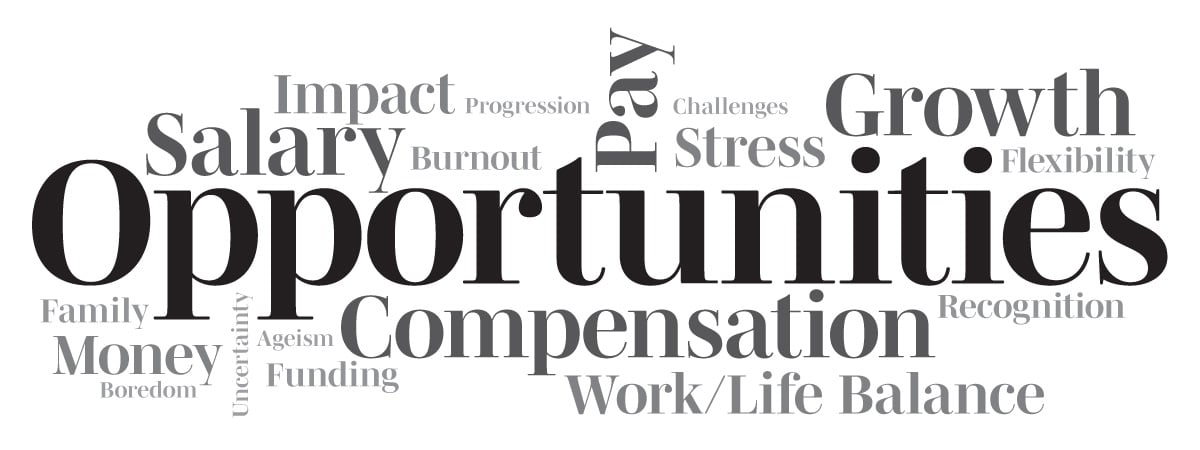
What’s Driving Career Change
Passing on Generational Wisdom
What advice would you give to early-career professionals in the food sciences? The 2026 IFT Compensation and Career Path Survey asked that question, and hundreds of participants shared their thoughts. Here’s a small sampling of what they had to say.
“Become known as the ‘go to’ person for a topic within the company. Face time is important. Learn to be a solution provider. Perception is reality, and a reputation is a fragile thing.” |
“Learn how to handle rejection without it impact-ing your confidence and drive.” |
||||
“It’s a journey not a sprint.” |
“Try fast. Fail fast. Correct fast.” |
“Think like your boss.” |
|||
“Know how to differentiate between correlation and causation. At some points, more data isn’t going to change the decision or outcome, so know when to acknowledge the point of diminishing returns on your effort.” |
“Ignore the job title and care about the job function. Think about where you want to be in 15 years and then take roles that will help you achieve that goal.” |
||||
“Protect your reputation in food science: One lie, one falsified result, one shortcut can destroy your career. Be honest. Always.” |
|||||
“The way in which your words are delivered is as important as the words themselves. Answering questions with ‘No, but ...’ instead of just ‘No’ will not only aid in your critical thinking, but it also builds relationships.” |
“Be vocal and bring as much visibility to what you do as possible. Work is 30% skill, 35% speaking up, and 35% networking.” |
||||
“Ask questions, early and often. Do so humbly yet unashamedly. Learn from anyone you can. It’s not wrong to not know; it’s a shame to not find out.” |
|||||
Hero Image: © Janis Abolins/iStock/Getty Images Plus
Author
-
Mary Ellen Kuhn Executive Editor
Mary Ellen Kuhn is executive editor of Food Technology magazine and director of content and creative services at the Institute of Food Technologists (mkuhn@ift.org).
Categories
-
Food Sciences
-
Food Technology Magazine
-
Issues and Insights


