
Making the Case for Alt-Meat
Good Food Institute founder Bruce Friedrich explains why it’s too soon to give up on cultivated and plant-based meat and posits that moving beyond conventional animal agriculture is essential to preserving the planet.

 Mary Ellen Kuhn
Food Technology Magazine
Key Takeaways
-
Global demand for meat continues to rise, strengthening the case for developing alternative ways to produce it.
-
The alternative protein sector is entering a more technically focused phase centered on improving taste, cost, and scalable production.
-
Plant-based and cultivated meat technologies represent complementary approaches to transforming how protein is produced.
Bruce Friedrich, founder and president of the Good Food Institute (GFI), a nonprofit think tank that works to advance alternative protein production, is a vegan. But he doesn’t expect anyone else to adopt that lifestyle.
That’s a point he makes clear on page one of his new book, Meat: How the Next Agricultural Revolution Will Transform Humanity’s Favorite Food—and Our Future. “Let me get one thing out of the way right now: I’m not here to tell anyone what to eat,” he writes.
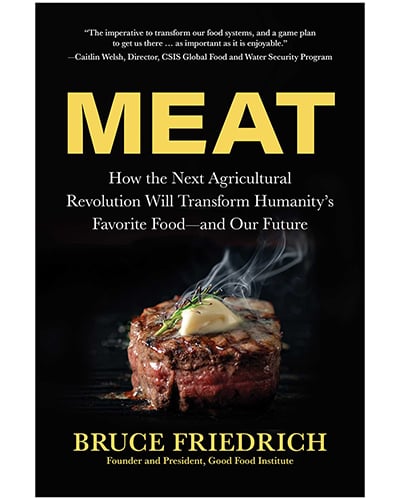
Bruce Friedrich shares a pragmatic but optimistic perspective on the future of alt-meat in Meat: How the Next Agricultural Revolution Will Transform Humanity’s Favorite Food—and Our Future. Photo courtesy of Bruce Friedrich
Most people love meat, and meat consumption is increasing across the globe. Friedrich doesn’t see that changing.
What must change, however, he argues eloquently, is the way that meat is produced. The early chapters of Meat lay out the impact of animal agriculture on the environment, food security, antibiotic resistance, and pandemic risk. The book then moves on to explore the potential for a new agricultural revolution in which the challenges the cultivated and plant-based meat sectors have faced are resolved.
Friedrich, whose life before GFI included managing a soup kitchen, teaching, working for PETA, and earning a law degree, recently took time out to answer questions posed by Food Technology. The responses are edited for length.
If you could make people aware of just one or two statistics about the environmental impact of conventional agriculture, what would they be?
First, the fundamental inefficiency is really quite arresting. Chickens are the most efficient farm animals at turning crops into meat, and it takes about nine calories of feed crops to produce one calorie of chicken. For pork, farmed fish, and especially beef, that ratio is even worse. Think about this: For every 100 calories of chicken produced, 900 calories of feed had to be produced. So 800 of those calories are not consumed as human food.
Second, that inefficiency multiplies everything else. You don’t just grow nine calories of crops; you ship those crops to feed mills, operate the feed mills, ship the feed to farms, operate the farms, ship the animals to slaughter, and operate the slaughterhouses. There are a bunch of extra energy-intensive and polluting factories, and energy-intensive and polluting trucks trucking crops, then animal feed, then animals between all those factories. That’s why the United Nations’ Food and Agriculture Organization’s landmark report Livestock’s Long Shadow concluded that raising animals for food is “one of the top two or three most significant contributors to the most serious environmental problems, at every scale from local to global,” including land degradation, climate change, air and water pollution, biodiversity loss, and deforestation.
Why was it important to you that this book not be an anti-meat treatise?
There are two primary reasons for this framing. First, achieving a global shift in meat production requires a bipartisan intervention. Focusing on innovation, markets, consumer choice, food security, and economic competitiveness allows the alt-meat project to transcend ideology; alt-meats have stayed bipartisan, in the United States and all over the world. That would change fast if alt-meat advocacy started telling people that some foods were more virtuous than others.
Second, it won’t work. I have observed that decades of diet-change advocacy, while successful in raising awareness and convincing millions of people to change their diet (which is great), have failed to decrease global meat consumption—again, meat consumption globally has set a new world record every single year for more than 60 years, which is as long as anyone has been counting.
We have moved from a single $300,000 cultivated burger to a global ecosystem where every major government investing in biotechnology is now funding this research.

Many plant-based and cell-based meat companies have been going through a rough patch. What makes you optimistic about the future potential of alt-meat?
These challenges are the standard trajectory for any transformative technology. For example, between 1900 and 1915, more than 500 car companies failed even as the industry was scaling. During the dot-com era, the NASDAQ lost 80% of its value and Amazon stock fell by more than 97%, yet internet commerce obviously went on to succeed.
Consider how radically the landscape has shifted in just one decade. Ten years ago right now, there was no Beyond Burger, no Impossible Burger, and only one cultivated meat company had raised any money at all, Upside Foods. Today, there are over 100 cultivated meat companies worldwide and more than 1,000 patents have been granted. We have moved from a single $300,000 cultivated burger to a global ecosystem where every major government investing in biotechnology is now funding this research.
Do professionals in the food sciences need to develop new skills in order to play bigger roles in advancing alt-meat product development initiatives?
They don’t have to, but it would help. One of my biggest aha moments was realizing that no single individual currently holds the full expertise required to make plant-based meat perfectly replicate the experience of eating animal meat. With cultivated meat, the core challenge is tissue engineering; so tissue engineers already have most of the scientific knowledge that will be required. With plant-based meat, we’re asking something different: How do you make plant fats and proteins behave like animal fats and proteins, across flavor, aroma, texture, and that whole “bite” experience? No one is trained end-to-end for that today, because outside of this one application, there hasn’t been any reason for the field to exist as its own integrated discipline.
And there’s a new accelerant here that wasn’t available to earlier generations of product developers: AI (artificial intelligence). If you’re a food scientist who also becomes fluent in how to use AI well—especially for pattern-finding across messy datasets, speeding iteration, and narrowing down what’s worth testing in the lab—you’re suddenly moving faster than the traditional R&D cycle allows, potentially an order of magnitude faster, or more. Put differently: food science expertise plus AI competence can radically shorten the timelines between hypothesis, formulation, sensory testing, and optimization.
Quite simply, any nation that cannot feed its people is a powder keg.
You make the point that food security is national security. Can you explain why that is true?
Quite simply, any nation that cannot feed its people is a powder keg. In the book, I walk through how this manifests globally.
China is currently moving in the wrong direction regarding food self-sufficiency, importing more and more food every single year and becoming increasingly vulnerable to geopolitical shocks; they have explicitly included alternative proteins in their five-year agricultural and bioeconomy plans to mitigate this.
For India, alternative proteins could help to solve the country’s malnutrition problem while serving as an economic driver to reach Prime Minister Narendra Modi’s goal of becoming a developed economy by 2047.
Israel, Singapore, Korea, and Japan are leading in this space because they are radically food insecure and understand that moving in the direction of food self-sufficiency is critical to political legitimacy in the eyes of the public. The United States and Brazil are leaning in because they do not want to lose their global agricultural superiority.
Food insecurity isn’t just a humanitarian crisis, as former Department of Defense and National Security Council official Matt Spence has warned from firsthand experience; it’s a strategic vulnerability. Matt shares that during his time working on Middle East policy at the Pentagon, ISIS used drought and crop failures as a recruiting tool, leveraging desperation to win support and expand its reach.
Your career path has taken you from soup kitchen manager to founder of the Good Food Institute 10 years ago. What’s the biggest life lesson you’ve learned along this path?
The biggest lesson is that most people are fundamentally good; they want to make decisions that make the world better, and that’s true regardless of political party, regardless of vocation, regardless of where they sit in the food system.
I’ve seen this again and again, including in places where outsiders often assume bad faith. Take the conventional meat industry. I hear from people who have been in “climate world” for a long time who are incredibly dubious about anyone in industry being an ally, but meat industry executives can be and are allies here. They are not waking up in the morning trying to harm animals or damage the environment. They are waking up with a focus on feeding people, keeping food affordable, supporting rural economies, and meeting consumer demand. Those are noble goals, and they matter.
If you start from the premise that most people are trying to do good, it changes how you approach everything. You stop seeing this as a fight between “good people” and “bad people.” You start seeing it as a shared problem and an opportunity: How do we keep what people value (meat that consumers love, jobs, affordability, reliability) while dramatically improving the way it’s produced?
That framing is also what makes progress possible politically. This can be bipartisan because it does not require anyone to abandon their identity or values. It asks us to do something very American: Use science, entrepreneurship, and practical problem-solving to produce better outcomes, while respecting consumer choice.
The scientific challenges are hard, but they’re almost certainly scientifically possible, and they’re likely quite a bit easier than many challenges where science has been successful.
What’s your greatest wish for the outcome of this book?
First, I hope that for a lot of people, it level sets the conversation around plant-based and cultivated meat: The scientific challenges are hard, but they’re almost certainly scientifically possible, and they’re likely quite a bit easier than many challenges where science has been successful.
There have been some private sector struggles for plant-based and cultivated meat, but year after year, we are seeing more and more scientists, more and more peer reviewed papers, and more and more government engagement.
Second, I hope it brings more people into the work: more NGOs and multilaterals, more government investment, more serious scientific and engineering talent, and ideally more major “AI for good” capacity focused on the problems that still need solving.
I hope the book helps readers see that this is not a niche project: It is an opportunity to improve food security, food systems resilience, public health, and the environment.
Hero Image: Photo courtesy of Bruce Friedrich
Author
-
Mary Ellen Kuhn Executive Editor
Mary Ellen Kuhn is executive editor of Food Technology magazine and director of content and creative services at the Institute of Food Technologists (mkuhn@ift.org).
Categories
-
Cultured Meat
-
Proteins
-
Novel Technologies
-
Meat and Poultry
-
Sustainable Food Systems
-
Food Technology Magazine


