
Processing | APPLIED SCIENCE
Meat Smoking: The Path to Tasty Products

-
Learning Objective 1
Understand the methods, wood sources, and advantages and disadvantages associated with natural smoking of meat, poultry, and fish.
-
Learning Objective 2
Learn about the common equipment and processes used in traditional natural smoking.
-
Learning Objective 3
Gain insight into how phytochemicals such as acids, carbonyls, and phenols impart flavor and antimicrobial properties to smoked meat and fish.
Have you ever wondered about how humankind learned about things like cooking food or smoking meat? As a species, we evolved from hunter-gatherers to agrarian societies, but when or how did our ancient ancestors learn such things as how to cook food? Maybe a clumsy person dropped his share of the mammoth into the fire and had to fish it out or go hungry. Once he or she got the meat from the fire and allowed it to cool, they may have found that it tasted better cooked than raw.
Smoking may have evolved in a similar fashion. Our predecessors knew that fire was warm and that the animals were afraid of it, so what better place to leave the leftovers? The smoke from the fire may have dried and flavored the meat as the tribe slept. Come morning, they murmured among themselves, “Meat good.” Who knows? They also may have observed that leaving meat in smoke discouraged the insects. So, smoking meats, poultry, or fish preserved the food, imparted flavors, and discouraged pests. A trifecta of discovery.
We do know, however, that smoking methods have evolved around the world since those early times. There are historical references from ancient Rome and elsewhere pertaining to smoking animal-based proteins. For example, smoking salmon in the Pacific Northwest by the indigenous tribes goes back thousands of years. It exists today because smoked meats, poultry, and fish taste good, whether done commercially, in home smokers, or simply grilling at home on the deck or patio. If one is interested in how smoking meats was done in the past, a visit to a place like Colonial Williamsburg or Mount Vernon in Virgina will allow you to see how our American ancestors smoked hams, wild game, and other meats.
The focus of this article is natural smoking, which is simply exposing meat or fish to the gases or vapor (smoke) derived from wood. Product manufactured by smoking can be labeled “smoked” or “naturally smoked.” Wood smoke can be captured through condensation and used as a flavoring (smoke flavor) that can be used to impart smoke flavor to foods. In some cases, the product is drenched in or showered with the smoke flavor. Products treated in this manner can be called “smoked.” Products to which liquid smoke flavors are added as part of the formulation require the language “natural smoke flavoring added.”
Natural smoke contains phytochemicals in the form of acids, carbonyls, and phenols.
Smoke Sources and Functions
There are many different types of wood that are used for smoking. Among the most popular are hickory, oak, maple, beech, mesquite, alder, fruit woods like apple or cherry, soft woods like cedar or spruce, and even corn cobs. Take a stroll through your local hardware store and look at the types of wood that are sold in the section that features grilling supplies to see the variety. The woods can be in different forms such as logs, wood chips or sawdust. The type of wood used will impact the flavors imparted to smoked meat, poultry, fish, and cheese products (see table below).
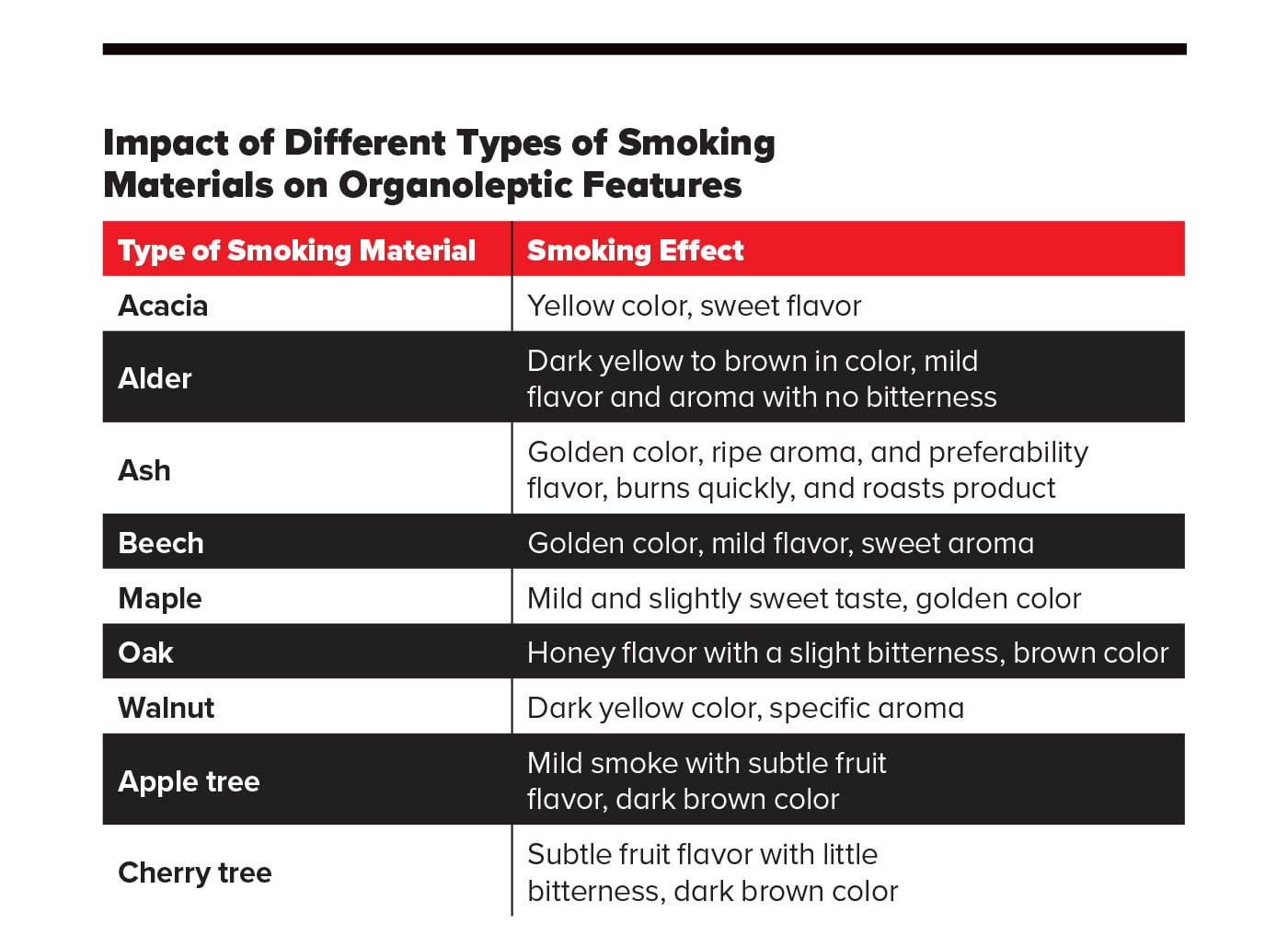
Adapted from ©Nizio, et al. Impact of Smoking Technology on the Quality of Food Products: Absorption of Polycyclic Aromatic Hydrocarbons (PAHs) by Food Products during Smoking. Sustainability 2023, 15, 16890, available under Creative Commons Attribution 4.0 License.
There are both advantages and disadvantages when it comes to naturally smoking products. Advantages include marketability, sensory properties of the finished products, equipment requirements, and the fact that smoking is a natural process. The traditional process is what makes naturally smoked meats and fish so marketable. Perhaps the greatest disadvantage is that smoking is not a green process. The smoke that is produced contains many different compounds, including carbon dioxide, carbon monoxide, and potential carcinogens such as polycyclic aromatic hydrocarbons (PAHs). Recent studies have suggested a number of methods that can be used to reduce PAHs contamination, including using filters on smoking equipment or applying marinades to meat before smoking processed food (Afe et al. 2020).
Natural smoke contains phytochemicals in the form of acids, carbonyls, and phenols. Acids are from lignan, which makes up 18%–30% of wood, while the carbonyls arise from wood cellulose and hemicellulose, making up the balance. The primary acid found in smoke is acetic acid, but there are others. Acids perform several different roles. They aid in the formation of skin on the product being smoked by coagulating proteins exposed to smoke on the surface of the meat or fish. Acids also contribute to the final flavor profile since they impart tartness. Acids also have antimicrobial properties because they are bacteriostatic, which means they are inhibitory to microorganisms.
Carbonyls play a similar role. They react with proteins to impart distinct colors by reacting with amine groups. Carbonyls also cross-link with proteins to assist in skin formation by reacting with the amino and sulfhydryl groups. And finally, they contribute to the flavors and aroma of the finished product.
Phenols are the primary flavor and aroma component in smoke. Phenolic compounds also act as natural antioxidants. Specific antioxidants from smoke include catechol, syringol, eugenol, isoeugenol, and 4-substituted syringols. Most importantly, phenolics have significant antimicrobial properties. Research has shown that compounds such as guaiacol have significant antimicrobial activity against Listeria monocytogenes, Staphylococcus aureus, Bacillus sp., and yeasts. They are not as effective against Escherichia coli, Lactobacillus sp., and Aspergillus.
Monophenols, diphenols, and triphenols are simple phenolic compounds. The use of wood smoke for food preservation implies the use of simple phenols (e.g., cresol, hydroquinone, gallic acid). Additionally, their use imparts desirable flavors to smoked food products, ranging from fruity, sweet and spicy, to smoky, musty/earth, burnt, or petroleum-like, to cedar, bitter, or creosote/tar (Jaffe et al. 2017, Maga 1988).

© Urilux/iStock/Getty Images Plus
Equipment and Processes
Natural smoking of meat, meat products, poultry, and fish can be conducted using several different types of equipment and processes (both batch and continuous). These include smoke pits, smoldering smoke generators, steam generated smoke generators, friction smoke generators, and electrostatic smoke generators.
The smoke pit is a modern-day derivation of what our distant ancestors used to smoke meat. Today, these systems may utilize logs, wood chips, or sawdust. Gas jets are the most common source for burning wood. Of course, the system requires a ventilator so smoke can be exhausted, which as alluded to earlier, creates a potential environmental concern.
The most common natural smoking system is the smoldering smoke generator. In this kind of smoker, an auger feeds sawdust to a metal ignition plate. The smoke quality depends upon the temperature of the ignition plate, the air supply, and the moisture content of the sawdust.
The steam-generated smoke generator utilizes superheated steam in the range of 400oF to 750oF and wood chips to generate smoke so there is no open flame. Smoke produced in this manner is generated very quickly allowing for shorter smoke cycles.
Friction smoke generation is another flameless process similar to the aforementioned steam generation process. Logs are the fuel source and the smoke is generated using a friction wheel. Smoke is quickly generated, but what is unique about friction smoke generation is that it is a hermetic process, which means no exhaust air escapes. One advantage of this method is that there is little tar generated, but flavor intensity is lower.
Electrostatic smoke generators employ a two-phase process. First, smoke is produced that is then passed through a battery of electric ionizers. Products produced using this technology may have flavor issues due to reduced uptake of phenolic compounds. There also are concerns about high levels of polycyclic hydrocarbons.
Most materials destined for smoking using any one of these processes are pretreated in some way. The most common treatment involves salt, primarily brining (usually with an injection system in the case of industrial application) or using a salt-based dry rub to improve flavor, increase moisture, and tenderize the meat prior to processing. Brines or rubs can incorporate a wide range of ingredients depending on market availability, and they can impart spicy, garlicky, sweet, or any number of flavor notes. How long a product destined for the smoker remains in the brine or marinade in the dry rub depends upon the process and the processor. Once this preliminary step has been completed, the meat, poultry, or fish is suspended on steel skewers or hooks and placed into the smoker or smoking cabinet equipment.
The quality of the smoke generated depends upon four factors: the smoke fuel source and its form, temperature of the ignition source, air flow, and moisture content of the wood source. The recommended temperature is between 600oF and 650oF. Higher temperatures (750oF and above) will encourage the generation of PAHs, as noted previously. The higher the moisture levels in the fuel source, the lower the levels of acids, carbonyls, and phenols in the smoke.
Hot Versus Cold Smoking
Most smoked products are hot smoked. Hot smoking both cooks the product and imparts flavors. Hot smoking is conducted at temperatures between 140oF and 300oF, process temperatures that preserve food. The process is usually completed in one day or less. As an example, smoked sausages are fully cooked.
Cold smoking is conducted at temperatures that typically do not exceed 80oF. The product must be cured in some way prior to initiating the process, which can take days. The cold smoking process—from curing to smoking—must be carefully monitored and good sanitation is essential since the food being smoked is not cooked as is done in the hot smoking process. Cold smoking uses chunks of wood as the heat source, which burn slower and produce more smoke. Probably the most common cold smoked product available to consumers is salmon.
The global smoked meat market is projected to grow to a value of nearly $44 billion by 2032, up from $35 billion in 2020.
A Growth Market
According to Business Research Insights, the global smoked meat market is projected to grow to a value of nearly $44 billion by 2032, up from $35 billion in 2020. One of the advantages of smoking food in the traditional way is that it is a natural process, which makes these products highly marketable. Traditionally, smoked products also have unique flavors and aromas that tantalize consumers and may not manifest themselves when using only smoke flavors. However, the environmental impact of traditional smoking methods does raise sustainability and food safety concerns, requiring meat, poultry, and fish processors, smokehouse artisans, and restaurants to innovate, adapt, and design proactive approaches through science and research that will support market growth of these tasty products.ft
Hero Image: © NataliaSokko/iStock/Getty Images Plus
Authors
-
Richard Stier Food Scientist
Richard F. Stier is a consulting food scientist with international experience in food safety (HACCP), food plant sanitation, quality systems, process optimization, GMP compliance, and food microbiology (rickstier4@aol.com).
Categories
-
Sustainability
-
Food Categories
-
Fish and Seafood
-
Meat and Poultry
-
Processing Equipment
-
Applied Science
-
Thermal Processing
-
Food Technology Magazine
-
Food Processing and Technologies


