
Growing Pains for Indoor Agriculture

 Dale Buss
Food Technology Magazine
-
Key Takeaway 1
Numerous early entrants in the controlled environment agriculture category have gone bankrupt and/or ceased operation.
-
Key Takeaway 2
Lack of capital, high interest rates, and operational inefficiencies are among the factors contributing to company failures.
-
Key Takeaway 3
New lighting options and tech-enabled growing strategies may help companies flourish.
If Jonathan Webb, founder of failed indoor growing operation AppHarvest, is the sad face of controlled environment agriculture (CEA), Eddy Badrina, CEO of Eden Green Technology, may be a hopeful new poster child of an industry that’s still trying to find its way.
AppHarvest was supposed to revolutionize CEA after raising $800 million and opening a sprawling greenhouse in Morehead, Ky., in 2020. But three years later, ignominiously, AppHarvest declared bankruptcy.
Badrina’s approach with Eden Green is to go up rather than out in a space- and energy-saving, vertical farming model that focuses not just on lettuce and spinach but on higher-profit herbs. Eden Green has broken ground on a $40 million expansion project near Dallas. “In five years, we plan to have 20 of these facilities up and running, in multiple states,” Badrina says.
Welcome to the era of awkward adolescence for CEA, a time when an industry with plenty of promise confronts the mistakes it already has made, and looks for ways to avoid future debacles on the way to fulfilling its purported destiny as a major bulwark against climate change and global hunger.
“The bubble has burst because of hyped-up companies that took advantage of technology and oversold it,” says Henry Gordon-Smith, founder and CEO of agriculture consultancy Agritecture. “So we’re in a fresh period that’s taking a while to recover out of.”
“Physical technology takes more time,” says Omar Asali, a board member and investor in CEA pioneer Plenty Unlimited. “People need to have a longer time horizon. I actually think a bunch of companies in the space got ahead of themselves, overpromised, were overoptimistic.”
What’s Gone Wrong
Failed players tended to “expand too quickly without a solid product-market fit,” says Rachel Fogle, an agricultural technology researcher and associate professor at Harrisburg University of Science and Technology. “Some focused on automation and sophisticated technology, like robots, that did not deliver the expected returns, leading to inflated operating costs and inefficiencies. Poor financial management, with high cash burn rates and a lack of capital when funding dried up, played a major role in company failures.”
Companies also got caught by rising interest rates. “When the cost of capital changed,” Asali says, “things got very rough for these companies.”
With backing by celebrity lifestyle guru Martha Stewart and other high-profile individuals, AppHarvest opened with promises not only to feed millions of Americans but also to jump-start the suffering economy of Appalachia by employing up to 1,500 people. But its high-tech greenhouses proved far less productive than promised, and workers complained about scorching temperatures that made for inhumane working conditions. Meanwhile, the company couldn’t cover its high costs with a customer base that it didn’t expand quickly enough.
AeroFarms is another indoor grower that has faced major challenges. At one point staked to a $1.2 billon valuation before its plans to go public, AeroFarms built the world’s largest vertical farm, in downtown Newark, N.J. The company was growing leafy greens with 99% less land and 95% less water than a traditional farm, without pesticide use or runoff into the environment.
AeroFarms threw AI, big data analytics, robotics, and LED lighting into the company’s tech-focused effort, but citing “significant industry and capital market headwinds,” the company filed for bankruptcy in the summer of 2023, although it later emerged from bankruptcy.
Notable failures over the past couple of years have been Orlando, Fla.–based Kalera, Pittsburgh-based Fifth Season, and Brooklyn-based Upward Farms, all of which have gone bankrupt and/or shuttered their operations. Europe, a pioneer in CEA, also has experienced some flops, including Netherlands-based Future Crops and Glowfarms and Berlin-based Infarm.
“CEA is undergoing an intense period of trial and error where the most effective methods of integrating production efficiency, capital and operational costs, and consumer demand rise to the top,” Fogle says.
Still, the industry continues to grow. “There will be steady growth, not dramatic, hockey-stick growth,” says Gordon-Smith. “It’s not a Silicon Valley story but a story of farmers using these technologies to adapt to real needs, to diversify their incomes and to manage challenging labor conditions.”
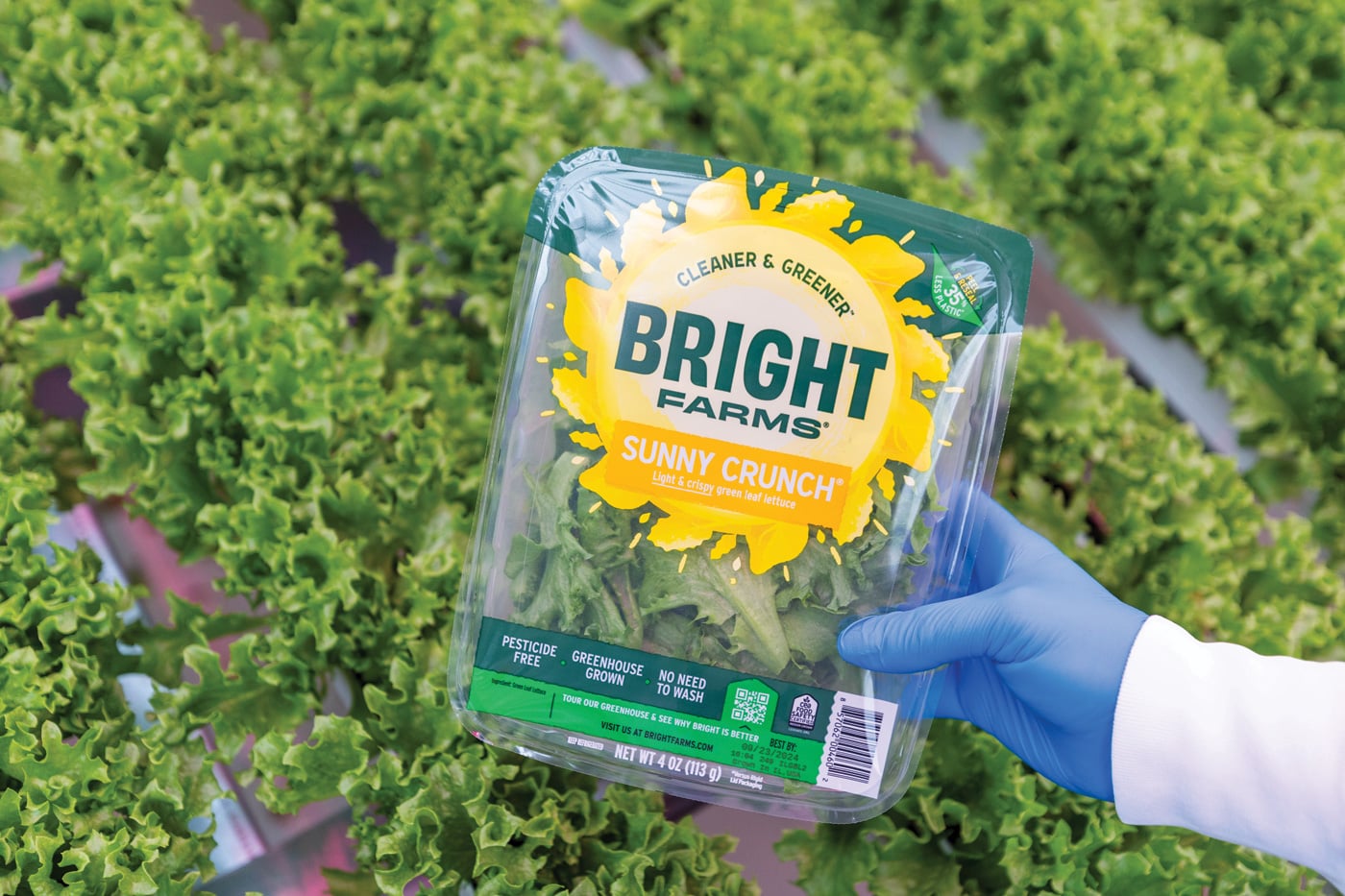
BrightFarms lettuce packaging touts the fact that the greens are grown without the use of pesticides. Photo courtesy of BrightFarms
Benefits and Potential
“The space will take time,” Asali says. “There will be some winners. It has narrowed, so there are fewer players. We need to emphasize the long term, not the short term, because this is needed technology. [But CEA] will be an area that augments existing supply. It’s not an area to replace traditional farming and greenhouses. The world needs ‘all of the above.’”
Fears of growing climate change are a big reason for the bullishness of CEA operators. “The conditions for fruits and vegetables to grow are being threatened by shifts in the climate. That’s one of the main factors,” says Gordon-Smith. “The ecosystem that allows us to grow food easily and typically outdoors is weakening over time.”
Bets still vary on which types of CEA operations will fare best in the long term: greenhouses, with their traditional horizontal layout, or vertical farming operations. Greenhouses take up more acreage but “generally are more cost-effective than fully automated vertical farms, [which have] high capital expenditures and operating costs, especially for energy,” Fogle says.
We need to emphasize the long term, not the short term, because this is needed technology.

Asali says the future belongs to the highest-yielding indoor ventures, just as with traditional farming. “Technologies that are more yielding by definition are going to have better unit economics, and their chances of success are higher,” he says. With a recent round of $400 million invested by Asali’s One Madison Group and two others, Plenty Unlimited has made a big splash via an agreement with Walmart to supply the retailer’s stores with indoor-grown produce, starting with leafy greens from Plenty’s California greenhouse. Plenty also is opening a strawberry farm in Richmond, Va., and one of six planned strawberry farms in Abu Dhabi, under a joint venture with a local company.
BrightFarms recently opened a greenhouse outside of Chicago as part of a nationwide push toward a sevenfold capacity increase; the plan also includes finishing greenhouses in Georgia and Texas. The company says it will eventually be able to produce as many as 150 million pounds of leafy greens each year. Cox Enterprises acquired BrightFarms in 2021.
Eden Green is executing a strategic pivot that Badrina believes will make his company one of the winners in this derby: a shift to producing herbs rather than just leafy greens. “We looked at it and said, ‘Our technology is highly flexible. We can grow what others can’t. What areas can complement the leafy green market?’ We discovered herbs are high volume, and there’s a high barrier to entry.”
According to Badrina, the status quo for sourcing the 10 most common herbs for grocery stores and restaurants includes goods from 12 countries that are shipped into four U.S. ports. “Then they’ve got to be aggregated into one shipment,” he says. “There’s no traceability; food safety is suspect; and even in the best-case scenario, [customers] can only rely on about 70% consistency. We’re the only major company I know of in the world that can now grow all 10 major herbs under one roof, pack and ship all from the same dock, and get it to our customers—whether retail or food distribution—within 24 to 48 hours.”
In general, Fogle says, successful CEA companies “tend to have a clear focus on their product offerings and optimize for sustainability and profitability from the start.” Gotham Greens, Greenswell Growers, and Little Leaf Farms, for instance, focus on leafy greens, “a product with stable demand, lower production complexity, and the ability to command premium prices.”
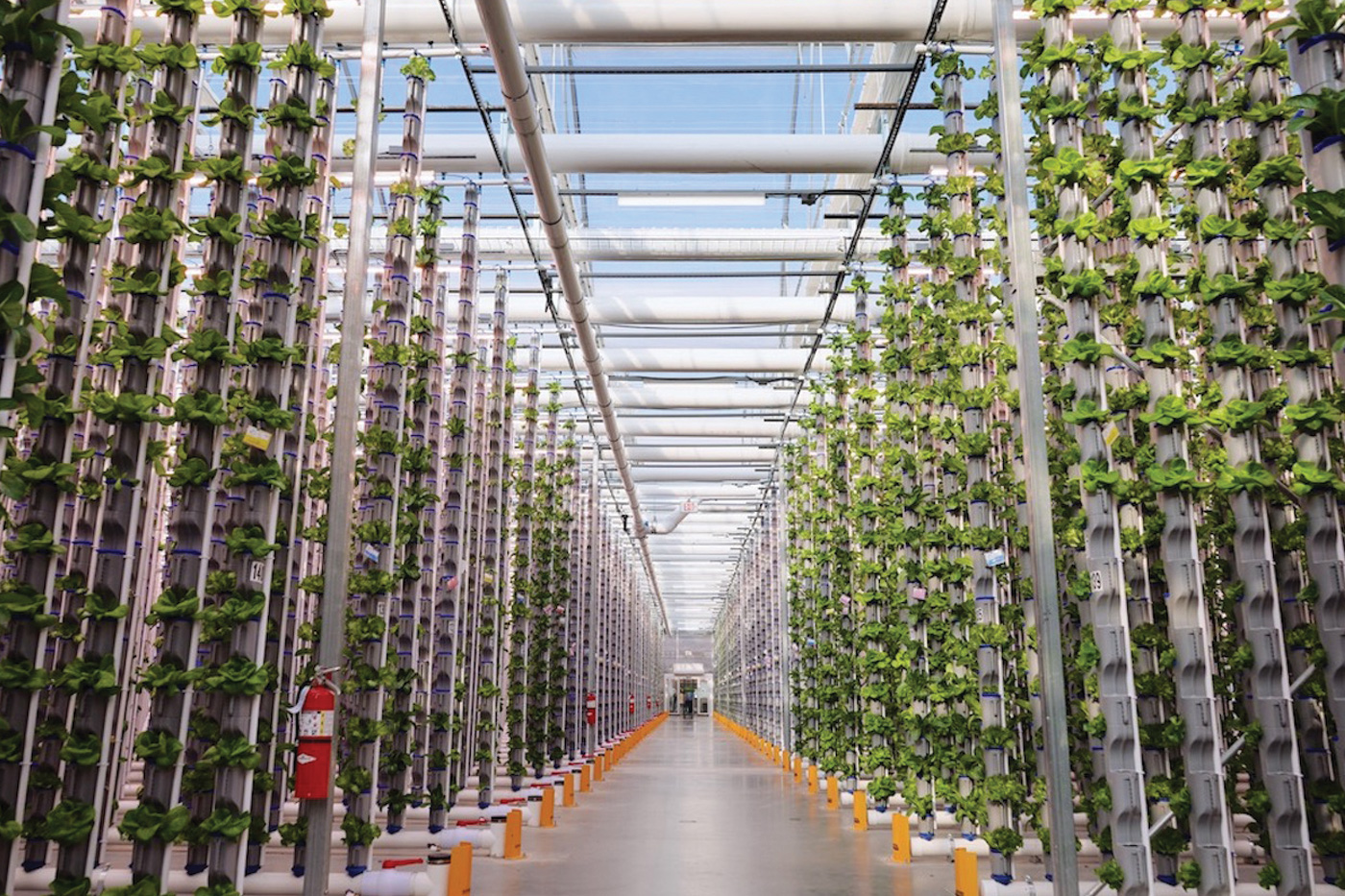
Indoor vertical farming operations at Eden Green use independently developed and patented technologies to grow produce hydroponically. Photo courtesy of Eden Green Technology
Technology Solutions
Advanced LED lighting systems are playing a big role in moving indoor growing forward by cutting energy use while bolstering plant growth. In Europe, for instance, Cree LED is busy replacing traditional high-power sodium lights—which ignite gases, similar to fluorescent lighting—with LED lights that last up to five times longer.
“Modern LED lighting has made a huge difference in reducing energy consumption while improving plant growth by offering customizable light spectrums for different growth stages,” Fogle says.
BrightFarms relies on greenhouses “that harness the power of the sun, rather than depending solely on artificial light,” says Steve Platt, BrightFarms CEO. “This helps keep our energy costs down, while having a positive impact on the planet. [And] our new greenhouses are fully automated, helping to reduce our labor costs and increase operational efficiencies and consistency on the farm.”
Eden Green employs a “nutrient film transfer” system to feed nutrients down its vertical plant rows, controlling water and air at the plant-spot level rather than at the level of the ambient environment. “It delivers 67°F carbon dioxide–infused, perfect humidity to each plant spot,” Badrina says. “We’ve got 328,780 plant spots in an acre and a half.”
We’ve been heavily investing in educating consumers about the benefits of greenhouse-grown produce.

Improving technology for input take-up also includes innovations in planting substrates. KAPPA AgTech has developed a silicone substrate that relies on food-grade rubber, which suspends seeds above the hydroponic nutrient solution, wicks just enough water to get the seeds to germinate, “and the seeds can poke through the silicone fingers and down into the nutrient solution,” says founder Schuyler Milton. “Silicone also takes the place of other, environmentally problematic substrates such as peat.”
KAPPA also is developing “ventilated lighting” that disperses air and light from the same spot rather than light from arrays of LED lights above. “It cools the LED lighting substantially,” Milton says. “And the lights are just above the plants: You’re not losing light to the outside, or to scatter or to shadows. That saves 30% to 40% in power when you come down from three feet to two inches.”
Geography matters, too. While Europe arguably led the world into mainstreaming CEA, the largest greenhouse concentration in the world actually is in Leamington, Ontario, Canada, which is home to nearly 2,000 acres of greenhouse production of everything from tomatoes to cucumbers to peppers to cannabis. Ontario’s proximity to big cities including New York, Chicago, and Detroit gives its CEA operators easy access to a population of more than 150 million consumers.
Consumer attitudes are still taking shape. “Many consumers recognize CEA products for their freshness and local sourcing, but they often do not fully grasp the broader sustainability benefits,” Fogle says. “Leading companies are increasingly emphasizing these benefits in their marketing strategies.”
But mainstream shoppers aren’t excited about the price premiums that are typically attached to indoor-grown fare, while Badrina posits that many consumers are “tired of hearing about” the sustainability benefits. “‘We’ve got cleaner, fresher, more reliable lettuce for your consumers, [but] it’s going to cost $1 to $1.50 more than conventional lettuce, and it’s going to be on the shelf with six of our competitors.’”
Nevertheless, at BrightFarms, “We’ve been heavily investing in educating consumers about the benefits of greenhouse-grown produce, and we’re seeing that pay off with 34% year-over-year growth in dollar sales in the past 52 weeks,” says Platt, whose company recently topped $60 million in annual sales.ft
Hero Image: Photo courtesy of RED Horticulture SAS
Authors
-
Dale Buss Writer
Dale Buss is an award-winning journalist and book author whose career has included reporting for The Wall Street Journal, where he was nominated for a Pulitzer Prize (daledbuss@aol.com).
Categories
-
Food Categories
-
Innovation
-
Novel Technologies
-
Food Technology Magazine
-
Fruits
-
Vegetables


