
Can Food Packaging Go Plastic-Free?
The authors detail the environmental drivers, emerging materials, and research priorities shaping the transition from fossil-derived plastics to bio-based and circular solutions for food packaging.

Learning Objectives
-
Understand the rationale behind replacing synthetic plastics.
-
Learn what types of bio- and aqueous-based packaging can replace synthetic polymer packaging.
-
Define research programs to advance bio- and aqueous-based packaging.
Reducing or eliminating synthetic (fossil-derived) polymers in food packaging is gaining urgency as environmental impacts from sourcing, use, and disposal come under increasing scrutiny. Because polymers serve critical functional roles, replacement requires more than reverting to traditional materials such as glass, wood, or metal. Bio-based and aqueous technologies are emerging as viable alternatives that can reduce reliance on synthetic plastics while maintaining performance.
The rationale to switch from synthetic plastics stems from environmental impacts across sourcing, use, and disposal. Since the 1970s, polymers have displaced steel, aluminum, and glass and have been used as coatings on glass, metal, and wood to enable high-speed production, chemical resistance in metal cans, and gap filling in wood panels. This transition was partially motivated by reduced carbon footprint, along with superior drop, impact, and thermal resistance, lower weight-to-volume ratios, favorable cost-per-barrier-unit economics, and hermetic-seal integrity compared with alternatives (Gooch et al. 2024). Common synthetic polymers used in food packaging include low-density polyethylene (LDPE), high-density polyethylene (HDPE), polypropylene (PP), polyethylene terephthalate (PET), and polystyrene (PS).
Sourcing and Use
Synthetic food-packaging polymers are derived from petrochemical feedstocks via catalytic cracking and subsequent polymerization. This represents 50%–90% of the environmental impact associated with plastics (World in Data 2026). Environmental costs include extraction, refining, monomer synthesis, polymerization reactions, and stabilization through antioxidants, ultraviolet stabilizers, processing aids, and catalyst residue management.
Microplastics in the environment and within humans are a major concern. Primary microplastics originate from monolithic polymer structures, while secondary microplastics originate from coating delamination or multilayer structure degradation. Annual per capita microplastic ingestion estimates range from 74,000 to 121,000 particles. Particle size distribution spans 2.5 nm (comparable to the diameter of DNA) to 5 mm. Recent Environmental Protection Agency–funded research mapped microplastic generation pathways throughout the food supply chain from agricultural production through consumer use (Vermont DEC 2026).
Current toxicological research indicates that microplastics induce cellular oxidative stress and inflammatory cascades, with potential additive leaching into systemic circulation. The U.S. Food and Drug Administration’s (FDA) stance is that microplastic exposure at current dietary levels does not constitute a safety concern based on available data.
Migration of additives and oligomers from polymer matrices is governed by diffusion kinetics, partition coefficients, polymer morphology, and food simulant characteristics. FDA regulatory frameworks incorporate food-type classifications, contact duration, and temperature profiles in establishing permissible polymer–food-contact pairings. Misuse—including microwave heating of non-microwave-approved materials and extended storage beyond intended shelf-life parameters—represents an uncontrolled variable. The FDA is actively reevaluating Generally Recognized As Safe determinations for specific food-contact substances, many of which are used in polymers (FDA 2026). Comprehensive stewardship programs ensure appropriate material–food–application matching, and bio-based polymers must align with legislation intended to reduce microplastics.
Disposal
Unlike glass, aluminum, or fiber-based materials with established material recovery facility sorting protocols, synthetic polymers lack comprehensive collection infrastructure. While post-consumer recycling streams exist for PET and HDPE homopolymers, polypropylene, polystyrene, and multilayer barrier structures lack equivalent recovery pathways. Economic constraints such as collection costs, contamination levels, sorting complexity, and virgin resin price volatility limit recycling feasibility. Consequently, substantial quantities undergo landfilling, waste-to-energy incineration, or contaminate water and land.
Approximately 11 million metric tons of plastic debris enter marine environments annually, with 10 major river systems contributing to 90% of ocean-bound plastic pollution (Jambeck et al. 2015). Unlike higher-density materials (i.e., glass, metals) or hydrolytically degradable substrates such as paper, buoyant polymers accumulate in oceanic gyres (e.g., the Great Pacific Garbage Patch contains 50%–60% packaging-derived material). Microplastics have also been detected in potable water, aquatic and terrestrial environments, and food matrices.
Commercial Bio-Based Plastics
Creating food-packaging polymers as alternatives to fossil-based derivation has been underway for many years. Some bio-based alternatives remain cost-disadvantaged relative to petrochemical polymers due to limited production scale, feedstock cost structures, and energy processing requirements. Market adoption of bio-based plastics requires consumer education and transparent labeling frameworks so consumers can distinguish between synthetic and bio-based packaging.
Market adoption of bio-based plastics requires consumer education and transparent labeling frameworks.
Bio-PE, Bio-PP, and Polyethylene Furanoate (PEF). Bio-based polyethylene and polypropylene function as direct replacements requiring zero modifications to processing equipment, performance specifications, or existing recycling infrastructure. Both derive from bioethanol fermentation followed by catalytic dehydration and polymerization. PEF, synthesized from 2,5-furandicarboxylic acid, offers superior gas and moisture barrier performance compared to PET, with recyclability within PET recycling streams. Brand adoption includes Danone, PepsiCo, and Carlsberg.
Bio-PE and bio-PP provide immediate scalability, while PEF represents next-generation barrier performance with circular-economy compatibility. A critical limitation is that all maintain polymer chain structures capable of fragmentation into microplastics under environmental or mechanical stress. Compliance with legislation required by June 30, 2027, will demand that compostable packaging materials meet U.S. Department of Agriculture National Organic Program standards. Environmental impact depends on formulation and end-of-life management.
Polysaccharide-Based Polymers. Thermoplastic starch (TPS) provides a moderate oxygen barrier in flexible film applications, including confectionery twist-wrap and specialized food-contact uses. High-amylose corn starch–based polymers developed by Kuraray have demonstrated oxygen and water vapor barrier properties comparable to ethylene vinyl alcohol copolymers under appropriate processing conditions. Advances in barrier architecture platforms developed by TerraSafe incorporate fully bio-based component systems—including aliphatic polyesters, modified starches, derivatized cellulose, natural resin systems, and bio-derived polyamides—enabling performance approaching that of petroleum-based multilayer structures. These materials can achieve functional parity across key performance metrics, including oxygen barrier, moisture barrier, and grease resistance, supporting their application in flexible and semi-rigid food-packaging formats.
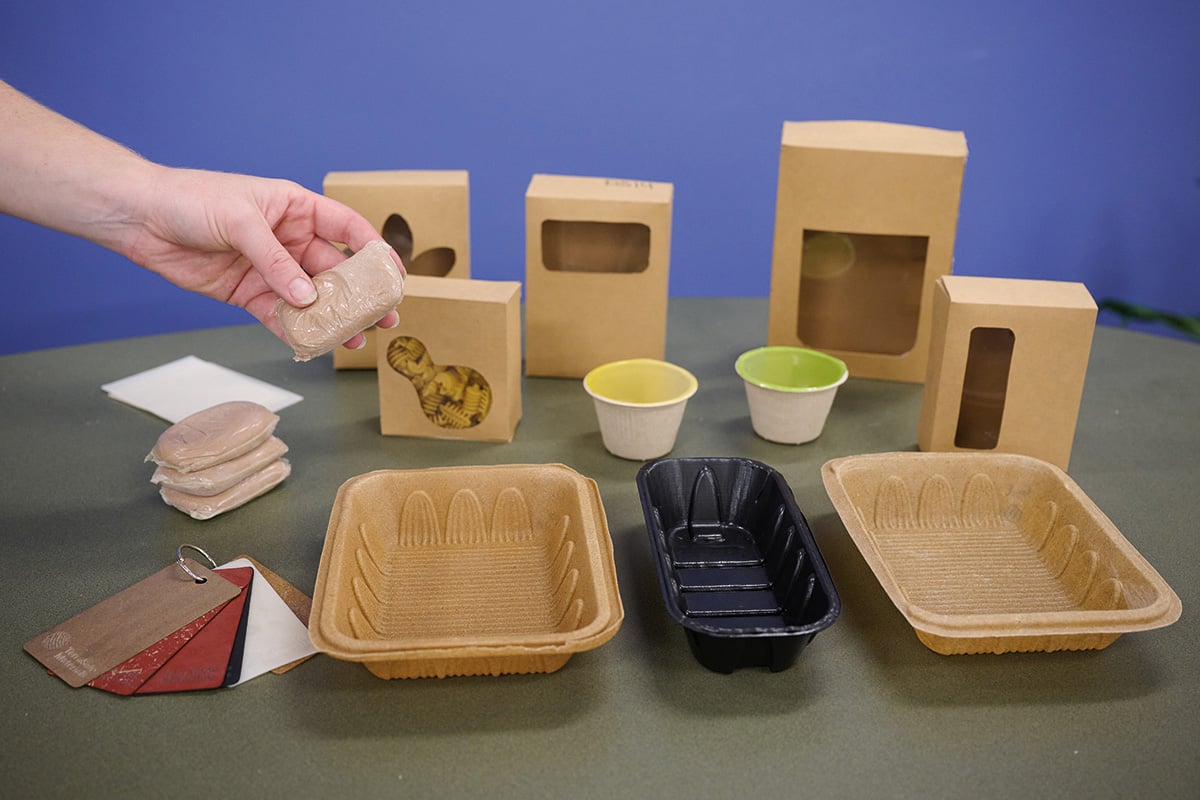
Aqueous Dispersion and Bio-Based Coatings. Replacement of synthetic coatings on paperboard substrates with aqueous dispersions and bio-derived coating chemistries is advancing and often aligns with recyclability and compostability standards. APP Group has developed fiber-based packaging substrates utilizing aqueous polymer dispersion technologies that provide moisture, grease, and liquid resistance while eliminating the need for conventional polyethylene and polyethylene terephthalate laminations. These systems are designed to maintain fiber recyclability while meeting industrial compostability requirements.
Additional coating technologies developed by BU Ahlstrom support quick-service and ready-to-eat food applications requiring resistance to oil migration and moisture penetration. These coatings enable grease, oil, and moisture resistance for wraps, bags, and food-contact papers while supporting recyclable or compostable end-of-life pathways. Lignin-containing coatings such as those developed by BioBarc improve barrier performance in paper- and paperboard-based packaging while maintaining compatibility with fiber-based recovery systems.
Valorizing Ag and Marine Waste
Valorizing agricultural residues and marine processing waste for packaging applications addresses both nonrenewable resource dependency and methane emissions associated with unprocessed organic waste streams (IFST 2021). Biopolymers derived from polysaccharides, lipids, and proteins represent viable alternatives to petrochemical-based materials. Lignocellulosic biomass, including sugarcane bagasse—the fibrous residue remaining after juice extraction—exhibits favorable mechanical properties suitable for packaging applications. Bagasse can serve as a precursor feedstock for terephthalic acid used in bio-based polyethylene terephthalate synthesis and also functions as a reinforcing filler in TPS foam matrices.
Additional valorized feedstocks include fruit pomace, seed hulls, nut shells, hemp residues, and spent coffee grounds, all of which demonstrate potential for film extrusion, thermoforming, and foam-molding applications. Research led by Yanyun Zhao, distinguished professor at Oregon State University, has demonstrated that upcycling agri-food processing byproducts can yield films, rigid containers, and cellular foams traditionally produced from petrochemical polymers, supporting circular material utilization within food and agricultural systems.
Fish scale collagen and crustacean shell chitin represent underutilized marine biopolymer resources with significant potential for packaging applications. Enzymatic or chemical processing converts these materials into functional biopolymers, including chitosan, alginate derived from seaweed, carrageenan from red algae, and agar. These polysaccharides exhibit film-forming capability and functional barrier properties suitable for coatings, films, and biodegradable packaging structures.
Active Packaging Functionality
Agricultural processing residues also contain bioactive compounds—including polyphenols, carotenoids, and tocopherols—that exhibit antioxidant and antimicrobial activity. Although achieving full barrier equivalence with petrochemical polymers may not always be feasible, controlled-release mechanisms enabled by biopolymer porosity allow modification of package headspace conditions to extend shelf life.
Incorporated antioxidants can mitigate photo-oxidative yellowing within biopolymer matrices while partitioning into package headspace to retard lipid oxidation. Antimicrobial agents such as essential oils, organic acids, and bacteriocins provide additional microbial growth inhibition. Research conducted by Virginia State University research scientist Aaron Dudley demonstrated that incorporation of hemp-derived extracts into electrospun polyvinyl alcohol nanofiber matrices imparted antioxidant and antimicrobial functionality, extending refrigerated poultry shelf life. Subsequent U.S. Department of Agriculture Agricultural Research Service postdoctoral research further examined ultrasound-assisted nanoemulsion formation and essential oil encapsulation within nanofiber coatings to reduce pathogen loads on fresh produce surfaces.
Critical Research Priorities
Replacement of synthetic polymers used for food packaging is underway, although challenges remain. The following are four critical research priorities:
1. Apply a Systems Approach
- More sustainable food packaging prevents food waste, the primary driver of total system environmental impact. Life cycle assessment (LCA) methodologies evaluating cumulative environmental burden remain the definitive analytical framework for evaluating replacement of synthetic polymers (Boz et al. 2020).
- Expansion of research on agricultural processing residues, food manufacturing byproducts, and marine waste conversion into functional packaging materials with quantified environmental impact reduction via comparative LCA methodologies will better define the role of valorized food waste.
More sustainable food packaging prevents food waste, the primary driver of total system environmental impact.
2. Focus on Barrier and Application Performance
- Develop bio-based polymer systems achieving petrochemical-polymer barrier parity across oxygen transmission rate (ASTM D3985), water vapor transmission rate (ASTM F1249), and grease resistance (TAPPI T 559) metrics.
- Blending biopolymers with synthetic polymers in high-severity processing environments reduces petrochemical carbon content while maintaining performance thresholds. Ecovio by BASF employs blends of synthetic polybutylene adipate terephthalate and polylactic acid for film applications.
- Evaluate material performance under industrial processing conditions beyond laboratory validation protocols. Collaborative research conducted at Kasetsart University (Bangkok, Thailand) and Washington State University demonstrated biopolymer blend optimization enabling thermoformed tray production with enhanced thermal stability and barrier performance (in press).
3. Apply the Same Food Safety Toxicology Standard
- Interaction kinetics between bio-based packaging matrices and food systems across pH, fat content, and temperature gradients must be determined.
- Characterize migration profiles and generate regulatory dossiers supporting FDA Food Contact Notification submissions and European Union Regulation 10/2011 compliance pathways.
- Rigorous evaluation is essential to avoid regrettable substitutions with inferior sustainability profiles or toxicological endpoints.
4. Provide Accurate Labeling
- Distinct labeling of synthetic and bio-based polymers is needed.
- Address current “plastic-free” labeling standards permitting 0%–5% polymer content in fiber-based packaging.
It’s A (Non-Plastic) Wrap
Synthetic plastics have long dominated the packaging landscape, but bio-based polymers are reshaping discussions around sustainability and performance. Although complete replacement may not be feasible, continued innovation and research are advancing packaging systems that reduce environmental impact while maintaining safety, functionality, and performance. Replacing synthetic plastic is an opportunity to redefine responsible packaging in the new generation.
Hero Image: Photo courtesy of APP-Foopak
Authors
-

Claire Koelsch Sand Owner and Founder
Claire Koelsch Sand, PhD, contributing editor to Food Technology and an IFT Fellow, is a global packaging leader with more than 35 years of food science and packaging experience. Sand is the owner and founder of Packaging Technology and Research, LLC (claire@packagingtechnologyandresearch.com).
-

Ogechukwu Tasie Food Science Consultant
Ogechukwu Tasie, PhD, is an independent food science consultant and a food science researcher at Packaging Technology and Research. Her research focuses on the intersection of food safety, nonthermal processing, and functional food science. She is a devoted mentor to students and an active member of IFT, where she serves as chair of the African American Black Resource Group and as president of the Southeastern Section (ob.tasie50@gmail.com).
Categories
-
Active and Intelligent Packaging
-
Food Standards
-
Food Technology Magazine
-
Emerging Food Technologies
-
Food Processing and Technologies
-
Sustainable Food Systems
-
Applied Science


