
Fermenting Insects for Food Applications
Celeste C. Ibarra-Herrera thinks the world should eat more insects—and her research on insect fermentation may make it easier to incorporate them into familiar foods.

When she moved to Puebla, Mexico, after completing her doctoral studies at Tecnológico de Monterrey, she discovered a wealth of dishes made with chapulines. Chapulines—grasshoppers of the genus Sphenarium—have long been incorporated into local cuisine.
“I tried edible insects in a restaurant because they are in all the restaurants here in Puebla,” she says. “They offer tacos made of chapulines, guacamole with chapulines, and quesadillas with chapulines.”
That turned out to be a formative culinary experience for Ibarra‑Herrera, now a professor of bioengineering at Tecnológico de Monterrey’s Puebla campus, where she is at the forefront of edible insect research as a member of the school’s Food Security and Nutrition Flagship Project. Her work focuses on finding innovative ways to incorporate insects into global diets by making insect ingredients more accessible and functional in food applications.
The group’s major project is preparing chapulines so they can be used as an ingredient in bread without changing the bread’s desirable qualities. Research team members chose bread for their initial project because it’s a worldwide dietary staple, Ibarra‑Herrera says. They had originally planned to work with tortillas but decided they were too regionally specific. Their goal was broader.
“If our target is to give people a real option to incorporate insects in their food, we should do something with [a food] that everybody eats,” she says.
Ibarra-Herrera began by characterizing the properties of several insects found in Mexico, starting with grasshoppers. The team analyzed their nutritional profiles, including protein, fat, and phenolic compounds.
The group then hit upon the idea that changing the grasshoppers’ diets might impact their nutrient content. And that’s exactly what happened. Feeding grasshoppers a diet of soy sprouts or maize leaves increased some nutrients, including protein and fiber. (Wild grasshoppers in Mexico are usually gathered from maize and alfalfa fields, where they feed on crops.)
Formulation Challenges
But adding insect ingredients—even those with an improved nutritional profile—to foods is tricky. “They make food darker, the taste changes, and the texture changes,” she says. “We have to think about how we can overcome these [issues].”
Even in a simple bread recipe, adding grasshopper flour makes the dough difficult to manage, and the baked bread lacks volume and is denser, according to Ibarra-Herrera. There’s also a distinct grasshopper flavor, which is likely to be a barrier for consumers who aren’t accustomed to eating them.
The researchers were familiar with Aspergillus oryzae (also called koji mold), which has long been employed in Asia to ferment soybeans and rice used to make sake. They hypothesized that using A. oryzae with solid‑state fermentation might alter the grasshopper molecules enough to make insect flour more adaptable in bread systems.
The addition of grasshopper flour did have an impact on flavor, but it was much more subtle than in the nonfermented version.
Before baking, the team had to identify the best fermentation parameters, including duration, Ibarra‑Herrera explains. After the bread was baked, they compared loaves made with fermented and nonfermented grasshopper flour—work recently published in the journal LWT.
They baked 10 loaves of bread, eight of which contained grasshopper flour and either rice or maize flour, and two control loaves made with wheat flour. The nonfermented grasshopper flour made bread that was dark and dense, and it had a distinct grasshopper flavor. But the bread made with fermented insect flour was similar to the control dough in terms of volume, texture, color, and elasticity. The addition of grasshopper flour did have an impact on flavor, Ibarra-Herrera says, but it was much more subtle than in the nonfermented version.
Matching Insects to Applications
Different insects are appropriate for different applications, Ibarra‑Herrera explains. Grasshoppers, for example, are high in protein. Other insects have a higher fat content and may be better suited to higher-fat applications like cookies.
The research team also tested bread made with fermented Tenebrio molitor (mealworm) made into flour. The mealworm flour contained more fat than the grasshopper flour, and the results of the two approaches were different in some important ways, Ibarra-Herrera says. Fermentation lowered sugars and increased proteins in both insects, but it did not improve the texture in the T. molitor formulations the way it did for the bread made with grasshopper ingredients.
Even with the formulation advantages that result from fermenting grasshopper ingredients, consumer acceptance of insect-based ingredients will be a challenge, research team members recognize. “If we don’t overcome this challenge, it doesn’t matter what we do or how nutritional these insects are,” Ibarra-Herrera observes.
Building a consistent food‑grade supply chain with standardized and sanitary production to ensure safety and quality would help people overcome their associations of insects with uncleanliness, she says.
Esther Pérez‑Carrillo, a member of the Food Security and Nutrition group at Tecnológico de Monterrey who worked with Ibarra‑Herrera on the chapulines project, agrees. The food industry is unlikely to adopt insect ingredients without market demand, creating a chicken‑and‑egg scenario. “If people don’t want food with insects, then the industry isn’t going to make this kind of product,” Pérez‑Carrillo says.
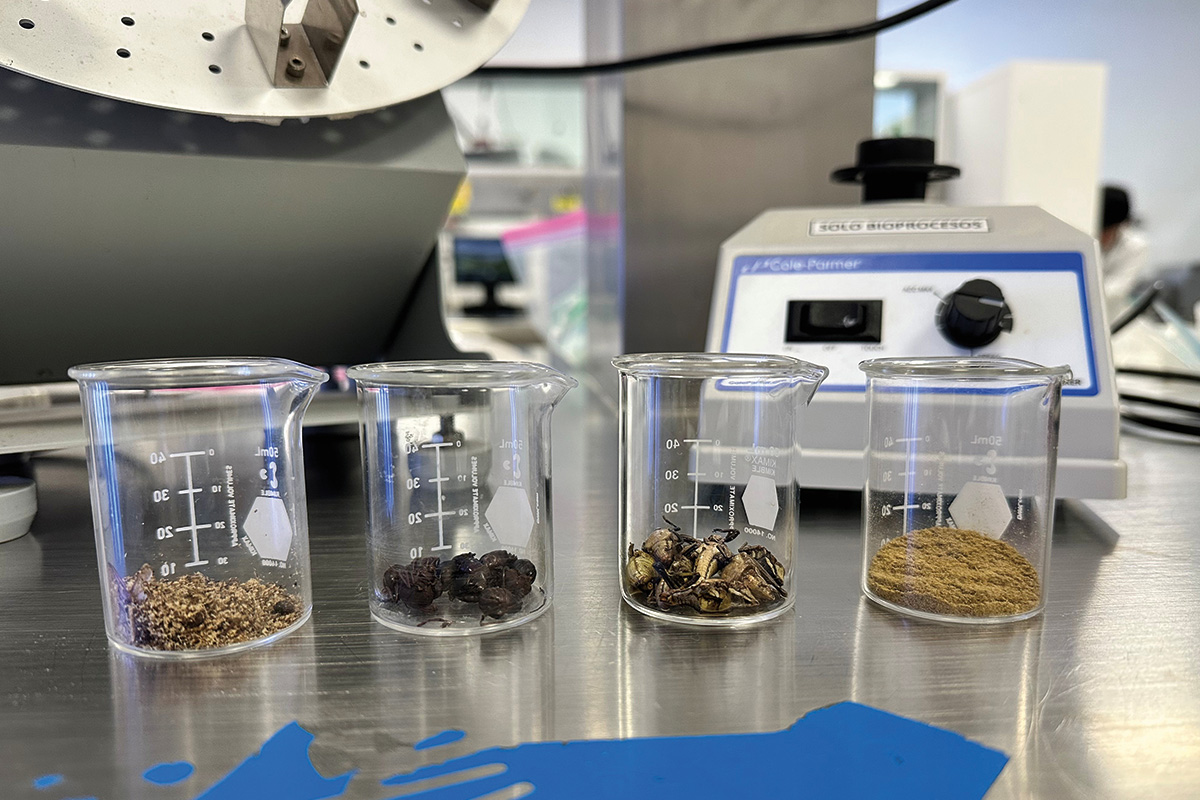
Samples of traditional Mexican edible insects in whole and ground form are lined up in Celeste Ibarra-Herrera’s lab. Photo by Celeste Ibarra-Herrera
What’s Next
Increasing the protein content of bread made with grasshopper flour is a key research focus for Ibarra‑Herrera and her colleagues. With that goal in mind, they are doing a deeper study of the fermentation process. They are also investigating bioactive compounds produced during insect fermentation and working to develop a healthy, high-protein beverage made with insect ingredients.
Global population growth will require a rethinking of food systems, she says, and the need for affordable, nutritious options is a growing concern for many food scientists. “We should be working on alternatives that we can give to people so they can have good quality food, nutritious food, but also food that is affordable and that people can get,” she says.
She hopes more researchers will engage with the topic and welcomes collaborations in Mexico and beyond. Over time, she believes, consuming foods made with insect ingredients could become more normalized, especially if they are used in everyday foods that people grow up eating.
“I think that everything starts in the kitchen with your family,” Ibarra‑Herrera reflects.
Vital Statistics
Education: BSc, biotechnology engineering and PhD, engineering sciences, Tecnológico de Monterrey
Professional Activities: Vice president, Asociación Mexicana de Ciencia de los Alimentos (AMECA), a Mexican nonprofit organization for people working in the food sciences and related disciplines
A Favorite Food: Escamole—termite eggs, also known as Mexican caviar—are a special dish that she likes prepared with butter, salt, and garlic and folded into a tortilla.
Proudest Accomplishment in Research: Contributing to the knowledge of edible insects in Mexico
Proudest Accomplishments in Life: Being a woman scientist, professor, thesis director, leader at her institution and in AMECA, mother of two, and partner
Linked In: Meet Celeste C. Ibarra‑Herrera
Hero Image: Photo by Isra, courtesy of Celeste Ibarra-Herrera
Authors
-
Danielle Beurteaux Writer
Danielle Beurteaux is a journalist who writes about science, technology, and food.
Categories
-
Food Ingredients and Additives
-
R and D
-
Food Technology Magazine
-
Sustainable Food Systems
-
Research


