
How to Reduce Foreign Material Hazards

-
Learning Objective 1
Understand why it is important that food processors do everything in their power to keep foreign materials out of their products.
-
Learning Objective 2
Gain insight into potential on-farm foreign material hazards and prevention measures.
-
Learning Objective 3
Learn about what can be done to keep foreign materials out of food in the food processing plant.
There are many of you who might have heard the old joke: What is worse than finding a worm in an apple? Answer: Half a worm. It’s a punchline that has likely turned the stomach of many. The primary focus of most food safety management systems is control of biological and physical hazards, but to most people, the biological hazards are invisible. On the other hand, physical hazards or foreign materials may be visible or sensed, so they tend to garner more attention by consumers, especially if the media gets involved.
For example, in 2005, a person claimed that he found a human finger in a serving of Wendy’s chili. The claim was trumpeted in the media, severely affecting sales at the chain. Turns out, the man lost a finger in an industrial accident, saved it, and then claimed it was found in the product. The hoax resulted in jail time for the claimant, but retractions were not forthcoming, and Wendy’s had no recourse for its lost sales and tarnished reputation. Going back even further, there were claims in 1993 that consumers had discovered syringes in cans of Pepsi. This was also reported by the media as fact, yet it turned out to be a hoax. The company invited the media into one of its processing plants and clearly demonstrated that putting a syringe into a can on a high-speed line would be next to impossible.
Many years ago, I worked for the National Food Processors Association (NFPA). One of our operating groups was called the Claims Division. This group would investigate issues that would potentially go to trial, so all evaluations entailed careful handling, chain of custody preservation, and expert analysis and documentation. Many of these potential claims entailed foreign materials that had significant psychological impact on many of the claimants. Not all claims were valid, but many were, including some that were obviously the result of employee sabotage. Among the alleged foreign materials that came to us for evaluation were insects, mice, chewing gum, metal, glass, and worms. These cases show that foreign materials that end up in food, beverages, or ingredients come from many different sources, so it behooves food processors to do everything in their power to keep foreign materials out of their products.
Any food product that is contaminated with foreign materials, whether metal, wood, insects, bone, or seashells, is deemed adulterated.
A Note on Regulation
Any food product that is contaminated with foreign materials, whether metal, wood, insects, bone, or seashells, is deemed adulterated. Knowingly distributing such a product is a violation of federal law. The adulterated product may not be unsafe, but it is still adulterated and cannot be distributed. The U.S. Food and Drug Administration (FDA) has established guidance that can be used for food safety by processors. This may be found in the agency’s Policy Compliance Guide Section 555.425: Foods, Adulteration Involving Hard or Sharp Foreign Objects, which states: Foods are considered adulterated if the product contains a hard or sharp foreign object that measures 7 mm to 25 mm, in length.
Many food processors utilize this guidance to establish their own foreign material controls and set limits for safety. This is especially true in operations that utilize metal detectors and X-ray technology.
Back to the Farm
Growers and animal husbandry businesses can take steps to minimize potential foreign material contamination. The greatest concern with farming occurs at harvest. There are many crops such as corn, green beans, tomatoes, spinach, and others that are mechanically harvested. Unfortunately, mechanical harvesters will pick up more than the crop, especially if not adjusted properly. Many harvesters incorporate a sorting step, but things do get by. One of the more amusing things the author witnessed in a food plant was at a green bean processor in Oregon. As the newly harvested green beans were being transferred at the front end and loaded to a wash tank, a 5-foot-long black snake dropped from the loader to the ground. The line workers took off in one direction and the snake in the other. The creature was picked up by the harvester.
Most crops that are mechanically harvested are dumped into a wash tank of some sort and then transferred to sorting belts that help control the inclusion of potential foreign materials. Foreign matter is either separated or will sink in the wash tanks and can be removed by hand on the sorting belts. But even hand-picked produce may contain surprises. This is especially true with leafy greens, since creatures such as slugs, snails, insects, and small frogs may literally glue themselves to the greens and can pass through washing and processing.
There also are things that can be done in husbandry operations. One of the greatest foreign material hazards is metal in ground beef products. Processors of products such as corned beef and pastrami will pass these large cuts of meat through a metal detector and will find buckshot/birdshot or needles. Apparently, people like to take potshots at animals in the field. Cows are hit, wounds heal over, and the shot remains in the animal. The needles come from animals that flinch when being injected by a vet, breaking off the needle from the syringe. Digging out the broken needle will hurt the animal, so it remains under the skin and in the flesh.
Despite all that the industry does to keep foreign materials from foods, things do get through. Just go to the U.S. Department of Agriculture or FDA website and look through recalls. Recalls are initiated for glass, wood, plastic, metal, and other things, but let us now focus on what can be done to minimize or prevent such incidents.
In the Food Plant
Basic Hazard Analysis and Critical Control Points (HACCP) prerequisite programs not only ensure safety but also help minimize foreign material contamination. Processors should develop, document, implement, and maintain these programs, especially the latter, which means making sure that the HACCP program is operating as designed and verifying that protocols are followed as drafted. A recent meeting of FDA personnel highlighted the top problems observed in plants by the agency: nine of 10 pertained to Good Manufacturing Practices failures.
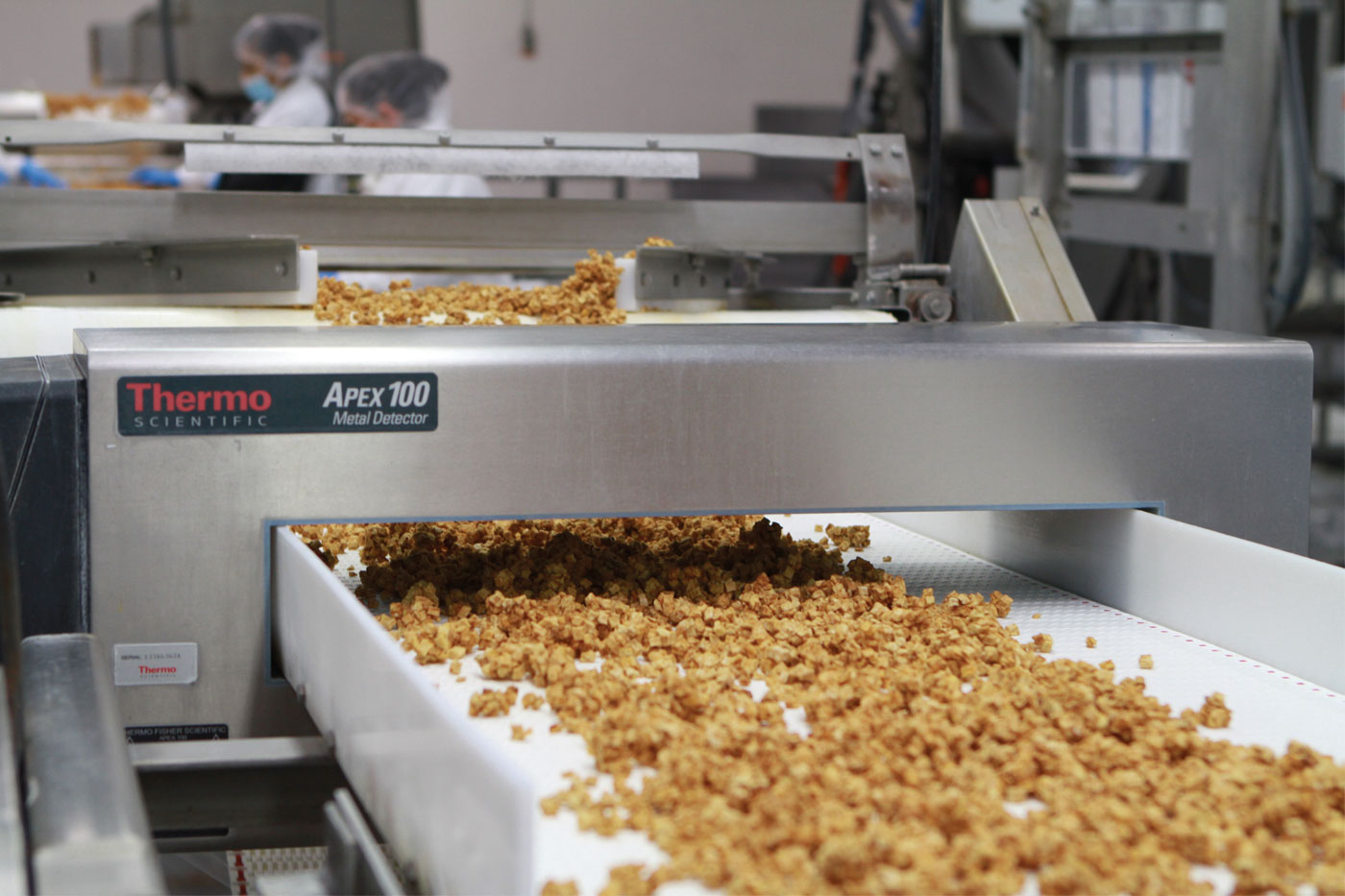
Foreign material control should employ a two-pronged approach: developing and implementing programs designed to minimize the potential for foreign material contamination and the adoption of technologies to detect and/or remove materials. Here, we’ll discuss the first, which are predicated on basic GMPs. Programs that can help to minimize the potential for contamination include personnel practices, preventive and routine maintenance, handwashing, chemical handling and storage, and most importantly, employee education.
Personnel Practices. Establishing good personnel practices can minimize foreign material contamination of food from inclusion of hair, jewelry, and clothing. Clothing should be tight-fitting, manufactured from materials that will not shed or easily come apart, utilize snaps or Velcro closures (no buttons), and have no pockets above the waist. Hair must be fully covered, which includes both hair on the head and facial hair. A worker who has very hairy arms should be asked to work in a long-sleeved shirt with elastic wristbands. Providing uniforms or work clothes to food plant workers has a cost, but it is also something that can minimize potential contamination.
Chemicals. Establishing a chemical handling and storage program, especially considering how food processors handle lubricants, is an absolute imperative. Food grade and non-food grade materials must be stored separately, be properly identified, and the workforce properly educated on their use. Remember, food grade lubricants may come into contact with foods and if they do get into a product, that item will now be deemed adulterated.
Preventive Maintenance. Depending upon the unit operation in a plant, maintenance can be extremely complex. There are units that require daily, weekly, monthly, quarterly, and yearly repairs or updates. A well-designed and well-maintained preventive maintenance program can minimize the potential for foreign material contamination. This program should also be supported by two other programs; cleaning and sanitizing and pre-operational inspections. The cleaning and sanitation program must include a check that the work was done and done properly. During this post-cleaning check, the surveyor should also take note of the condition of the equipment: Is there a missing bolt? Does it appear that a chopper or cutter has scored a wall or is there a piece of the blade missing? Similar checks should also be included in pre-operational inspections.
The most important element for in-plant prevention of foreign material contamination is employee education.
Employee Education. The most important element for in-plant prevention of foreign material contamination is employee education. All these issues must be addressed in detail during new employee orientation, on-the-job training, and in regular refresher sessions. Another issue that both orientation and refresher sessions need to emphasize is the role of each and every plant worker in preventing contamination and ensuring food safety. The educational process needs to address not only the how-tos for each of these elements but why the programs are in place.
The sessions also need to impart to plant workers the need to report to management any incidents that could pose a problem, which includes potential employee sabotage. It is not snitching on a colleague; it is protecting consumers, the company, and the company’s business. The incidents cited above pertaining to the finger in the chili and syringes in a soft drink are examples of sabotage by consumers. During my time with NFPA and the Claims Division, we saw many examples of employee sabotage in canned foods, including but not limited to a mouse, condoms, chewing gum, nails, and insects. In fact, gum in canned foods was so common that a research project was initiated that evaluated the effects of thermal processing in chewing gum.
Best Practices
No one likes to find surprises in their food. It is up to each food, ingredient, or beverage processor to establish programs to keep foreign materials out of their products at the plant level, work with vendors who have a history of providing safe, wholesome, and high-quality products, and establish systems to detect and remove any foreign material that may get into foods. The best way to establish what foreign materials might be an issue with your products and processes is to look at your historical data, both consumer and customer complaints and quality data.ft
Hero Image: © dusanpetkovic/iStock/Getty Images Plus
Authors
-
Richard Stier Food Scientist
Richard F. Stier is a consulting food scientist with international experience in food safety (HACCP), food plant sanitation, quality systems, process optimization, GMP compliance, and food microbiology (rickstier4@aol.com).
Categories
-
Food Safety and Defense
-
Processing Equipment
-
Applied Science
-
Food Technology Magazine
-
Food Processing and Technologies


